
Why Siberia’s lakes sometimes explode, leaving behind giant craters in the frozen Arctic

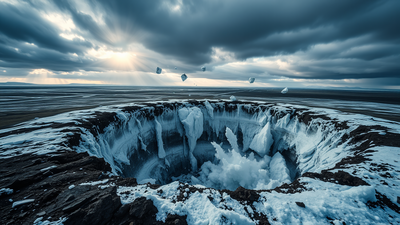
Since 2014, a strange and violent phenomenon has been unsettling scientists and local herders across the remote Yamal and Gydan peninsulas of western Siberia. Without warning, the ground itself explodes, blasting soil and chunks of ice hundreds of feet into the air and leaving behind a massive crater that can plunge more than 160 feet deep. Locals first spotted these giant holes appearing seemingly at random across the frozen tundra, and early theories ranged from meteorite strikes to secret military testing before scientists eventually connected them to methane, a gas that had been quietly building up beneath the permafrost for decades. What began as a genuine geological mystery has since turned into an active area of climate research, and two recent studies have pushed the explanation further than ever before.
What the first Siberian crater actually looked like
The very first crater was discovered on the Yamal Peninsula in 2014, measuring around 30 metres across and more than 50 metres deep, surrounded by debris scattered outward in a pattern that made an explosive origin obvious from the start. In the years since, seven more of these giant gas emission craters, now often shortened to GECs by researchers, have been confirmed in the same limited stretch of Siberian terrain, and every single one has appeared exclusively in this one region rather than spreading more widely across the vast Arctic permafrost zone. That narrow geographic footprint became one of the central puzzles scientists needed to solve, since any convincing explanation for the craters also had to explain why they only ever seem to form here.
How methane builds up beneath the frozen ground
Permafrost behaves like a thick, frozen lid sitting on top of deeper layers of soil and rock, and in western Siberia that lid happens to sit above some of the largest natural gas reserves anywhere on the planet. As the climate has warmed since the 1980s, this frozen lid has slowly thinned and weakened, allowing gas trapped deep underground to migrate upward and accumulate in pockets just beneath the surface with nowhere left to escape. Pressure inside these trapped pockets keeps building over years, sometimes decades, until it finally exceeds what the thinning permafrost above can withstand, triggering a sudden, violent release that blasts a crater into the landscape in a matter of seconds after such a long, quiet buildup.
The salty water mechanism behind the explosions
One recent explanation focuses specifically on a layer of unfrozen, unusually salty groundwater found beneath the surface in this part of Siberia, known as a cryopeg. According to a study published in Geophysical Research Letters, meltwater from the surface can migrate downward through the soil, drawn by a natural process called osmotic pressure linked directly to this salty cryopeg layer below. As pressure builds up at depth through this process, it can eventually crack the surrounding frozen soil, triggering the decomposition of methane hydrates, ice like structures that trap methane molecules within their crystal lattice, and releasing the gas explosively in the process. Researchers behind the study noted that anomalously high methane concentrations recorded at the original Yamal crater strongly support the idea that this hydrocarbon really is escaping into the atmosphere as a direct result of the crater’s violent formation.
Why deep geology may be the missing piece
A separate and more recent study has offered a somewhat different, though closely related, explanation focused on what lies much further underground. According to research published in Science of the Total Environment by Helge Hellevang and colleagues at the University of Oslo, the volume of ejected material found around these craters is simply too large to be explained by processes confined entirely within the permafrost layer itself. Instead, the team concluded that heat and natural gas rising from far deeper underground, travelling upward through fault lines that intersect the base of the permafrost, are needed to generate genuinely explosive pressure. In this model, climate warming still plays an important role, but mainly an indirect one, accelerating surface thaw and encouraging the formation of shallow lakes and ponds that further weaken the frozen ground exactly where these deep gas pathways happen to reach the surface.
Why craters are so easily mistaken for ordinary lakes
Both research teams agree on one particularly tricky detail, these dramatic craters do not stay looking dramatic for very long. Within just a few years of forming, water seeps in and the crater’s steep walls gradually collapse inward, transforming what was once an obviously explosive scar into something that looks almost identical to an ordinary thermokarst lake, the kind of water body that commonly forms wherever permafrost thaws and the ground surface slumps. This makes the true scale of the phenomenon extremely difficult to measure, and researchers examining satellite imagery across more than 126,000 square miles of Yamal and Gydan terrain have found many lake like features that could plausibly be disguising older, unreported craters, suggesting the true number of these explosive events may be considerably higher than the handful currently confirmed.
Why this mystery matters well beyond Siberia
Understanding exactly how these craters form carries significance that reaches far beyond satisfying scientific curiosity about one remote corner of the Arctic. Methane is a considerably more potent greenhouse gas than carbon dioxide over the short term, and any process capable of releasing large, sudden pulses of it directly into the atmosphere deserves serious attention as the region continues warming. Researchers involved in this work have stressed that their current models represent an important first step rather than a definitive final answer, with further fieldwork and computer simulations still needed to properly test these ideas. For now, the exploding craters of western Siberia stand as a stark, visible reminder of just how much long buried change may already be stirring beneath a landscape that has stayed frozen and silent for thousands of years.


