
Scientists create the first 3D cloak that makes objects invisible to heat

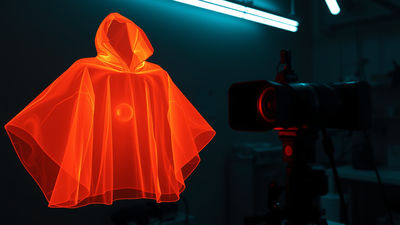
On an infrared camera, a warm object normally stands out clearly against its cooler surroundings. Researchers at the University of Illinois Urbana-Champaign have now built a three-dimensional cloak that bends heat around an object entirely, erasing its thermal outline while keeping the space inside protected from extreme temperatures. Rather than blocking heat at a barrier, the device redirects it around the hidden region before letting it continue along its original path, so an infrared camera watching from outside sees a temperature pattern that looks largely undisturbed, as if nothing were there at all.
Why earlier thermal cloaks kept failing
According to the study titled Free-form thermal cloaks in three dimensions, published in Nature Communications, previous experimental thermal cloaks could only manage heat across flat surfaces or along one predetermined route. If heat approached from any other direction, the temperature disturbance caused by the hidden object would become visible again, limiting these earlier designs to narrow, controlled conditions rather than real-world use. Shelly Zhang, professor of civil and environmental engineering and one of the study’s authors, said a genuine thermal cloak needs to work no matter where the heat is coming from, and that the team’s device can conceal a complex three-dimensional object from an unlimited number of directions while keeping the temperature inside stable and protected.
Turning a mathematical idea into a physical structure
To move past the limitations of earlier designs, the researchers built on a concept called transformation thermotics, a theory that calculates exactly how heat needs to travel around a protected region so that the surrounding temperature field appears undisturbed from the outside. The core challenge was translating that mathematical prescription into something that could actually be manufactured, since different regions of the cloak needed carefully tuned thermal conductivities, meaning each part had to move heat at different speeds and in different directions. The team solved this by designing a lattice material whose geometry could be adjusted independently across three dimensions, allowing each section to conduct heat differently and bringing the physical device much closer to the behaviour predicted for an ideal cloak.
Combining aluminium and rubber to steer heat
With the underlying geometry worked out, the researchers needed a way to prove the design could function as a real object rather than only inside a computer simulation. They combined two materials with sharply different abilities to carry heat, 3D printing a precise aluminium lattice to create highly conductive pathways that move heat quickly through selected regions, while filling the remaining spaces with a rubbery material through mould casting, which transfers heat far more slowly. Together, these two materials created a controlled thermal route through the structure, with some sections accelerating heat flow and others restricting it, steering energy around the space occupied by the concealed object.
Testing the cloak with hot and cold conditions
For the laboratory test, the researchers placed the cloak between hot and cold regions to create a temperature gradient across the device, then used an infrared camera to record how heat moved through and around the structure. From outside, the thermal pattern looked almost as though the concealed object simply did not exist, with heat passing around the protected region and rejoining beyond it without the strong distortion that would normally reveal an obstruction. Inside the cloak itself, the temperature stayed uniform and remained insulated from the hot and cold conditions surrounding it.
Hiding complex shapes, including human heads
To push the design further, the team tested the cloak on intricate three-dimensional forms, including detailed shapes resembling human heads, rather than only the simple geometric objects typically used in controlled laboratory experiments. These tests demonstrated that the method could accommodate irregular, complex shapes rather than being limited to objects specifically designed to make the experiment easier, a meaningful step toward eventual real-world application.
Where this technology could eventually be used
According to the researchers, the ability to guide heat precisely around complicated forms could prove useful anywhere temperature needs careful management, including redirecting heat away from vulnerable components in electronic systems or preventing nearby heat sources from interfering with delicate devices. It could also help protect equipment operating in extreme temperature environments, and Zhang noted potential security and defence applications, including reducing the infrared signatures that allow thermal cameras to distinguish people or machinery from their surroundings. As Zhang put it, any field that needs precise control of heat, or needs to protect something from being detected thermally, could benefit from this work.
Why hiding self-generated heat remains the next challenge
The current device is primarily designed to redirect heat arriving from outside the protected object. Concealing an object that generates its own heat presents a considerably harder problem, since that internal energy would continue building up inside the protected region and could eventually reveal its location regardless of how well external heat is redirected. Solving this would require a cloak capable of responding dynamically, concentrating, distributing or redirecting heat based on shifting conditions both inside and outside the device, rather than simply following one fixed thermal pathway.
What comes next for thermal cloaking research
The research team, which included postdoctoral researcher Weichen Li and graduate student Yibo Wang alongside professor Ole Sigmund at the Technical University of Denmark, now plans to investigate smart, multifunctional cloaks capable of these more active tasks. Zhang said the team has shown that a true 3D omnidirectional thermal cloak is possible, and that the next step is building cloaks that do not just hide and protect an object, but actively manipulate where heat gathers, how it spreads and where it eventually leaves the protected region.


