
NEW DELHI: Young adults in India ranked 60th out of 84 countries in key mental well-being parameters in the 2025 report of an ongoing global mental health study, scoring significantly poorly than their peers aged 18-34 in most parts of the world.The ‘Global Mind Health in 2025′ released Thursday by US-based Sapien Labs reveals not just a serious mental health crisis among young Indian adults but also a profound generational gap, as older people enjoyed significantly better mental health scores.The report, which surveyed over 78,000 internet-enabled individuals in India, assigned young adults (18-34 years) a low mind health quotient (MHQ) score of 33. This contrasts sharply with an MHQ score of 96 for those aged 55 and above, a level aligning with normal mental function and putting them at rank 49 among 84 countries. This stark difference highlights a “structural, multi-year generational shift” in mental well-being that researchers suggest is not merely a temporary effect of recent events like the pandemic.”The scores reflect a very steep decline in younger generations – steeper than many other countries globally. While those aged 55+ are doing fine, younger adults are seriously struggling,” said Tara Thiagarajan, founder and chief scientist at Sapien Labs.”This reflects declines in the factors we have outlined in the study, and some others, as well such as increased toxic load in the environment (air, water, food) and lack of physical activity,” she added.The study says the mental health crisis among India’s youth goes beyond issues such as anxiety and depression, reflecting a broader reduction in core mental functioning, including the ability to regulate emotions, maintain focus, build stable relationships, and recover from stress.Based on data generated in previous years, the study identifies four key drivers of mental health – family bonds, spirituality, consumption of ultra-processed food (UPF) and early exposure to smartphones. In India, the 64% of respondents in the 18-34 age group reported being close to their family, compared to 78% of those over 55.While relatively lower than in some other nations, regular UPF consumption among young Indian adults (44%) was substantially higher than among the older generation (11%). The average age for a first smartphone in India was 16.5 years, a figure expected to be much lower for Gen Alpha, with earlier exposure linked to increased mental health risks.Globally, the study found young adults in economically developed countries struggling with mental health much more than their counterparts in less developed nations. Those at the bottom included Japan, Taiwan, Hong Kong, the UK and China, while countries with relatively better mind health were predominantly in sub-Saharan Africa, including Ghana, Nigeria, Zimbabwe, Kenya and Tanzania. Finland, which consistently tops the World Happiness Index, ranked 28 on mind health for those 55+ and 40 for those 18-34 years – indicating that satisfaction with circumstances of life was distinct from mental capacity to navigate life’s challenges .The mind health quotient is a metric that aggregates respondent ratings of 47 cognitive, emotional, social and physical capacities and problems that enable or diminish our ability to function effectively. The scale reflects a person’s fundamental mental capacity, says Sapien Labs.End of ArticleFollow Us On Social MediaVideos’AI Only Works With What Has Been Expressed So Far’: Prasoon Joshi Gets Candid At DNPA 2026India & Israel Sign Multiple MoUs On Agriculture & AI During PM Modi & Netanyahu’s Bilateral MeetIndian Navy’s New Hunter, INS Anjadip To Targets Submarines Close To CoastFair Pay, Consent, Online Safety: Ashwini Vaishnaw Draws Red Line For Digital Platforms’We Do See A Role, But..’: India Backs Trump’s Gaza Plan As Modi, Israel PM Discuss US-Iran Conflict‘India Essential To Middle East Future’: Israeli Prez Herzog Tells PM Modi, Lauds Economic Growth’UPI Will Be Used In Israel’: PM Modi After Key Meet With Netanyahu, Pushes India-Israel FTAI&B Minister Ashwini Vaishnaw Sounds Big Alert On Cybercrime, Pushes Fair Revenue For CreatorsJamaat Chief Exposes Political Faultline In Bangladesh, Backs Yunus After President’s Big Charge’Owe India A Great Lot Of Debt’: Israel PM Benjamin Netanyahu Hails PM Modi During Joint Statement123PhotostoriesHoli 2026: How to make classic Malpua at home10 must-try Chicken snacks for Holi party at homeFrom red aalta to warrior-gold cuffs: Vijay Deverakonda’s wedding look screams maximalist groom energyDelhi’s 61-km road along with Najafgarh drain corridor to ease traffic and boost connectivityWorld’s 8 most stressful cities to live in and their biggest pressure pointsNot just the clothes! Rashmika Mandanna and Vijay Deverakonda’s heritage wedding jewellery has the internet talking1500 kg fake paneer and mawa seized in Ghaziabad: 8 smart alternatives for popular dishes for the Holi celebrationWhat sets luxury cars apart? 5 features you won’t find in economy modelsFrom admitting affairs with Russian women to regretting divorce with Melinda French Gates: 5 times Bill Gates regretted his decisions — And what they teach us about power and psychologyWalking at 12-3-30 for weight loss: Can this low-impact routine help you lose fat effectively?123Hot PicksNew Indian Railways reformsSaudi poultry import banGold rate todayBihar wedding shootIncome Tax CalculatorPublic holidays February 2026Bank Holidays februaryTop TrendingCandace OwensKayla NicoleMadison BeerJoel EmbiidVanessa BryantTony DungyDan MuseNHL Trade RumorsWWE Elimination Chamber 2026Ron Duguay


NEW DELHI: Young adults in India ranked 60th out of 84 countries in key mental well-being parameters in the 2025 report of an ongoing global mental health study, scoring significantly poorly than their peers aged 18-34 in most parts of the world.The ‘Global Mind Health in 2025’ released Thursday by US-based Sapien Labs reveals not just a serious mental health crisis among young Indian adults but also a profound generational gap, as older people enjoyed significantly better mental health scores.
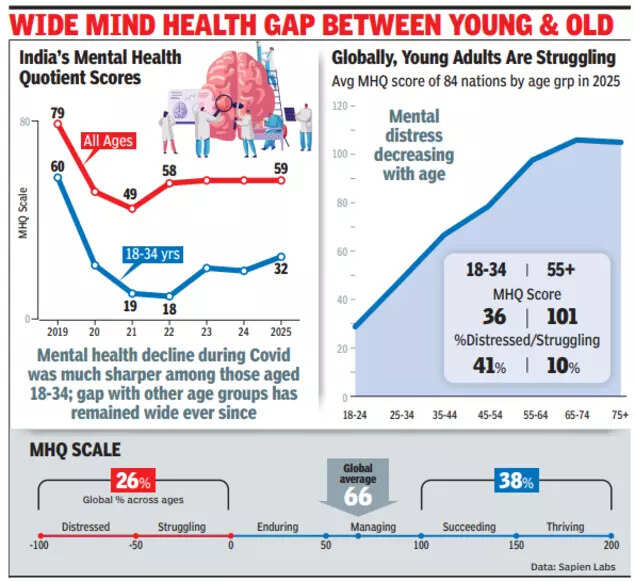
The report, which surveyed over 78,000 internet-enabled individuals in India, assigned young adults (18-34 years) a low mind health quotient (MHQ) score of 33. This contrasts sharply with an MHQ score of 96 for those aged 55 and above, a level aligning with normal mental function and putting them at rank 49 among 84 countries. This stark difference highlights a “structural, multi-year generational shift” in mental well-being that researchers suggest is not merely a temporary effect of recent events like the pandemic.“The scores reflect a very steep decline in younger generations – steeper than many other countries globally. While those aged 55+ are doing fine, younger adults are seriously struggling,” said Tara Thiagarajan, founder and chief scientist at Sapien Labs.“This reflects declines in the factors we have outlined in the study, and some others, as well such as increased toxic load in the environment (air, water, food) and lack of physical activity,” she added.The study says the mental health crisis among India’s youth goes beyond issues such as anxiety and depression, reflecting a broader reduction in core mental functioning, including the ability to regulate emotions, maintain focus, build stable relationships, and recover from stress.Based on data generated in previous years, the study identifies four key drivers of mental health – family bonds, spirituality, consumption of ultra-processed food (UPF) and early exposure to smartphones. In India, the 64% of respondents in the 18-34 age group reported being close to their family, compared to 78% of those over 55.While relatively lower than in some other nations, regular UPF consumption among young Indian adults (44%) was substantially higher than among the older generation (11%). The average age for a first smartphone in India was 16.5 years, a figure expected to be much lower for Gen Alpha, with earlier exposure linked to increased mental health risks.Globally, the study found young adults in economically developed countries struggling with mental health much more than their counterparts in less developed nations. Those at the bottom included Japan, Taiwan, Hong Kong, the UK and China, while countries with relatively better mind health were predominantly in sub-Saharan Africa, including Ghana, Nigeria, Zimbabwe, Kenya and Tanzania. Finland, which consistently tops the World Happiness Index, ranked 28 on mind health for those 55+ and 40 for those 18-34 years – indicating that satisfaction with circumstances of life was distinct from mental capacity to navigate life’s challenges .The mind health quotient is a metric that aggregates respondent ratings of 47 cognitive, emotional, social and physical capacities and problems that enable or diminish our ability to function effectively. The scale reflects a person’s fundamental mental capacity, says Sapien Labs.


