
Nasa discovered a deep blue planet 63 light-years away, but its blue colour comes from glass, not water

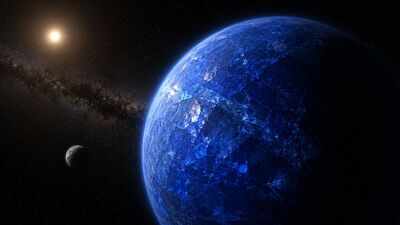
From a great distance, the planet could easily give the wrong first impression. Seen in visible light, it appears as a rich blue world, bringing to mind the familiar colour of Earth as viewed from orbit. Yet the resemblance ends almost immediately. Instead of oceans reflecting sunlight, this distant planet is wrapped in an atmosphere so intensely hot that ordinary materials behave in unfamiliar ways. Winds race across its skies at extraordinary speeds, while tiny particles suspended high above the planet give it the striking shade that caught astronomers’ attention.According to Nasa, the world, known as HD 189733b, lies around 63 light-years from Earth and circles its parent star at extremely close range. Observations made with the Hubble Space Telescope allowed astronomers to determine the planet’s visible colour for the first time, revealing a deep blue appearance unlike any other exoplanet studied in this way.
Why this alien planet looks blue even without oceans
The colour of Earth comes largely from sunlight reflecting off vast oceans, combined with the way the atmosphere scatters light. HD 189733b reaches a similar visual result through an entirely different process.As per Nasa, astronomers used Hubble’s Space Telescope Imaging Spectrograph to monitor the planet before, during and after it disappeared behind its host star. The measurements showed that blue light changed in a way that green and red light did not. That subtle difference allowed scientists to conclude that the planet itself reflects or scatters blue light, making it appear as a deep blue dot if it could be viewed directly.The observations also confirmed earlier evidence suggesting that the planet’s atmosphere strongly scatters blue wavelengths. Rather than liquid water producing the colour, it is thought to come from fine silicate particles suspended within the atmosphere.
Why this deep blue planet is far more dangerous than it looks
Despite its calm-looking appearance from afar, HD 189733b is one of the most hostile environments astronomers have examined. Daytime temperatures approach 2,000 degrees Fahrenheit, leaving no possibility of Earth-like weather or familiar landscapes.According to Nasa, the intense heat allows silicate materials to exist high in the atmosphere, where they may condense into tiny glass droplets. Those particles scatter blue light more effectively than red light, creating the planet’s distinctive colour.The weather itself is equally unusual. Winds are estimated to reach around 4,500 miles per hour, fast enough that any glass forming in the atmosphere would likely be carried sideways rather than falling straight down. The result is a world where conditions bear little resemblance to anything found in the Solar System’s habitable environments.
Why this blue planet is classified as a hot Jupiter
HD 189733b belongs to a group of planets known as hot Jupiters. These are giant gas planets that orbit extremely close to their parent stars, completing an orbit in only a short period while enduring relentless heat.As per Nasa, the planet sits roughly 2.9 million miles from its star and is tidally locked. That means one hemisphere permanently faces the star while the opposite side remains in continuous darkness.The world has attracted sustained attention over the years because it is close enough for astronomers to investigate its atmosphere in considerable detail. Earlier observations with Nasa’s Spitzer Space Telescope produced one of the first temperature maps ever created for an exoplanet. Those measurements indicated that the day and night sides differ in temperature by roughly 500 degrees Fahrenheit, a contrast believed to drive the planet’s exceptionally powerful winds.
How this blue planet helps Nasa study alien atmospheres
The blue appearance is more than a visual curiosity. It provides another piece of evidence showing how clouds and atmospheric particles shape the way distant planets look from Earth.According to Nasa, studying worlds such as HD 189733b helps astronomers better understand the chemistry, cloud formation and atmospheric behaviour of hot Jupiters as a whole. Since these planets cannot be visited directly, even slight changes in the light they reflect offer valuable clues about what exists high above their cloud tops.The planet may look surprisingly familiar from afar, yet almost every detail behind that colour tells a very different story. Its deep blue hue comes not from oceans or a mild climate, but from an atmosphere heated to extraordinary temperatures, filled with silicate particles and swept by winds strong enough to carry glass across the sky.


