
This tiny Australian fish lives in just one place on Earth, and people are fighting to keep it alive

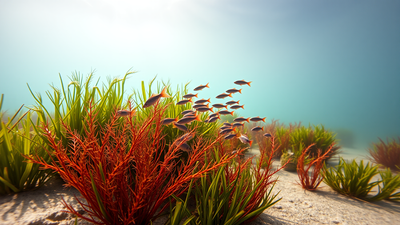
In a dry, remote stretch of central Queensland, tiny springs bubble up from deep underground to form shallow, ankle-deep pools in the middle of the desert. Living only in these springs is a fish so small it barely reaches the size of a thumbnail, called the red-finned blue-eye. It exists nowhere else on earth. For years, this fragile population has faced constant pressure from a much tougher invasive fish, and its survival has depended almost entirely on the work of conservationists at Edgbaston Reserve, who have spent years building fences, breeding fish in captivity and slowly pushing back against a threat that has already wiped this species out of several springs before.
A fish found in only one place on the planet
The red-finned blue-eye survives exclusively within the spring-fed pools of Edgbaston Reserve, land managed by the conservation group Bush Heritage Australia. According to Bush Heritage Australia, only males of the species carry the bright red fins that give it its name, and the fish is listed as critically endangered by the International Union for Conservation of Nature. These unique springs are fed by water that has travelled hundreds of kilometres underground through the Great Artesian Basin, before finally reaching the surface to form small, isolated wetlands unlike almost anywhere else in Australia.
Why the springs at Edgbaston matter so much
Edgbaston Reserve is not important for just one species. According to Bush Heritage Australia, the reserve is considered one of the most significant natural spring systems for biodiversity found anywhere within the entire Great Artesian Basin, home to 23 species found nowhere else on earth. Alongside the red-finned blue-eye, these include the equally threatened Edgbaston Goby, several types of snail, a small crustacean, a flatworm, a spider and a dragonfly, all depending entirely on these small, spring-fed pools to survive.
The invasive fish putting this tiny species at risk
The biggest danger facing the red-finned blue-eye is a hardier introduced fish called Gambusia, or mosquitofish. According to Bush Heritage Australia, Gambusia were brought to Australia from the United States in the 1920s in an attempt to control mosquitoes, and have since caused serious harm to native fish species across the country. Wherever Gambusia manage to invade a spring, the blue-eyed goby is typically wiped out within twelve to eighteen months, since the invasive fish compete aggressively for food and space and are believed to prey on eggs and newly hatched blue eyes.
How conservationists have fought to protect the fish
When Bush Heritage first acquired the reserve in 2009, an early survey found around 25 springs overwhelmed by Gambusia, with only four springs still holding red finned blue eyes, and notably, every one of those surviving springs was completely free of the invasive fish. In response, the team fenced off remaining populations to stop Gambusia from re-entering, and began actively relocating blue eyes to safer springs. Bush Heritage Australia also confirms that the invasive fish have already caused the local extinction of red-finned blue eyes from seven separate springs since 1991, showing just how serious and immediate the threat remains.
A breakthrough after years of failed captive breeding attempts
Breeding the fish safely away from Gambusia proved difficult at first. Earlier attempts to breed red-finned blue-eyes in standard aquarium tanks kept the fish alive but failed to get them to reproduce. According to Bush Heritage Australia, the solution eventually came from building artificial spring systems, sinking bores that release water into buried tanks designed to closely mimic the fish’s natural spring habitat. This approach finally allowed the team to establish successful captive breeding populations, both onsite at the reserve and at a secure location in Brisbane, creating a vital insurance policy for the species.
Extra threats beyond the invasive fish
Gambusia are not the only pressure facing this fragile ecosystem. Bush Heritage Australia notes that cattle and feral pigs have also degraded habitat at the springs, trampling vegetation and increasing water turbidity to levels the blue eyes struggle to tolerate. Since 1878, thousands of bores drilled into the wider Great Artesian Basin for agricultural water use have also reduced natural spring flows and aquifer pressure across the region, adding long-term strain to an ecosystem that depends entirely on steady underground water pressure to keep these surface springs alive at all.
A slow but steady sign of recovery
Despite these ongoing pressures, the conservation effort at Edgbaston has shown real signs of progress. Freshwater ecologist Dean Gilligan, who joined Bush Heritage in 2021, has continued expanding efforts to control Gambusia while growing new breeding populations of red-finned blue eyes. Captive-bred fish have already been successfully released back into naturally occurring springs, and with support from an Australian Government Threatened Species Strategy Action Plan grant, the team is now working to establish five entirely new populations of the species, a modest but meaningful step for a fish that exists nowhere else in the world and depends completely on continued human effort simply to survive.


