
India’s T-90 tanks may get active shield against missiles, drones and top-attack weapons

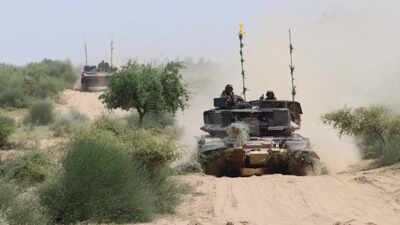
NEW DELHI: The Defence Research and Development Organisation (DRDO) is developing an advanced Active Protection System (APS) for the Indian Army’s T‑90 tanks, marking a significant leap in indigenous armoured defence technology. The Combat Vehicles Research & Development Establishment (CVRDE) is leading the effort to create APS technologies capable of defeating explosives‑based anti‑armour threats, while the High Energy Materials Research Laboratory (HEMRL) is working on blast‑based hard‑kill countermeasures and propulsion technologies to neutralize a wide range of anti‑tank projectiles, according to a DRDO paper seeking industry partners.What sets this system apart is its reported ability to intercept threats traveling at speeds exceeding 1,500 meters per second, a capability that surpasses most APS currently fielded by advanced Western militaries, sources said. These systems are also designed to protect tanks from top-attack munitions as per an armed forces capability development roadmap document.The system is being developed as part of India’s efforts to enhance the survivability of its armoured fleet in an era where tanks increasingly face threats from anti-tank guided missiles (ATGMs), armed drones and loitering munitions.According to the document, the Combat Vehicles Research and Development Establishment (CVRDE) is leading work on APS technologies capable of defeating explosive-based anti-armour threats. The High Energy Materials Research Laboratory (HEMRL) is developing blast-based hard-kill countermeasures and propulsion technologies designed to neutralise a broad spectrum of incoming projectiles.One of the most significant features of the proposed system is its reported ability to intercept threats travelling at speeds exceeding 1,500 metres per second. Such performance would potentially allow it to engage not only anti-tank missiles but also certain high-velocity kinetic-energy projectiles, among the most difficult threats for armoured vehicles to defeat.The APS is also being designed to protect tanks against top-attack munitions, according to an armed forces capability development roadmap. These weapons, which target the relatively thinner armour on a tank’s roof, have emerged as a major challenge for armoured formations in recent conflicts.The development reflects a growing shift in armoured warfare. Tanks, long considered the embodiment of battlefield firepower, protection and mobility, are increasingly vulnerable to precision-guided weapons. In the war in Ukraine, anti-tank missiles and drones have repeatedly been used to target armoured vehicles, highlighting the need for active defensive systems in addition to conventional armour.Active Protection Systems are broadly divided into hard-kill and soft-kill categories.Hard-kill systems physically destroy or disable incoming projectiles before impact. Using sensors and radar to detect threats, they launch countermeasures that can destroy a missile, trigger premature detonation of its warhead or destabilise kinetic-energy penetrators. Several countries have already fielded such systems. Russia’s Arena uses Doppler radar and interceptor munitions, while Israel’s combat-proven Trophy system employs explosively formed penetrators to defeat incoming missiles. The United States has tested systems such as Quick Kill and Iron Curtain, while Russia’s newer Afganit system is reported to be capable of engaging both anti-tank missiles and kinetic-energy rounds.Soft-kill systems seek to deceive or obscure incoming guided weapons rather than destroy them. These include smoke screens, infrared jammers and electronic countermeasures that interfere with a missile’s guidance system. Such defences can be deployed pre-emptively or activated automatically when a threat is detected.By integrating both hard-kill and soft-kill technologies into a unified architecture, DRDO aims to provide layered protection for frontline armour. If successfully developed and fielded, the system could significantly improve the battlefield survivability of India’s T-90 fleet while reducing dependence on foreign protection technologies.The project is part of a broader push towards defence self-reliance and the development of indigenous solutions for emerging battlefield threats, positioning India among a small group of countries working on next-generation active protection systems for armoured vehicles.


