
China Missile Strike Threat: China’s growing arsenal puts Australia in potential strike range: Report

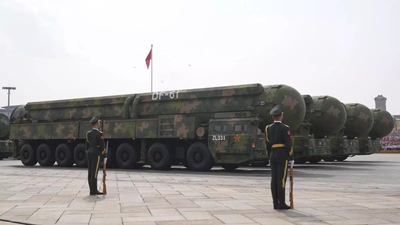
China is increasingly capable of carrying out a direct missile strike on Australia, with the threat expected to grow over the next decade as Beijing expands its long-range missile arsenal, nuclear-powered submarines and advanced bomber capabilities, according to a new analysis.A recent report by the Lowy Institute warns that Australia’s primary exposure comes from Chinese missiles launched from ships, submarines and intermediate-range ballistic missiles that could potentially reach the Australian mainland from Chinese territory or South China Sea outposts.“The direct strike threat is real and growing,” the report said, while stressing that it was assessing capability rather than intent, as per news agency AFP.The DF-27 intermediate-range ballistic missile, along with a potential conventionally armed intercontinental ballistic missile, is expected to enhance China’s reach over the coming years significantly.The US military estimates the DF-27 has a range of 5,000 to 8,000 kilometres.
Expanding missile and submarine power
The report says China’s ability to strike Australia would increase as new systems enter service, including long-range missiles and expanded submarine fleets.It adds that Beijing’s People’s Liberation Army (PLA) is rapidly modernising its strike capabilities, including hypersonic weapons and improved delivery platforms.The analysis finds that missiles such as the DF-26 could reach northern Australia if deployed from bases in the South China Sea, including artificial islands constructed by Beijing.It further warns that China’s growing nuclear-powered submarine fleet could enable sustained strike operations against Australian targets in a future conflict scenario.
“Pressing need” for deeper security debate
Sam Roggeveen, director of the Lowy Institute’s International Security Program, said the findings were intended to encourage informed public discussion rather than alarmism.“I think the growth of the People’s Liberation Army is the most important thing to happen to Australian security since the collapse of the Soviet Union, and there is a pressing need for a more informed Australian discussion about it,” Roggeveen said, as cited by news agency AFP.He described the report as “neither hawkish nor dovish, neither alarmist nor complacent”.
Capability, not intent, the key concern
The analysis highlights that while China’s military focus remains primarily on regional priorities such as Taiwan, its expanding capabilities could allow it to conduct long-range operations across the wider Indo-Pacific in the event of a broader conflict.“The chances of a Chinese attack on Australia are small, but governments must look at capability, not just intent,” Roggeveen said.The report warns that in a major regional conflict, northern Australian bases could become targets for China’s Rocket Force, which it identifies as the PLA’s most effective long-range strike arm.
Submarine expansion and regional implications
A separate analysis cited by WAtoday notes that China is rapidly expanding its nuclear-powered attack submarine fleet, which could grow to around 25 vessels by 2035, up from about nine currently.According to the report, these submarines would be capable of carrying cruise or hypersonic missiles, enabling sustained strike operations and persistent patrol coverage near Australian waters.It also warns that China’s broader naval expansion, including destroyers, aircraft carriers and frigates, could further extend its operational reach in the Indo-Pacific.The report argues that China’s missile systems already provide limited strike capability against northern Australia, particularly when deployed from forward positions in the South China Sea.
Strategic implications for Australia
The analysis comes as Australia continues to reshape its defence posture under the AUKUS agreement and broader Indo-Pacific security partnerships, focusing on deterrence from its northern approaches.While emphasising that intent remains uncertain, the Lowy Institute argues that China’s expanding arsenal demands closer scrutiny in defence planning, particularly as missile ranges, submarine endurance and air capabilities continue to grow over the next decade.The report concludes that China’s evolving military strength could significantly reshape regional security dynamics, with Australia increasingly within the reach of advanced long-range strike systems.


