
Army gets demo of indigenous counter-drone system ‘Bhargavastra’

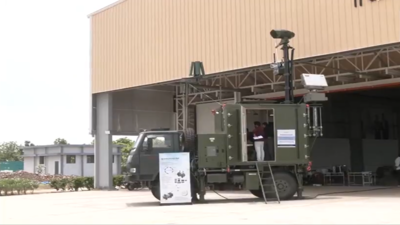
A new counter-swarm drone system called ‘Bhargavastra’ has been showcased to the army, marking a significant step in India’s efforts to build layered defences against the growing threat of weaponised drones and loitering munitions. The demonstration, held in Nagpur on July 24, was conducted under the Make-II programme as part of a status review.The Bhargavastra system is mounted on a vehicle and integrates a Command and Control Vehicle equipped with radar, Electro-Optical/Infrared (EO/IR) sensors and passive radio-frequency detectors, linked through a network. Alongside, a launcher vehicle carries multiple launch tubes. During the trial, a swarm of drones was detected and tracked by the system’s sensors. The C4I suite generated a real-time air picture, issued alerts and assigned targets to the launcher, following which the firing sequence was demonstrated.What sets Bhargavastra apart is its dual-layered kill mechanism. It combines unguided micro-rockets with a lethal radius of 20 metres and precision-guided micro-missiles capable of intercepting targets up to 2.5 kilometres away. The system can detect larger UAVs up to a range of 10 km and 6 km for smaller drones. The system is designed to operate across diverse set of terrain, ranging from deserts to snow bound high altitude regions over 5,000 metres.In addition to kinetic strikes using missiles, the system employs soft-kill techniques such as electronic jamming, providing a comprehensive layered defence. The entire system has been developed as a cost-effective solution against autonomous drones and is resistant to conventional electronic warfare measures such as jamming. By employing indigenously developed rockets and micro-missiles in a multi-layer engagement architecture, Bhargavastra is capable of neutralising both individual drones and coordinated swarms.The company emphasised that the system has been engineered for seamless integration with the armed forces’ existing networks. It is particularly effective against swarms of autonomous drones, which have emerged as a dominant battlefield capability in conflicts from Ukraine to West Asia. The system offers a cheaper alternative to deploying expensive surface-to-air missiles against relatively low-cost drones, improving the cost-exchange ratio in counter-drone operations.Open-source information suggests that while a handful of advanced nations are developing similar micro-missile systems, a fully integrated, vehicle-mounted platform with swarm neutralisation capabilities like Bhargavastra has not yet been deployed elsewhere. India’s defence establishment has repeatedly flagged the need for credible counter-drone systems as unmanned platforms proliferate across battlefields. Bhargavastra’s demonstration reflects an attempt to bridge that gap with indigenous technology, offering a layered, mobile and cost-effective solution tailored to India’s operational environment.


