
Scientists recreated a tiny piece of the early universe inside a glass tube to study how life’s building blocks formed

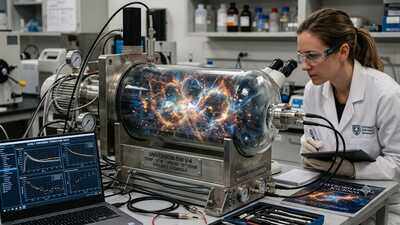
Long before Earth existed, before the Sun had fully formed, clouds of gas and microscopic dust drifted through interstellar space. Within those tiny grains, astronomers believe, some of the chemistry that eventually gave rise to planets, and perhaps even life, first began. Yet studying this process has always been difficult because the dust forms in some of the most hostile environments in the universe, often around dying stars or within vast molecular clouds many light-years away.Now, scientists have recreated part of that cosmic chemistry inside a laboratory. By generating artificial interstellar dust under carefully controlled conditions, researchers from the University of Sydney have produced particles whose chemical fingerprints closely resemble those observed by space telescopes. The work provides a new way to investigate how carbon-rich cosmic dust formed billions of years ago and how it may have supplied the raw ingredients that later became part of planets, meteorites and, ultimately, living organisms.
How scientists recreated interstellar cosmic dust inside a laboratory
The research, ‘Laboratory Synthesis of Carbonaceous Cosmic Dust Analogues Using Plasma Polymerisation’, was led by Linda Losurdo from the School of Physics, University of Sydney, together with Professor David R. McKenzie, and published in The Astrophysical Journal.Rather than attempting to collect dust from space, the team recreated the conditions believed to exist within parts of the interstellar medium.Inside sealed glass tubes, researchers first removed almost all the air using a vacuum system, creating pressures similar to those found in space. They then introduced a carefully controlled mixture of nitrogen, carbon dioxide and acetylene before applying a high-voltage electrical discharge.The electrical energy transformed the gases into plasma, an ionised state of matter composed of charged particles. As energetic collisions broke molecular bonds apart, atoms gradually recombined into increasingly complex carbon-rich materials. Over roughly an hour, these compounds condensed onto silicon substrates, producing an ultra-thin layer of laboratory-made dust that closely resembles carbonaceous dust detected throughout the cosmos.Some deposits even formed glitter-like particles visible under the microscope, although their scientific value lies not in their appearance but in their chemistry.
Why the laboratory-made dust matters for understanding the origins of life
Analysis showed that the artificial dust contained carbon, hydrogen, oxygen and nitrogen, the four elements commonly abbreviated as CHON.Together, these elements form the backbone of countless organic molecules, including many that later participate in biological chemistry. Although the experiment did not produce life or complex biomolecules, it recreated an important earlier stage in cosmic chemical evolution.Astronomers have long known that carbon-rich dust forms around ageing stars, supernova remnants and dense molecular clouds where new stars are born. As these particles drift through space, they become incorporated into comets, asteroids and young planetary systems.Many researchers propose that some of the organic material delivered to the early Earth arrived aboard these ancient space rocks during the Solar System’s violent infancy. Understanding how the dust itself formed therefore helps scientists reconstruct one of the earliest chapters in the story of life’s chemical origins.As Losurdo and colleagues explain in their study, reproducing these materials under controlled laboratory conditions allows researchers to investigate the chemical pathways responsible for producing carbonaceous interstellar dust.
Do you believe that recreating interstellar dust in a laboratory can provide insights into the origin of life?
3k+ users shared opinion today
5k+ users already voted today
3k+ users shared opinion today
Share Opinion
The artificial dust matched the chemical fingerprints seen in space
One of the study’s most significant findings emerged when the team examined the dust using infrared spectroscopy.Every material absorbs and emits infrared radiation in its own distinctive way, producing a characteristic spectral pattern that astronomers use to identify substances across the universe.When researchers compared the laboratory samples with astronomical observations, they found remarkably similar infrared features, particularly those associated with carbon-rich interstellar dust.This agreement suggests the plasma experiment successfully reproduced several of the chemical processes believed to occur naturally in space. Rather than relying solely on computer models or telescope observations, scientists can now recreate and analyse these reactions under repeatable laboratory conditions.The approach provides a valuable bridge between astronomy and experimental chemistry, allowing theories about cosmic dust formation to be tested directly.
Why recreating space in the laboratory changes how scientists study the universe
Observing interstellar dust through telescopes reveals what exists across the cosmos, but it cannot show every chemical step involved in its formation. Laboratory experiments offer something different: control.Researchers can alter gas mixtures, temperatures and energy levels, then observe how those changes influence the materials that form. This makes it possible to investigate processes that would otherwise remain hidden inside distant molecular clouds thousands of light-years away.Professor David R. McKenzie noted that producing cosmic dust analogues in the laboratory enables scientists to study conditions that cannot be manipulated through astronomical observations alone.The experiment does not explain precisely how life began, nor was it designed to. Instead, it recreates one of the earliest known stages in the chain of events that eventually made life possible.By reproducing a fragment of interstellar chemistry inside a glass tube, researchers have created a powerful new tool for investigating how the universe assembled the raw materials from which planets, and perhaps life itself, eventually emerged.


