
Yuka Okuda, a Rabindrasangeet performer, delivers a talk on Ray’s ‘Charulata’. All seats look taken in a mediumsized Tokyo theatre on an Aug evening in the Japanese summer. The audience listens rapt to a woman sitting on stage, framed by the movie screen behind her. Clearly, it’s not just another screening, but then, neither can the topic be called usual for this part of the world. For the woman on stage is discussing Rabindrasangeet, and the context is ‘Charulata’, maestro and auteur Satyajit Ray’s 1964 masterpiece, one of the seven films that were shown last year in Japan as part of a retrospective of his works.The lineup — featuring ‘Jalsaghar’ (1958), ‘Mahanagar’ (1963), ‘Charulata’ (1964), ‘Kapurush’, ‘Mahapurush’ (both 1965), ‘Nayak’ (1966), and ‘Jai Baba Felunath (1979) — earning their first theatrical release in Japan, spans a two-decade arc of some of Ray’s most memorable films. Israel Iran WarUS-Israel-Iran War Live Updates: ‘Indian navy’s guest struck without warning’: Iran slams US after torpedo sinks warship IRIS Dena’Will bitterly regret’: Iran warns US after IRIS Dena, ‘Indian Navy’s guest’, sunk by torpedo’Could be targeted’: Second Iranian warship heads towards Sri Lanka a day after US submarine attackThe films were also made available on VOD and home video with Japanese subtitles. The demand has grown to the point that these films are set for a Blu-ray release in March.To Sandip Ray, filmmaker and Ray’s son, however, none of this is surprising. After all, it was the Japanese film great Akira Kurosawa who’d said, “Not to have seen the cinema of Satyajit Ray means existing in the world without seeing the sun or the moon.” Sitting in his Lake Temple Road residence in Kolkata, he recalled the role of a Japanese distributor, Toho-Towa Co. Ltd, founded in 1928 by film pioneer Nagamasa Kawakita, and said Kawakita’s wife, Kashiko Kawakita, was a Ray admirer. “She was very close to our family and a die-hard Satyajit follower right from the start,” he said. When Ray first visited Japan, it was Kashiko who arranged a meeting between Ray and Kurosawa in 1966. “I think till the 80s, they distributed all of Baba’s films in Japan. The films must have done good business. Otherwise, why would she ask about new films every year?” said Sandip Ray.The seven restored titles began their theatrical run on July 25 at Le Cinema Bunkamura in Tokyo. The retrospective was to run for three weeks, but a further week was added due to the demand. “The films were not only screened in Tokyo, but in cities like Hiroshima, Osaka, Kyoto, etc, covering 15-20 cinemas nationwide,” said Varsha Bansal, who helmed the restorations of the Ray classics produced by her grandfather, RD Bansal.The screenings were paired with discussions and talks. If film researcher and producer Eri Morinaga spoke after ‘Mahanagar’, Asian cinema researcher Tamaki Matsuoka delivered a talk following a screening of ‘Jalsaghar’. Yuka Okuda, a Rabindrasangeet performer and Bengali language instructor, led a session after a ‘Charulata’ screening. “I offered some reflections on the impact of the Rabindrasangeet in the film… Some in the audience said they wanted to watch the film again. It made us realise all the more that Ray’s cinema is a deeply layered and magnificent creation,” Okuda told TOI .About the AuthorPriyanka DasguptaPriyanka Dasgupta is the features editor of TOI Kolkata. She has over 20 years of experience in covering entertainment, art and culture. She describes herself as sensitive yet hard-hitting, objective yet passionate. Her hobbies include watching cinema, listening to music, travelling, archiving and gardening.Read MoreEnd of ArticleFollow Us On Social MediaVideosIndia Condoles Khameini’s Death, Jaishankar Speaks To Iranian FM; ‘Iran War God’s Plan’: US MilitaryNitish Kumar Files RS Nomination, Vows Support to New State GovernmentCV Ananda Bose Resigns As Bengal Governor, TN Guv RN Ravi To Replace Him; Mamata Attacks Amit Shah’Undeniable’: US Deputy Secretary Landau Hails India’s Rise As Key To The 21st CenturyJaishankar Dials Iran FM Araghchi After India Condoles Khamenei’s Death In US-Israeli StrikesIran Conflict Presents ‘Huge Opportunity’ For India To Become Clean Energy Exporter: Amitabh KantIndian YouTuber Nancy Grewal Killed In Canada Stabbing, Questions Rise Over Motive Behind Attack’Conflict In Backyard’: Rahul Gandhi Targets PM Modi On Iran Warship, Govt Denies Responsibility’India Deserves UN Security Council Seat’, Says Finland President Alexander Stubb In Strong Support‘Maha Strategy Repeated’: Opposition Hits Out at BJP After Nitish RS Move123PhotostoriesBrad Pitt’s most iconic on-screen looks that continue to lend fashion goalsCould you be low on magnesium? Common warning signs to know, according to doctorsJanhvi Kapoor birthday special: From ‘Homebound’, ‘Mili’ to ‘Gunjan Saxena’, best performances to watch on OTTHow to make Kolhapuri Egg Curry for lunch at home5 common mistakes to avoid while making restaurant-style Naan at homeMark Zuckerberg buys $170 million mansion in Miami: A look into a tech billionaire’s ultra-luxury abodeIce Apple: One of India’s summer favourite fruits and 5 must-try refreshing ‘tadgola’ recipes for scorching heatFoods richer in potassium than bananas: Doctor reveals 6 heart-healthy options that can help support blood pressure naturallyBigg Boss Malayalam contestants who split with their partners after the show7 ways to extend your car’s engine life123Hot PicksChina Military BudgetIran Mobile Missile LauncersMiddle East CrisisNitish KumarIncome Tax CalculatorPublic holidays March 2026Bank Holidays MarchTop TrendingAP SSC Hall TicketsBreanna StewartFortnite v39 51 Update Release timeDak Prescotts ContractBengaluru Cab Driver TheftNancy GrewalMiddle East CrisisTelangana High CourtUS SubmarineTrump assassination plot

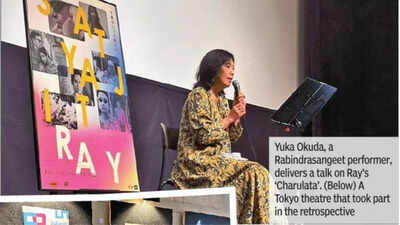
Yuka Okuda, a Rabindrasangeet performer, delivers a talk on Ray’s ‘Charulata’.
All seats look taken in a mediumsized Tokyo theatre on an Aug evening in the Japanese summer. The audience listens rapt to a woman sitting on stage, framed by the movie screen behind her. Clearly, it’s not just another screening, but then, neither can the topic be called usual for this part of the world. For the woman on stage is discussing Rabindrasangeet, and the context is ‘Charulata’, maestro and auteur Satyajit Ray’s 1964 masterpiece, one of the seven films that were shown last year in Japan as part of a retrospective of his works.The lineup — featuring ‘Jalsaghar’ (1958), ‘Mahanagar’ (1963), ‘Charulata’ (1964), ‘Kapurush’, ‘Mahapurush’ (both 1965), ‘Nayak’ (1966), and ‘Jai Baba Felunath (1979) — earning their first theatrical release in Japan, spans a two-decade arc of some of Ray’s most memorable films. The films were also made available on VOD and home video with Japanese subtitles. The demand has grown to the point that these films are set for a Blu-ray release in March.To Sandip Ray, filmmaker and Ray’s son, however, none of this is surprising. After all, it was the Japanese film great Akira Kurosawa who’d said, “Not to have seen the cinema of Satyajit Ray means existing in the world without seeing the sun or the moon.” Sitting in his Lake Temple Road residence in Kolkata, he recalled the role of a Japanese distributor, Toho-Towa Co. Ltd, founded in 1928 by film pioneer Nagamasa Kawakita, and said Kawakita’s wife, Kashiko Kawakita, was a Ray admirer.
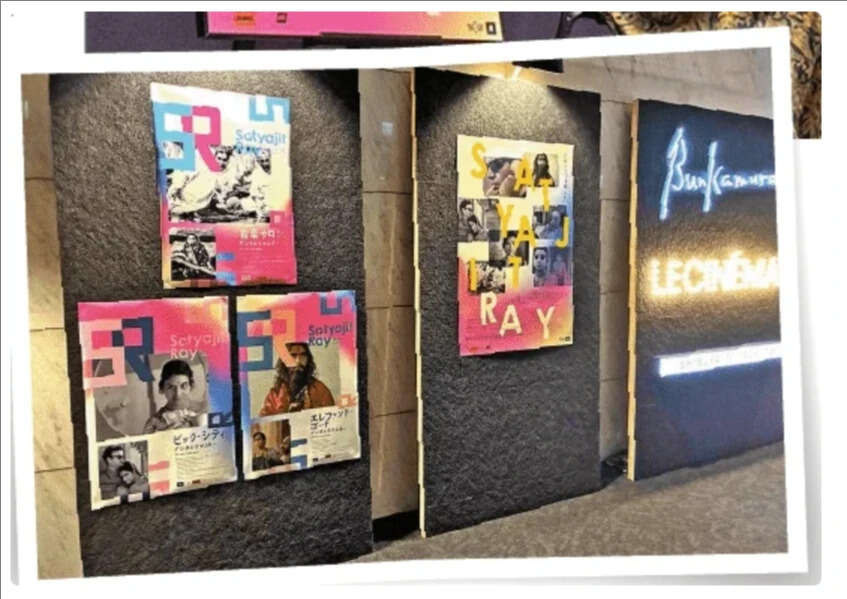
“She was very close to our family and a die-hard Satyajit follower right from the start,” he said. When Ray first visited Japan, it was Kashiko who arranged a meeting between Ray and Kurosawa in 1966. “I think till the 80s, they distributed all of Baba’s films in Japan. The films must have done good business. Otherwise, why would she ask about new films every year?” said Sandip Ray.The seven restored titles began their theatrical run on July 25 at Le Cinema Bunkamura in Tokyo. The retrospective was to run for three weeks, but a further week was added due to the demand. “The films were not only screened in Tokyo, but in cities like Hiroshima, Osaka, Kyoto, etc, covering 15-20 cinemas nationwide,” said Varsha Bansal, who helmed the restorations of the Ray classics produced by her grandfather, RD Bansal.The screenings were paired with discussions and talks. If film researcher and producer Eri Morinaga spoke after ‘Mahanagar’, Asian cinema researcher Tamaki Matsuoka delivered a talk following a screening of ‘Jalsaghar’. Yuka Okuda, a Rabindrasangeet performer and Bengali language instructor, led a session after a ‘Charulata’ screening. “I offered some reflections on the impact of the Rabindrasangeet in the film... Some in the audience said they wanted to watch the film again. It made us realise all the more that Ray’s cinema is a deeply layered and magnificent creation,” Okuda told TOI .


