
Why does my child talk nonstop at home but barely speak at school?

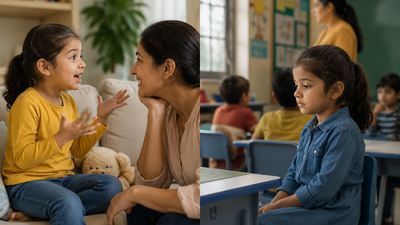
You know this kid. Maybe it’s yours. At home, they narrate everything, what the dog is doing, why their sandwich got cut wrong, an entire retelling of a cartoon episode with sound effects. But then you pick them up from school, and the teacher tells you they said maybe three words all day, and mostly just to point at things. And you sit there wondering how these can possibly be the same child.It’s a genuinely confusing thing for parents to watch, and it turns out it’s a lot more common, and a lot more studied, than most people realize.
28 Jul 2026 | 16:25
Do you think social media has changed the parent-teen relationship?
There’s a real name for this, and it’s not just shyness
This pattern, chatty at home, near silent everywhere else, has an actual clinical name: selective mutism. It’s common for kids with selective mutism to be very chatty at home with family but silent at school, and parents typically start noticing the signs when a child is around three or four years old, even if a formal diagnosis doesn’t happen until later, once the school silence becomes impossible to ignore.And it’s not the kid being stubborn or difficult on purpose. A study published in the journal Pediatrics, one of the earliest papers to describe this in American pediatric literature, laid it out plainly, the problem is most common in the child who speaks actively and well at home but who refuses to speak in school. That word “refuses” is doing something misleading there though, because it’s not defiance. It’s closer to a kind of freeze response.
Why it gets missed for so long
Part of what makes this tricky is that these kids don’t usually cause problems in the traditional sense. Kids with selective mutism are typically mild-mannered and polite in classroom settings, so their silence can be misread as shyness rather than something that needs actual attention. A quiet, well-behaved kid doesn’t set off alarm bells the way a disruptive one does. But that same quietness can mean a child going a full year or more without ever speaking to a teacher, unable to even ask permission to use the bathroom, according to the same guide.
The good news buried in all this
Here’s the part worth holding onto, this responds well to help, and the earlier it’s addressed, the better kids tend to do. A follow-up study published in the European Child & Adolescent Psychiatry journal tracked 24 children through six months of a specific cognitive behavioral therapy approach and found that a year later, two-thirds no longer met the criteria for selective mutism at all. And younger children did notably better, with 78 percent of kids aged three to five recovering, compared to 33 percent of kids aged six to nine. Age really does seem to matter here, which is exactly why catching this early instead of waiting it out matters too.So if this sounds like your kid, it’s genuinely worth a conversation with your pediatrician rather than assuming they’ll just grow out of it on their own. It’s not a character trait. It’s an anxiety response, and it’s one that treatment can actually change.


