
US Army conducts first live-fire hypersonic test with repurposed HATS launcher

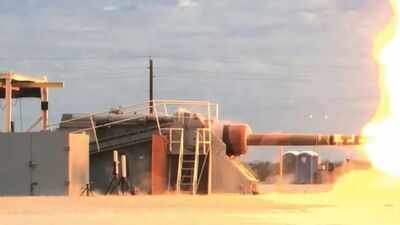
The US Army has reportedly conducted the first live-fire hypersonic test using the Heavy Artillery Test System (HATS), a repurposed launcher originally developed for the Strategic Long Range Cannon (SLRC) programme, which was scrapped after Congress ended dedicated funding in 2022.The test took place on July 30 at Arizona’s Yuma Proving Ground (YPG), a major US Army testing facility spread across more than 830,000 acres in the southwestern part of the state.The trial reportedly involved the Army’s DEVCOM Armaments Center, Lawrence Livermore National Laboratory (LLNL) and YPG.
Instead of a complete hypersonic missile, the team fired a specially developed Integrated Launch Package (ILP) from the HATS. The hardened package carried the experimental payload and provided a faster, lower-cost way to assess its performance at impact.The cannon used in the trial was adapted from the SLRC, which was designed to fire rocket-assisted, precision-guided projectiles at targets more than 1,000 miles (1,609 km) away, far beyond the range of conventional 155-mm artillery.After the programme was cancelled, the military repurposed the launcher as a platform for hypersonic research. In the latest test, the cannon fired only the warhead enclosed within the protective ILP rather than a complete missile.Engineers used telemetry, high-speed cameras and other range instruments to track the package from launch to impact, allowing them to assess its performance during the final stage of a weapon’s mission.The test also marked the first live-fire trial of the hardened ILP, demonstrating that it could withstand the extreme forces of a cannon launch. According to the Army, the data could support future hypersonic weapons development while reducing the need for costly full-scale missile tests.A complete hypersonic missile test can cost between $9.5 million and more than $15 million, depending on the vehicle and programme. The cannon-based approach is not intended to replace conventional flight tests but could complement wind tunnels, laboratory experiments, rocket sleds and live missile launches while lowering testing costs.


