
The tragic life of Sarah Baartman: The woman exploited for her body as the ‘Hottentot Venus’ and displayed even after death, finally came home 192 years later

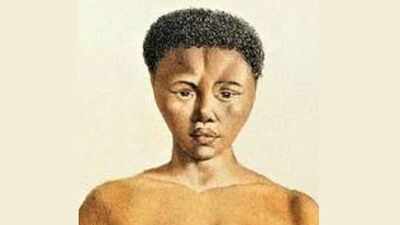
In the late 1700s, in what is now South Africa’s Eastern Cape, a girl named Sarah (Sara/Saartjie) Baartman was born into a world already shaped by colonial violence. Her mother died when she was two. Her father, a cattle driver, died when she was a teenager. As a young woman, a Dutch colonist murdered her partner, and the baby they had together did not survive. Bereft of family and security, she entered domestic service in Cape Town, doing ordinary work in an increasingly brutal system.Nothing about her early life suggested she would become one of the most talked‑about women in modern history. Yet her body, and the way others chose to see it, eventually turned her into a symbol of racism, exploitation and the dehumanising gaze that defined much of the colonial era.
From Cape Town to the “Hottentot Venus”
In October 1810, Sarah—illiterate and with limited options—allegedly signed a contract with English ship’s surgeon William Dunlop and Hendrik Cesars, the mixed‑race entrepreneur whose household she worked in. The agreement said she would travel to England to take part in shows, as per reports.Sarah had steatopygia, a natural build‑up of fat leading to extremely protuberant buttocks, a trait found among some Khoisan women. At the time, in Europe, curves were fashionable and caricatured, and her body drew enormous, voyeuristic curiosity.When she arrived in London, she was exhibited in a venue around Piccadilly Circus under the stage name “Hottentot Venus”—“Hottentot” was then a Dutch term for Khoikhoi and San peoples (now understood as derogatory), and “Venus” evoked the Roman goddess of beauty. On stage, she wore tight, flesh‑coloured clothing adorned with beads and feathers, smoked a pipe, and was invited to dance and play instruments. Wealthy patrons could pay for private “demonstrations” in their homes where guests were allowed to touch her. Even in a London already home to various ethnic minorities, Sarah was not seen as a full participant in society; she was a spectacle.Campaigners against slavery, which Britain had officially banned in the trade (but not in practice) in 1807, were horrified. Her handlers were prosecuted for holding her against her will, but not convicted—Sarah herself testified in their favour. Historians still debate whether she was coerced or acting under some sense of agency and hope for better prospects. As one scholar has noted, the relationship between Sarah and her promoters was never equal, even if she believed she might gain materially or otherwise from performing.Her popularity faded over time, and she went on tour around Britain and Ireland—always centred on the same voyeuristic curiosity.
Paris, “racial science,” and a brutal afterlife
In 1814, Sarah moved to Paris with Cesars. There, she briefly became a kind of cult celebrity, frequenting the Café de Paris and attending society parties. Eventually, Cesars returned to South Africa, and Sarah fell under the control of an “animal exhibitor” known as Reaux. Accounts suggest she drank and smoked heavily during this period and was likely prostituted by him.French scientists and artists became interested in her. She agreed to be studied and painted but refused to appear fully naked, insisting that such exposure was beneath her dignity; even in the shows, she had never been completely unclothed. This era marked the rise of what would come to be called “racial science,” where bodies of colonised peoples were measured, classified and ranked in ways that tried to justify domination, as per the BBC.On 29 December 1815, Sarah Baartman died at about 26 years of age. The recorded cause was an “inflammatory and eruptive disease,” later speculated to be pneumonia, syphilis, alcoholism, or a combination of factors linked to her harsh life.Death did not end her exhibition.The naturalist Georges Cuvier, who had once danced with her at a party, made a plaster cast of her body and then dissected it, the report further reveals. He preserved her skeleton and pickled her brain and genitalia, placing them in jars and putting them on display at Paris’s Museum of Man. There, her remains stayed on public view until 1974. For decades, visitors could look at her body remade into “specimens,” while scientific narratives described the Khoisan as the “lowest” rung in imagined human hierarchies, sometimes grotesquely suggesting links with non‑human primates.
A long journey home
Sarah left South Africa in 1810. Her remains did not return until nearly 200 years later.After Nelson Mandela became President of South Africa in 1994, he formally requested the repatriation of Sarah Baartman’s remains and Cuvier’s plaster cast. The French government eventually agreed. In March 2002, her remains were returned, and in August 2002, she was buried in Hankey, Eastern Cape, not far from where she had been born. It had been 192 years since she was taken to Europe.Her story, once obscured, began to receive more attention. Books such as ‘The Hottentot Venus: The Life and Death of Saartjie Baartman’ and scholarly works like ‘Representation and Black Womanhood: The Legacy of Sarah Baartman ‘explore how she became a “landscape” upon which narratives of exploitation and Black womanhood were projected. Authors point out that in many retellings, Sarah “the woman” remains invisible, overshadowed by the symbol she has become. Many films and doumentaries also brought her life to mainstream. Even pop culture has echoed her legacy: in 2014, a magazine cover of reality star Kim Kardashian balancing a champagne glass on her protruding bottom drew criticism for resembling historic caricatures of Baartman—highlighting how the commodification and spectacle of Black women’s bodies continue in new forms.
Why her story still matters
Today, Sarah Baartman is widely seen as a powerful emblem of colonial exploitation and racism—the ridicule, hypersexualisation and commodification of Black bodies, particularly Black women’s, for entertainment and “science.” Her life illustrates:– How economic desperation and unequal power relationships can blur the line between consent and coercion.– How pseudo‑scientific ideas were used to justify oppression and turn people into “objects” of study rather than individuals with rights and dignity.– How the image of a single woman can be repeatedly used, reinterpreted, and sometimes misused, while her own voice and interior life are left largely unrecovered.At the same time, her journey—from a young woman in Eastern Cape to a spectacle in Europe, to remains in jars, to an honoured burial in her homeland—has become a story of remembrance and justice. Campaigns for her repatriation, discussions around her representation, and renewed attention to her humanity show how history continues to shape conversations about race, power and human dignity.


