
The Supreme Court has ordered a nationwide audit of all private and deemed universities in response to a student’s grievance. This sweeping directive demands sworn affidavits on their establishment, governance, regulatory approvals, and non-profit status, aiming to expose structural opacity and assess regulatory oversight. NEW DELHI: Supreme Court has ordered an unprecedented nationwide audit of all private and deemed universities, transforming a student grievance into a deep scrutiny of India’s sprawling higher education sector. In a sweeping directive, apex court has asked Centre, all states and UTs, and University Grants Commission (UGC) to submit personally sworn affidavits disclosing how these institutions were set up, who governs them, what regulatory approvals they hold, and whether they truly function on a notfor-profit basis.The move comes in response to a petition filed by a student of Amity University, Ayesha Jain, who alleged the institution harassed and barred her from attending classes after she legally changed her name. What began as a single case of administrative apathy has now turned into a judicial inquisition into the governance and financial practices of the entire private university ecosystem.Supreme Court’s focus is clear — expose the structural opacity and examine whether regulatory bodies like UGC have adequately performed their role. Past interventions show this isn’t unfamiliar terrain. In 2005, the court struck down Chhattisgarh Private Universities Act that had allowed over 100 shell institutions to operate without basic academic infrastructure. In 2009, a central review found 44 deemed universities unfit for their status due to poor academic and governance standards. In 2017, a Supreme Court verdict invalidated engineering degrees awarded via unapproved distance mode by deemed universities and barred them from conducting such courses without clear regulatory approval.This current review cuts deeper. It questions how private universities acquire land, appoint leadership, handle finances, and whether they have credible grievance redressal mechanisms. The demand for personal accountability — from chief secretaries to the UGC chairperson — signals judicial impatience with the status quo. A UGC official, on condition of anonymity, acknowledged: “There have been longstanding compliance gaps. This is a chance to restore public trust.” The official added that in the current case, the commission “in fact recommended the university to consider the name change request”.Private universities, many of which operate under different state and central laws, are rattled. “This is a sweeping brush,” said a vice chancellor of a reputed state private university. “We support transparency, but we also fear being tarred with the same brush as a few errant institutions.”Observers see timing in the court’s action. Higher Education Commission of India (HECI) Bill, intended to overhaul regulation and merge UGC, AICTE, and others under one roof, is expected in the upcoming Parliament session.“An issue concerning a private university legislated by state law is now expanded to rope in all private deemed universities governed by separate regulations under a central law. In a similar exercise, in 2017 in the case of Orissa Lift case, an issue concerning four deemed universities affected all in an irreversible manner. With HECI round the corner, it is hoped that the present issue finds a policy solution through HECI Bill,” said an academic policy expert.About the AuthorManash Pratim GohainManash Pratim Gohain is a seasoned journalist with over two decades at The Times of India, where he has built a rich body of work spanning education policy, politics, and governance. Renowned for his incisive coverage of the National Education Policy (NEP) 2020, accreditation reforms, and skilling initiatives, he has also reported on student politics, urban policy, and social movements. His political reportage—both reflective and news-driven—adds depth to his writing, bridging policy with public impact. Through his 2,500 articles and related outlets, he has emerged as a trusted voice in national discourse, particularly in linking education reform to broader societal change.Read MoreEnd of ArticleFollow Us On Social MediaVideosIndia Is a Key Ally, Cyprus Assures Strong Push to Finalise India–EU FTA TalksImran Khan Health Rumour: PTI Holds Sit In Outside Adiala Jail, KP CM Sohail Afridi Stages ProtestRam Madhav Challenges ‘No-Religion’ Narrative in White Collar Terror DebateAustralia Says India Is Now A Leading Global Power, Credits PM Modi For Transforming World DynamicsOusted PM Sheikh Hasina Faces Fresh Conviction as Court Awards 21-Year TermPM Modi Announces Major Move Allowing Private Players Into Nuclear Sector To Spur Advanced ReactorsExplained: Why Vikram-I Could Transform India’s Satellite Launch Market And Global Space Leadership‘Pak, Bangladesh, US…’: BJP Alleges Congress Using Foreign ‘X’ Accounts to Set India’s NarrativePakistan’s Adiala Jail Issues Statement On Imran Khan’s Health Amid Viral Death RumoursThe Indrajaal Ranger: India Unveils AI-Enabled Anti-Drone Patrol Vehicle In Hyderabad123PhotostoriesFrom ‘Apne’ to ‘Rocky Aur Rani Kii Prem Kahaani’: Dharmendra movies you can watch on OTT platforms‘Stranger Things 5’: Meet the new cast and find out who survives the final battle‘Stranger Things’ cast: Then and now‘Stranger Things’ cast: Educational qualificationsTaarak Mehta Ka Ooltah Chashmah: From Dilip Joshi being older than Amit Bhatt to Mandar Chandwadkar leaving his Dubai job for acting; Lesser-known facts about the castGastroenterologist doctor reveals the power of eating 3 eggs everyday5 must-visit national parks in the USA that are also UNESCO World Heritage Sites5 things to do during Brahma Muhurta for 21 days to transform your lifeThe hidden skill of Metacognition: What is it and how it makes the brain work smarterFrom Jonathan to Alagba: 5 tortoises across the world with exceptionally long lifespans123Hot PicksDelhi AQI TodayNew Labour CodeWorld NewsGold rate todaySilver rate todayPublic Holidays NovemberBank Holidays NovemberTop TrendingToronto Maple LeafsAyesha CurryFuzzy ZoellerCristiano RonaldoStefon DiggsGabrielle UnionVanessa BryantReed Sheppard GirlfriendStephen CurryCandace Owens
NEW DELHI: Supreme Court has ordered an unprecedented nationwide audit of all private and deemed universities, transforming a student grievance into a deep scrutiny of India’s sprawling higher education sector. In a sweeping directive, apex court has asked Centre, all states and UTs, and University Grants Commission (UGC) to submit personally sworn affidavits disclosing how these institutions were set up, who governs them, what regulatory approvals they hold, and whether they truly function on a notfor-profit basis.The move comes in response to a petition filed by a student of Amity University, Ayesha Jain, who alleged the institution harassed and barred her from attending classes after she legally changed her name. What began as a single case of administrative apathy has now turned into a judicial inquisition into the governance and financial practices of the entire private university ecosystem.
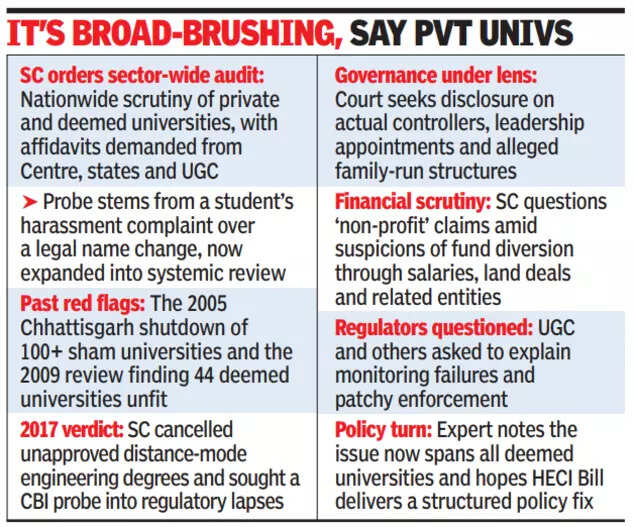
Supreme Court’s focus is clear — expose the structural opacity and examine whether regulatory bodies like UGC have adequately performed their role. Past interventions show this isn’t unfamiliar terrain. In 2005, the court struck down Chhattisgarh Private Universities Act that had allowed over 100 shell institutions to operate without basic academic infrastructure. In 2009, a central review found 44 deemed universities unfit for their status due to poor academic and governance standards. In 2017, a Supreme Court verdict invalidated engineering degrees awarded via unapproved distance mode by deemed universities and barred them from conducting such courses without clear regulatory approval.This current review cuts deeper. It questions how private universities acquire land, appoint leadership, handle finances, and whether they have credible grievance redressal mechanisms. The demand for personal accountability — from chief secretaries to the UGC chairperson — signals judicial impatience with the status quo. A UGC official, on condition of anonymity, acknowledged: “There have been longstanding compliance gaps. This is a chance to restore public trust.” The official added that in the current case, the commission “in fact recommended the university to consider the name change request”.Private universities, many of which operate under different state and central laws, are rattled. “This is a sweeping brush,” said a vice chancellor of a reputed state private university. “We support transparency, but we also fear being tarred with the same brush as a few errant institutions.”Observers see timing in the court’s action. Higher Education Commission of India (HECI) Bill, intended to overhaul regulation and merge UGC, AICTE, and others under one roof, is expected in the upcoming Parliament session.“An issue concerning a private university legislated by state law is now expanded to rope in all private deemed universities governed by separate regulations under a central law. In a similar exercise, in 2017 in the case of Orissa Lift case, an issue concerning four deemed universities affected all in an irreversible manner. With HECI round the corner, it is hoped that the present issue finds a policy solution through HECI Bill,” said an academic policy expert.


