
Tesla driver caught asleep at 100 km/h with two kids in car: How a pair of sunglasses ‘fooled’ the self driving feature

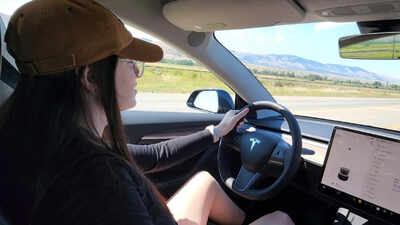
A ‘shocking’ incident has raised questions about how Tesla’s high-tech driver monitoring system after a Tesla driver was reportedly filmed fast asleep at the wheel while traveling at 100 km/h. Making matters worse, two young children were also in the vehicle as it zipped down the highway entirely unmonitored. The tech does not allow a driver to pass out without shutting the vehicle down but it did in this case and the answer comes down to a simple, everyday accessory: a pair of large sunglasses.
What is Tesla’s tech in question
Tesla’s “Full Self-Driving” (FSD) software is legal in Canada with British Columbia’s Motor Vehicle Act strictly banning high-level automated vehicles on public roads. Since Tesla’s system is classified as “Level 2” automation, the driver is legally required to be fully awake and in control at all times.
How Sunglasses defeated the system
Tesla relies on a dual-layer monitoring system to ensure drivers are paying attention, but this incident exposes a massive gap in its design. Since an update in 2024, Tesla’s primary safeguard is an internal cabin camera mounted above the rearview mirror. This camera is designed to watch the driver’s face, tracking eye movements for signs of drowsiness or distraction.However, Tesla’s own owner’s manual explicitly admits a flaw: the camera tracking will not work if the driver is wearing a hat, if the lighting is poor, or if they are wearing sunglasses, a report by Electrek said. Since the driver in the video was wearing large sunglasses, the camera could not see the eyes. When the camera is blinded, the car automatically falls back on its older, weaker backup system: checking for physical pressure (“torque”) on the steering wheel.Experts note that torque detection is incredibly easy to trick. The car doesn’t know if a driver is awake; it only knows if weight is pressing on the wheel.


