
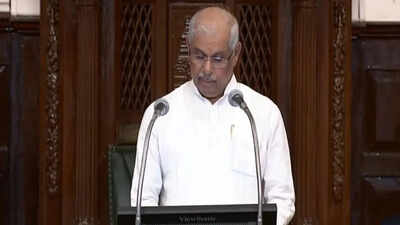
Tamil Nadu Governor Rajendra Vishwanath Arlekar (Image/ANI) NEW DELHI: Tamil Nadu Governor Rajendra Vishwanath Arlekar on Thursday said that the state will continue to follow the two-language policy and will urge the centre to reconsider the three-language formula, while also pushing for wider use of Tamil in official and judicial communication. Addressing the state assembly in his maiden inaugural address, Arlekar said: “Tamil Nadu will continue its two-language policy since it is what the people of Tamil Nadu have accepted. We will urge the Union government to use Tamil as the language of pleading in the Madras High Court. The government will strongly oppose the National Education Policy.” The controversy over language and ceremonial protocol in Tamil Nadu had earlier erupted during chief minister Vijay’s swearing-in ceremony, where Vande Mataram was played before state anthem.He said the state’s stand on language policy is rooted in long-standing legislative history and public acceptance.”In 1968, when Perarignar Anna was the Chief Minister, a resolution was passed in the Tamil Nadu Legislative Assembly that the three-language formula must be removed and only Tamil and English should be taught. From then until now, the two-language policy has been adopted in Tamil Nadu. This Government will continue to follow this policy since the two-language policy is one that the people of Tamil Nadu have accepted,” the Governor said.Arlekar also said the Tamil Nadu government believed that central funds should not be linked to the implementation of the three-language formula, terming the condition ‘unacceptable’.He further criticised the Union government over alleged withholding of Rs 3,458 crore under the Samagra Shiksha Abhiyan, saying such decisions were affecting the state’s education funding.“This Government will strongly oppose the National Education Policy, 2020. The Union Government’s stand that Rs 3,458 crore due to Tamil Nadu under the Samagra Shiksha Abhiyan will be released only if the three-language formula is implemented is unacceptable,” he said.The Governor also emphasised that the protection of the Tamil language remains a ‘foremost pillar’ of the government’s ‘Vetri Thamizhagam’ vision document.Among key demands, he called for permission to use Tamil as the language of pleading in the Madras high court and its Madurai Bench, and also urged the establishment of a permanent Supreme Court Bench in Chennai to improve access to justice for people in the southern states.He said a detailed report highlighting the Centre’s ‘discriminatory approach’ towards financial devolution to Tamil Nadu will be prepared and made public.”A special legal committee will be constituted to pursue issue up to Supreme Court to secure fair financial devolution,” he said.CM Vijay, leader of opposition of Tamil Nadu Udhayanidhi Stalin and other senior leaders were present in the assembly during the address.The Governor said the government would continue efforts to press the Centre to safeguard Tamil Nadu’s welfare, protect state rights and implement necessary development schemes.He also referred to a White Paper released by the TVK-led state government, which highlighted alleged fiscal mismanagement by the previous administration, stating that ‘every individual living in Tamil Nadu bears a debt burden of over Rs 1 lakh.’For the first time in recent years, the Governor closely followed the government-prepared text of his speech, unlike his predecessor RN Ravi, who had earlier walked out during his address amid tensions between the Raj Bhavan and the DMK-led government.Meanwhile, administrative and fiscal concerns were also flagged in the assembly, including allegations of declining tax efficiency, with reports citing a fall in tax revenue from 5.93 per cent of GSDP to 5.40 per cent due to ‘systemic issues and corruption.’Get the latest India news and live updates. Download the TOI App.About the AuthorTOI News DeskThe TOI News Desk comprises a dedicated and tireless team of journalists who operate around the clock to deliver the most current and comprehensive news and updates to the readers of The Times of India worldwide. With an unwavering commitment to excellence in journalism, our team is at the forefront of gathering, verifying, and presenting breaking news, in-depth analysis, and insightful reports on a wide range of topics. The TOI News Desk is your trusted source for staying informed and connected to the ever-evolving global landscape, ensuring that our readers are equipped with the latest developments that matter most.”Read MoreEnd of ArticleFollow Us On Social MediaVideosVaiko-Vijay Meetings Trigger Buzz Over MDMK’s Future In Tamil Nadu’s Changing PoliticsModi-Starmer Confirm July 15 Launch Of Trade Pact Projected To Boost Bilateral CommerceJharkhand Rajya Sabha Polls Turn Into Numbers Battle As BJP Eyes Surprise Upset Against INDIA BlocDelhi-NCR Unveils Vision For Four New Cities As Population Set To Surge’Mother Of All Trade Deals’: India, EU Target FTA Signing Before End Of 2026’Jahan Thackeray Wahan Shiv Sena’: Sanjay Raut Rejects Split RumoursDefence Output More Than Doubles In Five Years As India Pushes Self-RelianceRanchi Police Arrest 2 Accused In RSS Office Petrol Bomb Attack’Calculated Move To Isolate And Endanger Her’: TMC On Mamata Security RowPM Modi, Trump Hold Bilateral Talks On Hormuz, Seafarers, Defence, Trade Ties123PhotostoriesKeep mosquitoes away naturally: 8 plants every balcony garden should have6 wild animals that have been known to prey on humans – what travellers need to knowForget probiotic supplements: These 7 traditional foods nutritionists swear by for better digestion, immunity and a healthier gutHow to attract good luck based on your birth dateRenting a house in India in 2026? 7 new rules every tenant must know8 comfortable saree-draping styles every working woman should try for long office hoursBeyond Buland Darwaza: Discover the mysterious Hiran Minar at Fatehpur SikriAre zebras black with white stripes or white with black? Here are 6 fascinating factsBharti Singh and Haarsh Limbachiyaa’s love story: All about the couple’s romance that began with a professional collaboration8 high-protein breakfasts to try when you are bored of eggs123Hot PicksOperation TigerCA TopperLionel MessiUS fed policyCrude prices fallStock MarketThomas TuchelWBJEE admit cardMP board second resultTop TrendingCristiano RonaldoIshan KishanShubham GillFIFA World Cup 2026What is Legacy BadgeDownload Optifine for Minecraft 26.2Aman SangerCBSE 10th Second Board Result 2026Eknath ShindeDevajit Saikia

NEW DELHI: Tamil Nadu Governor Rajendra Vishwanath Arlekar on Thursday said that the state will continue to follow the two-language policy and will urge the centre to reconsider the three-language formula, while also pushing for wider use of Tamil in official and judicial communication. Addressing the state assembly in his maiden inaugural address, Arlekar said: “Tamil Nadu will continue its two-language policy since it is what the people of Tamil Nadu have accepted. We will urge the Union government to use Tamil as the language of pleading in the Madras High Court. The government will strongly oppose the National Education Policy.” The controversy over language and ceremonial protocol in Tamil Nadu had earlier erupted during chief minister Vijay’s swearing-in ceremony, where Vande Mataram was played before state anthem.He said the state’s stand on language policy is rooted in long-standing legislative history and public acceptance.“In 1968, when Perarignar Anna was the Chief Minister, a resolution was passed in the Tamil Nadu Legislative Assembly that the three-language formula must be removed and only Tamil and English should be taught. From then until now, the two-language policy has been adopted in Tamil Nadu. This Government will continue to follow this policy since the two-language policy is one that the people of Tamil Nadu have accepted,” the Governor said.Arlekar also said the Tamil Nadu government believed that central funds should not be linked to the implementation of the three-language formula, terming the condition ‘unacceptable’.He further criticised the Union government over alleged withholding of Rs 3,458 crore under the Samagra Shiksha Abhiyan, saying such decisions were affecting the state’s education funding.“This Government will strongly oppose the National Education Policy, 2020. The Union Government’s stand that Rs 3,458 crore due to Tamil Nadu under the Samagra Shiksha Abhiyan will be released only if the three-language formula is implemented is unacceptable,” he said.The Governor also emphasised that the protection of the Tamil language remains a ‘foremost pillar’ of the government’s ‘Vetri Thamizhagam’ vision document.Among key demands, he called for permission to use Tamil as the language of pleading in the Madras high court and its Madurai Bench, and also urged the establishment of a permanent Supreme Court Bench in Chennai to improve access to justice for people in the southern states.He said a detailed report highlighting the Centre’s ‘discriminatory approach’ towards financial devolution to Tamil Nadu will be prepared and made public.“A special legal committee will be constituted to pursue issue up to Supreme Court to secure fair financial devolution,” he said.CM Vijay, leader of opposition of Tamil Nadu Udhayanidhi Stalin and other senior leaders were present in the assembly during the address.The Governor said the government would continue efforts to press the Centre to safeguard Tamil Nadu’s welfare, protect state rights and implement necessary development schemes.He also referred to a White Paper released by the TVK-led state government, which highlighted alleged fiscal mismanagement by the previous administration, stating that ‘every individual living in Tamil Nadu bears a debt burden of over Rs 1 lakh.’For the first time in recent years, the Governor closely followed the government-prepared text of his speech, unlike his predecessor RN Ravi, who had earlier walked out during his address amid tensions between the Raj Bhavan and the DMK-led government.Meanwhile, administrative and fiscal concerns were also flagged in the assembly, including allegations of declining tax efficiency, with reports citing a fall in tax revenue from 5.93 per cent of GSDP to 5.40 per cent due to ‘systemic issues and corruption.’


