
Switzerland built giant tunnels under the Alps to reduce truck traffic, but the project is now helping protect the country’s mountains from climate threats | World News

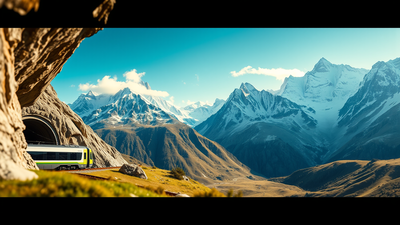
Most people picture Switzerland’s mountain tunnels as an engineering flex, a way to shrink travel time between cities. But the real story behind this vast underground network is less about convenience and more about climate. Since the 1990s, Switzerland has been quietly pulling truck traffic off its fragile Alpine roads and pushing it underground onto rail lines instead, a decision Swiss voters actually made themselves through a public vote. What started as a response to smog and traffic jams choking mountain valleys has turned into one of the clearest examples anywhere of a country restructuring its infrastructure specifically to cut emissions and protect a landscape under real environmental pressure.
Why Switzerland decided to move freight off Alpine roads
Through most of the 20th century, trucks carrying goods across Europe had no real choice but to grind over Alpine mountain passes, and by the 1980s, this had turned into a genuine problem for the people living in those valleys. Traffic kept climbing, exhaust fumes lingered in narrow mountain air that does not clear easily, and locals were dealing with constant noise and safety risks from heavy vehicles squeezing through small alpine towns. In 1994, Swiss voters approved something called the Alpine Initiative, a constitutional amendment committing the country to shifting freight traffic through the Alps from road to rail. According to Switzerland’s Federal Office of Transport, this principle has been written into the Swiss Constitution since 1994, and the country has been working to reduce truck crossings ever since.
How building tunnels made the freight shift possible
Turning that vote into reality meant building the physical infrastructure to support it, which is where the country’s famous base tunnels come in. Rather than climbing steep mountain gradients, freight trains can now pass through the Alps almost flat, running through massive tunnels bored directly beneath the mountains rather than over them. This matters because flatter routes need far less energy to move heavy freight, and rail transport already burns a fraction of the energy trucks use for the same job while producing a much smaller share of the emissions per tonne moved.
How much freight has actually shifted to rail
The results of this decades-long policy are measurable. According to the Federal Office of Transport, roughly three-quarters of freight crossing the Alps in Switzerland now travels by rail rather than road. More recent monitoring from the agency shows rail’s share sitting close to 69 per cent as of 2025, a level that has fluctuated slightly year to year but remains far above where it stood before the tunnels and rail investment took hold. The Swiss government has set a further target of cutting truck crossings through the Alps down to 650,000 a year, showing this is still very much an active policy goal rather than a finished project.
Why fewer trucks matters for the people living there
For communities tucked into narrow Alpine valleys, every truck that moves onto rail instead of the road translates into something tangible: quieter nights, cleaner air and less risk from heavy vehicles sharing tight mountain roads with local traffic. These valleys are also ecologically sensitive, with pollution and vehicle emissions lingering longer in confined mountain air compared to open lowland areas. By pulling freight underground and onto rail, Switzerland has effectively reduced the day-to-day environmental burden these communities were carrying, without needing to restrict trade or economic activity moving through the country.
Building tunnels without wrecking the landscape
Constructing tunnels of this scale is not exactly gentle on the environment either, and Swiss authorities have had to account for that too. Major tunnel projects have involved careful planning around construction waste, water management and habitat protection, with efforts made to transport materials by rail where possible, filter emissions from construction machinery, and treat wastewater before it reaches nearby rivers. Once construction wrapped up on major projects, restoration work followed, including rebuilding riverbanks, returning streams to more natural courses and reconstructing dry stone walls to give reptiles and small animals somewhere to live again.
Why underground infrastructure helps with climate resilience too
Beyond emissions, there is another climate angle to this story that is becoming more relevant every year. As extreme weather, landslides and avalanches become more frequent threats to mountain infrastructure, tunnels routed deep underground stay operational in conditions that would shut down a surface road or rail line completely. This gives Switzerland’s transport network a kind of built-in resilience, since goods and passengers can keep moving even when conditions above ground turn genuinely dangerous.
A policy still being worked out today
Despite the progress, Swiss officials are clear that the job is not finished. Truck crossings through the Alps have not fallen as steadily as planned in recent years, partly due to construction work and capacity limits on rail lines in neighbouring countries, and the government has had to introduce temporary financial support for combined transport services to keep the system running smoothly. What makes Switzerland’s approach genuinely distinctive is not just the scale of the tunnels themselves, but the fact that the entire project traces back to a democratic decision, voters explicitly choosing to prioritise their mountain environment over the convenience of unrestricted road freight, and then building the underground infrastructure needed to actually make that choice work.


