
Suvendu Adhikari and Mamata Banerjee (File photo) NEW DELHI: With both the Trinamool Congress (TMC) and the BJP announcing their candidate lists, the battle for Bengal has effectively begun. While the TMC has declared candidates for all 294 seats, the saffron party has so far named 144, covering roughly half the Assembly. The contest is largely being seen as a direct duel between Mamata Banerjee’s TMC and the BJP led by Prime Minister Narendra Modi.The BJP is now aiming to challenge Mamata Banerjee’s over-a-decade-long rule. Its rise in the Bengali-speaking state has been striking, from near-zero presence to becoming the principal opposition and a serious contender for power.The Modi-led campaign has consistently kept Mamata at the centre of its political attacks, targeting what remains an elusive prize—the second-largest assembly in the country — West Bengal.Israel Iran WarUS-Israel-Iran War News Live Updates: US pounds Iranian missile sites near key Strait of Hormuz; Iran rains down cluster bombs on Tel AvivUAE, Saudi Arabia, Kuwait, Qatar and Bahrain announces official start date of Eid Al Fitr 2026‘Trust completely shattered’: Saudi Arabia warns Iran of military retaliation after wave of Gulf attacks2021: The BJP’s turning pointThe 2021 assembly election marked a turning point. Despite projecting a landslide victory, the BJP secured 77 seats—falling short of power but registering a dramatic surge from just 3 seats earlier, and firmly establishing itself as a formidable opposition.In many ways, the 2021 election told a bigger story than Mamata Banerjee’s victory, it marked the BJP’s rise to prominence in Bengal politics.How Bengal voted in 2021Often called the BJP’s ‘Chanakya’, Amit Shah had confidently declared during the campaign that the party would cross the 200-mark in the 294-member assembly, coining the slogan “abki baar, 200 paar”. The results, however, told a very different story.The BJP fell well short, not just of 200, but even of the halfway mark of 147 seats.The outcome also brought personal setbacks for several of the party’s prominent faces. Union minister Babul Supriyo, former Rajya Sabha MP Swapan Dasgupta, and Lok Sabha MP Locket Chatterjee were among those who lost their seats.Voting patterns and missed calculationsMuch of the BJP’s strategy had rested on consolidating Hindu votes and gaining the support of Scheduled Caste (SC) communities, while closely watching whether Muslim voters would back the TMC. In the end, the results suggested that Muslim voters largely stood with Mamata Banerjee, while SC votes did not consolidate in the BJP’s favour as expected.From 2019 highs of BJP to 2021 setbackCompared to its strong performance in the 2019 Lok Sabha elections, the Assembly results were a setback. Back then, the BJP had won 18 out of 42 seats and led in 121 assembly segments with a vote share of 40.2%. In 2021, it secured 77 seats—44 fewer than the segments it had led in earlier and its vote share dipped slightly to 38.13%.BJP: A decade of rapid riseYet, beneath the disappointment lies a remarkable story of growth. Just a decade ago, in the 2011 Assembly elections, the BJP had failed to win a single seat and managed only 4% of the vote. In 2014, it won two Lok Sabha seats with an 18% vote share. In 2016, it secured three Assembly seats with around 10% votes. From there to 77 seats and over 38% vote share in 2021 marks a dramatic rise.In the process, the BJP has replaced the Left and the Congress, who had dominated Bengal politics for decades, as the principal opposition force. While both the Left parties and the Congress drew a blank in an unprecedented outcome, smaller players like the Rashtriya Secular Majlis Party and an independent candidate managed to win a seat each.The BJP has not just gained seats; it has built an organisational base, a cadre, and a leadership structure in the state. That machinery, now firmly in place, is likely to shape its strategy for future battles, both in the Lok Sabha elections and the next assembly contest.The Nandigram battleAnother key takeaway for the BJP was the victory of its “giant killer” Suvendu Adhikari, who defeated Chief Minister and TMC supremo Mamata Banerjee in Nandigram by a narrow margin of 1,956 votes after a fiercely contested battle.The contest had turned into a prestige fight after Mamata herself chose to challenge Adhikari on his home turf. He had gone a step further, declaring he would quit politics if he failed to defeat her by 50,000 votes. While he fell short of that ambitious claim, his eventual win, even by a slender margin proved politically significant.The defeat dealt a symbolic blow to the TMC’s larger victory and meant Mamata Banerjee would have to seek re-election to the Assembly within six months to continue as chief minister.About the AuthorTOI News DeskThe TOI News Desk comprises a dedicated and tireless team of journalists who operate around the clock to deliver the most current and comprehensive news and updates to the readers of The Times of India worldwide. With an unwavering commitment to excellence in journalism, our team is at the forefront of gathering, verifying, and presenting breaking news, in-depth analysis, and insightful reports on a wide range of topics. The TOI News Desk is your trusted source for staying informed and connected to the ever-evolving global landscape, ensuring that our readers are equipped with the latest developments that matter most.”Read MoreEnd of ArticleFollow Us On Social MediaVideosWar, Oil & Economy: Big Risks Ahead for India Explained’India Doing The Right Thing’: Congress Backs Modi Govt On Iran War, Tewari Says ‘Not Our War’Karti Chidambaram on TN Polls: ‘Stalin Way Ahead, Vijay’s Star Power Not Enough, BJP Has No Ground’Jaishankar Dials UAE FM As Iran Strikes Escalate And India Pushes To Stabilise West Asia Amid WarRajya Sabha Erupts In Laughter As Athawale’s Hilarious Speech Targets CongressFighter, Filmmaker Or Facilitator Of Conflict? Why Matthew VanDyke Has Raised Many Eyebrows In IndiaIndia May Face Rising Gas Prices And Energy Supply Risks After Qatar’s Ras Laffan LNG Hub StrikeIndia Sends More Warships To Escort Ships Through Battle-Hit Strait Of Hormuz“Israel Of The Region” Ex Afghan Minister Slams Pakistan, Urges India To Take Stronger Action’Pak Missiles Could Hit US’: Intel Chief Tulsi Gabbard Flags Nuclear Threat, India Left Off List123PhotostoriesDivyanka Tripathi on conceiving naturally at 40; Vivek Dahiya recalls a mild panic attack as the couple shares their pregnancy journeyCelebrate Eid 2026 with these 15 delicious Biryani varietiesFeeling burned out? 5 proven ways to take back control of your life7 healthy foods that boost your child’s brain development naturallyChennai plans 3.2-km pedestrian corridor between Velachery, Taramani MRTS stationsChennai Metro expansion hits roadblock: Rs 9,335-crore Airport–Kilambakkam corridor awaits green lightIndia’s most beautiful and iconic train routes perfect for slow travellers‘Dhurandhar: The Revenge’: Reasons why the Ranveer Singh starrer is worth watching in theatersKidney health and hydration: Why ‘just drink more fluid’ isn’t the full storyTimes ‘Dhurandhar’ star Ranveer Singh spoke straight from the heart about his daughter, Dua123Hot PicksChina oil tankersMPsfarewellIran war newsGold rate todayIncome Tax CalculatorPublic holidays March 2026Bank Holidays MarchTop TrendingFortnite chapter 7eid al fitr 2026Green Card HoldersPeter ThielQatar missile fireNSA Doval US envoy talksDeve GowdaRajya Sabha MP farewellChina oil tankersCM Devendra Fadnavis

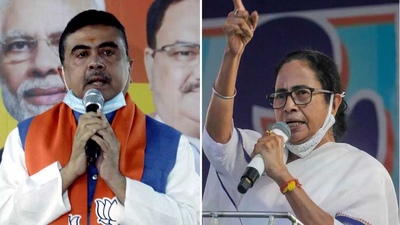
NEW DELHI: With both the Trinamool Congress (TMC) and the BJP announcing their candidate lists, the battle for Bengal has effectively begun. While the TMC has declared candidates for all 294 seats, the saffron party has so far named 144, covering roughly half the Assembly. The contest is largely being seen as a direct duel between Mamata Banerjee’s TMC and the BJP led by Prime Minister Narendra Modi.The BJP is now aiming to challenge Mamata Banerjee’s over-a-decade-long rule. Its rise in the Bengali-speaking state has been striking, from near-zero presence to becoming the principal opposition and a serious contender for power.The Modi-led campaign has consistently kept Mamata at the centre of its political attacks, targeting what remains an elusive prize—the second-largest assembly in the country — West Bengal.
2021: The BJP’s turning point
The 2021 assembly election marked a turning point. Despite projecting a landslide victory, the BJP secured 77 seats—falling short of power but registering a dramatic surge from just 3 seats earlier, and firmly establishing itself as a formidable opposition.In many ways, the 2021 election told a bigger story than Mamata Banerjee’s victory, it marked the BJP’s rise to prominence in Bengal politics.
How Bengal voted in 2021
Often called the BJP’s ‘Chanakya’, Amit Shah had confidently declared during the campaign that the party would cross the 200-mark in the 294-member assembly, coining the slogan “abki baar, 200 paar”. The results, however, told a very different story.
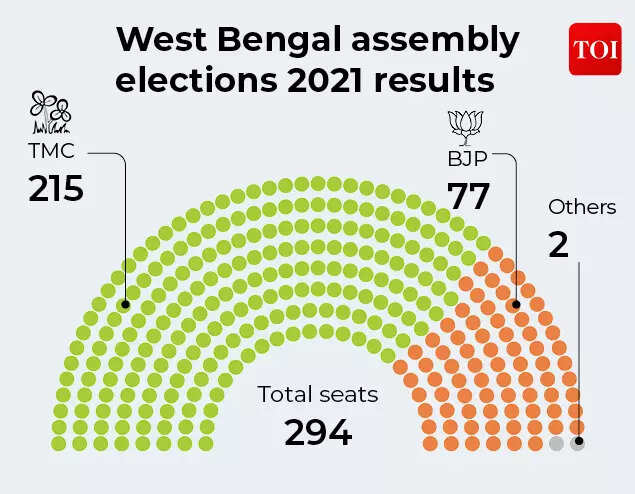
The BJP fell well short, not just of 200, but even of the halfway mark of 147 seats.The outcome also brought personal setbacks for several of the party’s prominent faces. Union minister Babul Supriyo, former Rajya Sabha MP Swapan Dasgupta, and Lok Sabha MP Locket Chatterjee were among those who lost their seats.
Voting patterns and missed calculations
Much of the BJP’s strategy had rested on consolidating Hindu votes and gaining the support of Scheduled Caste (SC) communities, while closely watching whether Muslim voters would back the TMC. In the end, the results suggested that Muslim voters largely stood with Mamata Banerjee, while SC votes did not consolidate in the BJP’s favour as expected.
From 2019 highs of BJP to 2021 setback
Compared to its strong performance in the 2019 Lok Sabha elections, the Assembly results were a setback. Back then, the BJP had won 18 out of 42 seats and led in 121 assembly segments with a vote share of 40.2%. In 2021, it secured 77 seats—44 fewer than the segments it had led in earlier and its vote share dipped slightly to 38.13%.
BJP: A decade of rapid rise
Yet, beneath the disappointment lies a remarkable story of growth. Just a decade ago, in the 2011 Assembly elections, the BJP had failed to win a single seat and managed only 4% of the vote. In 2014, it won two Lok Sabha seats with an 18% vote share. In 2016, it secured three Assembly seats with around 10% votes. From there to 77 seats and over 38% vote share in 2021 marks a dramatic rise.In the process, the BJP has replaced the Left and the Congress, who had dominated Bengal politics for decades, as the principal opposition force. While both the Left parties and the Congress drew a blank in an unprecedented outcome, smaller players like the Rashtriya Secular Majlis Party and an independent candidate managed to win a seat each.The BJP has not just gained seats; it has built an organisational base, a cadre, and a leadership structure in the state. That machinery, now firmly in place, is likely to shape its strategy for future battles, both in the Lok Sabha elections and the next assembly contest.
The Nandigram battle
Another key takeaway for the BJP was the victory of its “giant killer” Suvendu Adhikari, who defeated Chief Minister and TMC supremo Mamata Banerjee in Nandigram by a narrow margin of 1,956 votes after a fiercely contested battle.The contest had turned into a prestige fight after Mamata herself chose to challenge Adhikari on his home turf. He had gone a step further, declaring he would quit politics if he failed to defeat her by 50,000 votes. While he fell short of that ambitious claim, his eventual win, even by a slender margin proved politically significant.The defeat dealt a symbolic blow to the TMC’s larger victory and meant Mamata Banerjee would have to seek re-election to the Assembly within six months to continue as chief minister.


