
Someone buried 40,000 Roman coins 1,700 years ago and never returned. Then archaeologists uncovered the hidden treasure

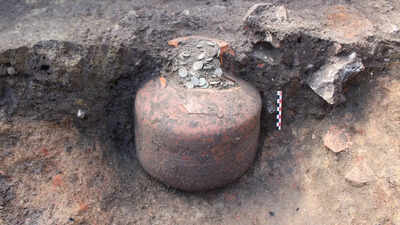
A routine archaeological excavation beneath a quiet village in northeastern France has uncovered one of the most remarkable Roman coin hoards found in recent years. Hidden for around 1,700 years, three ceramic jars packed with an estimated 40,000 bronze and copper Roman coins were discovered beneath the remains of an ancient neighbourhood in Senon. Far more than a spectacular treasure find, the discovery has revealed a forgotten chapter of Roman life, from well-planned streets and heated homes to clues about how residents managed their wealth during one of the empire’s most turbulent periods. Archaeologists believe the buried jars may not have been emergency treasure at all but something far more surprising.
40,000 Roman coins reveal a forgotten neighbourhood
The remarkable discovery was made during a preventive archaeological excavation carried out before a homeowner expanded a property in Senon, a small village in France’s Grand Est region. Led by the National Institute for Preventive Archaeological Research (INRAP), the excavation covered roughly 1,500 square metres and uncovered an entire Roman neighbourhood rather than just a cache of coins.Beneath the modern village lay a remarkably well-preserved settlement featuring stone houses, paved streets, courtyards, workshops, ovens, underground cellars and hypocaust heating systems, the Romans’ version of underfloor heating. The layout suggests it was a thriving residential and commercial district, likely inhabited by merchants, artisans and other relatively prosperous residents. Archaeologists also found evidence that Senon had existed long before the Roman conquest. The earliest remains, including pits, ditches and timber-built structures, date back to the mid-2nd century BC, when the settlement belonged to the Celtic Mediomatrici tribe. After Julius Caesar’s conquest of Gaul, the village expanded rapidly as limestone quarries supplied building materials for new homes and public structures, transforming Senon into a flourishing Roman town that remained occupied for centuries before devastating fires eventually led to its abandonment.
Why the three jars have fascinated archaeologists
The most extraordinary discovery came from three large ceramic jars carefully buried beneath the floors of Roman buildings.Unlike treasure chests hidden in haste, the jars had been sunk vertically into the ground with their openings positioned just below floor level, allowing them to remain accessible. One jar alone weighed around 38 kilograms and is estimated to have contained between 23,000 and 24,000 bronze and copper coins. A second may have held another 18,000 to 19,000 coins, while the third appears to have been emptied in antiquity, leaving only a few coins behind.Together, archaeologists estimate the three vessels originally held more than 40,000 Roman coins.
The coins date to one of Rome’s most unstable periods
The coins bear the portraits of Victorinus, Tetricus I and Tetricus II, rulers of the breakaway Gallic Empire that controlled parts of Gaul, Britain and Hispania during the political turmoil of the 3rd century AD.Although many of the coins were minted before the Gallic Empire collapsed in AD 274, archaeologists believe the jars were buried between AD 280 and AD 310, showing the currency continued circulating for decades after the empire itself disappeared.
Why archaeologists don’t believe this was hidden treasure
Researchers now think the jars may have served as household banks rather than emergency treasure hoards.Their position beneath house floors made them easy to access, and coins found stuck to the outside of two jars suggest people continued depositing and withdrawing money after the containers had been buried. Instead of concealing wealth during a crisis, the owners appear to have used the jars as long-term storage for their savings.
The fire that may explain why nobody returned
Archaeologists found evidence that the neighbourhood suffered a devastating fire during the early 4th century. Although residents rebuilt much of the area afterwards, another major blaze later destroyed the settlement.This time, the inhabitants never returned. Houses collapsed, courtyards filled with rubble and the buried jars gradually disappeared beneath layers of earth, remaining untouched for nearly 1,700 years.
More than coins were hidden beneath the village
The excavation has transformed historians’ understanding of Senon’s past. Alongside the coin hoards, researchers uncovered abandoned limestone quarries, rebuilt homes, workshops, reused architectural stone and evidence showing how the settlement evolved from a Celtic village into a flourishing Roman town before its eventual abandonment.After documenting the site using detailed maps and 3D digital models, archaeologists removed the coins for conservation and analysis before refilling the excavation so the homeowner’s construction project could continue.For archaeologists, the discovery is valuable not simply because of the sheer number of coins but because they remained in their original archaeological setting. Together, the jars, surrounding buildings and everyday objects provide an unusually detailed glimpse into how ordinary Roman residents lived, worked and managed their wealth during one of the empire’s most turbulent periods.


