
Solar panels were installed above grapevines in Italy’s Puglia, and the harvest revealed a surprising 277% jump in grape production

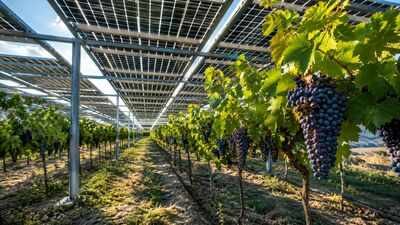
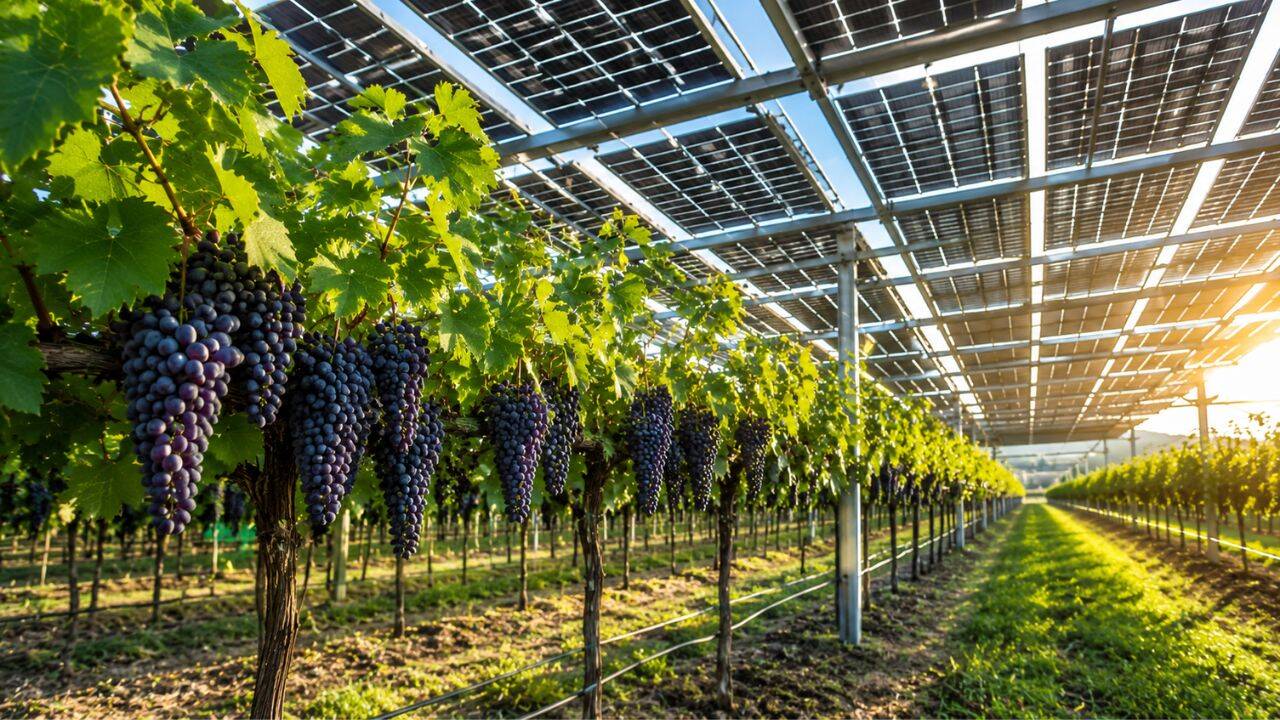
In a vineyard in Italy’s Puglia region, rows of grapevines grew beneath something more usually associated with power stations than agriculture: photovoltaic panels. The arrangement changed the amount of sunlight reaching the vines, but it also altered what was happening much closer to the ground. Soil stayed wetter, temperatures were less extreme and the air around the plants became calmer. The research published in Horticulturae by MDPI, titled ‘Exploring the Grape Agrivoltaic System: Climate Modulation and Vine Benefits in the Puglia Region, Southeastern Italy’ revealed when the grapes were harvested in 2025, vines growing under the panels produced 277% more grapes than vines exposed to full sun. The result has added an unusual dimension to the debate over how farmland might cope with hotter, drier conditions while still being used to produce food and renewable electricity.
How agrivoltaics helps grapevines grow better
Agrivoltaics is based on a fairly simple idea. Instead of treating farmland and solar generation as competing uses of land, photovoltaic panels are positioned so that crops can continue growing beneath or between them.The arrangement is particularly interesting in Mediterranean farming regions, where agriculture is already dealing with less predictable rainfall, prolonged heat, drought and periods of unusually heavy rain. Vineyards are not immune to those changes. Grapevines need sunlight, but excessive heat and water stress can affect both the quantity of fruit and how it develops.The Puglia experiment put that question into a practical setting. Researchers examined grapevines growing beneath an agrivoltaic installation and compared them with vines receiving unobstructed sunlight. They looked beyond the harvest itself, recording soil moisture, soil temperature, local weather conditions and the fruitfulness of the vines.The panels changed the growing conditions in several ways at once.
How solar panels helped grapevines produce 277% more grapes
According to the research, the most striking result was the yield. Grapevines growing under the photovoltaic panels produced 277% more grapes than those in full sun.That figure was not simply a consequence of more favourable conditions at harvest. The researchers also observed better bud fruitfulness on shaded canes, suggesting that the difference was already being reflected in the vines’ reproductive performance. The panels also helped the soil hold on to moisture. With part of the ground shielded from direct solar radiation, water was lost less rapidly, while soil temperatures were moderated.A vineyard does not necessarily benefit from the highest possible amount of heat. There is a point at which additional warmth becomes a source of stress rather than an advantage.The shade provided by the panels appears to have shifted that balance.
The vineyard’s biggest changes came from wind and atmospheric dryness
The effect was not as simple as creating a cooler pocket of air beneath the panels. Measurements showed that the photovoltaic system had little effect on air temperature. Instead, some of the more subtle changes were found in wind and atmospheric dryness.Wind speeds were lower beneath the installation. The panels also reduced the vapour pressure deficit, a measure related to how strongly the atmosphere draws moisture from plants and soil. Even if the thermometer records a similar temperature, a plant can experience very different levels of water stress depending on humidity, wind and the amount of moisture available around its leaves and roots.The agrivoltaic structure therefore acted less like a giant shade cloth and more like a change to the vineyard’s immediate microclimate. The vines still occupied the same piece of land, but the conditions surrounding them were no longer quite the same.
Grapevines received a different mix of light beneath the panels
Light is an obvious concern when solar panels are placed above crops. Grapevines need radiation for photosynthesis, and reducing direct sunlight too much could potentially work against the purpose of growing them there. The measurements from Puglia produced a more complicated picture.Spectral analysis indicated that the light reaching the vines beneath the panels had a different composition. There was an increase in UV and blue light, even though the panels reduced the overall exposure to direct sunlight.That does not mean the extra UV and blue wavelengths automatically explain the higher yield. The study points instead to a changed light environment that may influence how the vines respond and photosynthesise.The result is a reminder that agrivoltaic systems are not simply about deciding how much shade a crop can tolerate. The height, arrangement and spacing of panels can alter the light reaching plants in ways that are more complicated than a basic reduction in brightness.
Solar panels turned the vineyard into a dual harvest system
There was a second harvest taking place above the vines.The research published by MDPI reports that the photovoltaic installation generated substantial amounts of electricity, with the system producing more than 90% of the output achieved by a conventional ground-mounted solar arrangement.That is an important part of the calculation. Agrivoltaics only makes sense as a dual-use system if the agricultural land remains productive while the panels still generate a worthwhile amount of energy.A conventional solar farm can be designed primarily around electricity production. Once crops are introduced, the priorities become less straightforward. Panels have to be positioned in a way that allows farming operations to continue, while the amount and pattern of shade must remain compatible with the crop.In the Puglia trial, both functions were able to operate on the same land.
The Puglia system produced far more from the same land area
The researchers also calculated a land equivalent ratio, or LER, of 3.54 for the agrivoltaic system. The measure is useful because it looks at the combined productivity of land when it is used for more than one purpose. A value above one indicates that the combined arrangement can produce more from a given area than separate uses would when considered together.An LER of 3.54 suggests that the Puglia system made unusually efficient use of the land when agricultural and electricity production were considered together.That does not mean every vineyard would achieve the same result. Agrivoltaic performance depends on the crop, climate, panel configuration, orientation, irrigation practices and local growing conditions. What worked in southeastern Italy cannot simply be copied elsewhere and expected to produce identical numbers.Still, the result provides a useful indication of what can happen when solar infrastructure is designed around a crop rather than placed on farmland as an afterthought.
A hotter, drier Mediterranean could change the case for vineyard shading
The Mediterranean climate makes the experiment particularly relevant. Agricultural areas around the Mediterranean are already facing shifts in rainfall and increasing periods of extreme heat. Farmers are having to work with less predictable water availability while maintaining yields and crop quality.Vineyards present an interesting case because grape production depends not only on how many grapes a plant produces, but also on how those grapes develop during the season. Heat, water availability and the timing of ripening can all influence the final crop.By moderating the conditions around the vines, an agrivoltaic structure can potentially change that seasonal progression.The Puglia results do not establish that panels are universally beneficial to grapevines. They show something narrower, and perhaps more useful: under the conditions tested, partial shading was associated with substantially greater production while the vines remained part of a working solar-energy system.


