
Socrates could stand still for hours lost in thought: The story behind his unusual habit

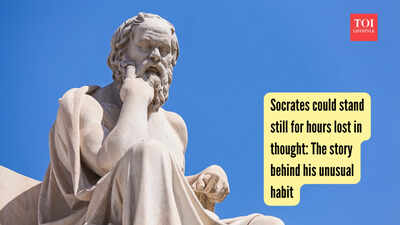
Socrates spent his life asking hard questions out loud, in the middle of crowded streets and dinner parties. But one of the strangest stories about him has nothing to do with talking.Talking about great thinkers like Socrates, we often imagine them at their best work at a desk, or pacing a quiet room somewhere, chin in hand.Rarely do we imagine them frozen mid-step in the middle of a war camp, surrounded by armed men, utterly unreachable.Yet that’s exactly the image of one of the most popular and revered names associated with clever questions and calm debate, not physical stillness.
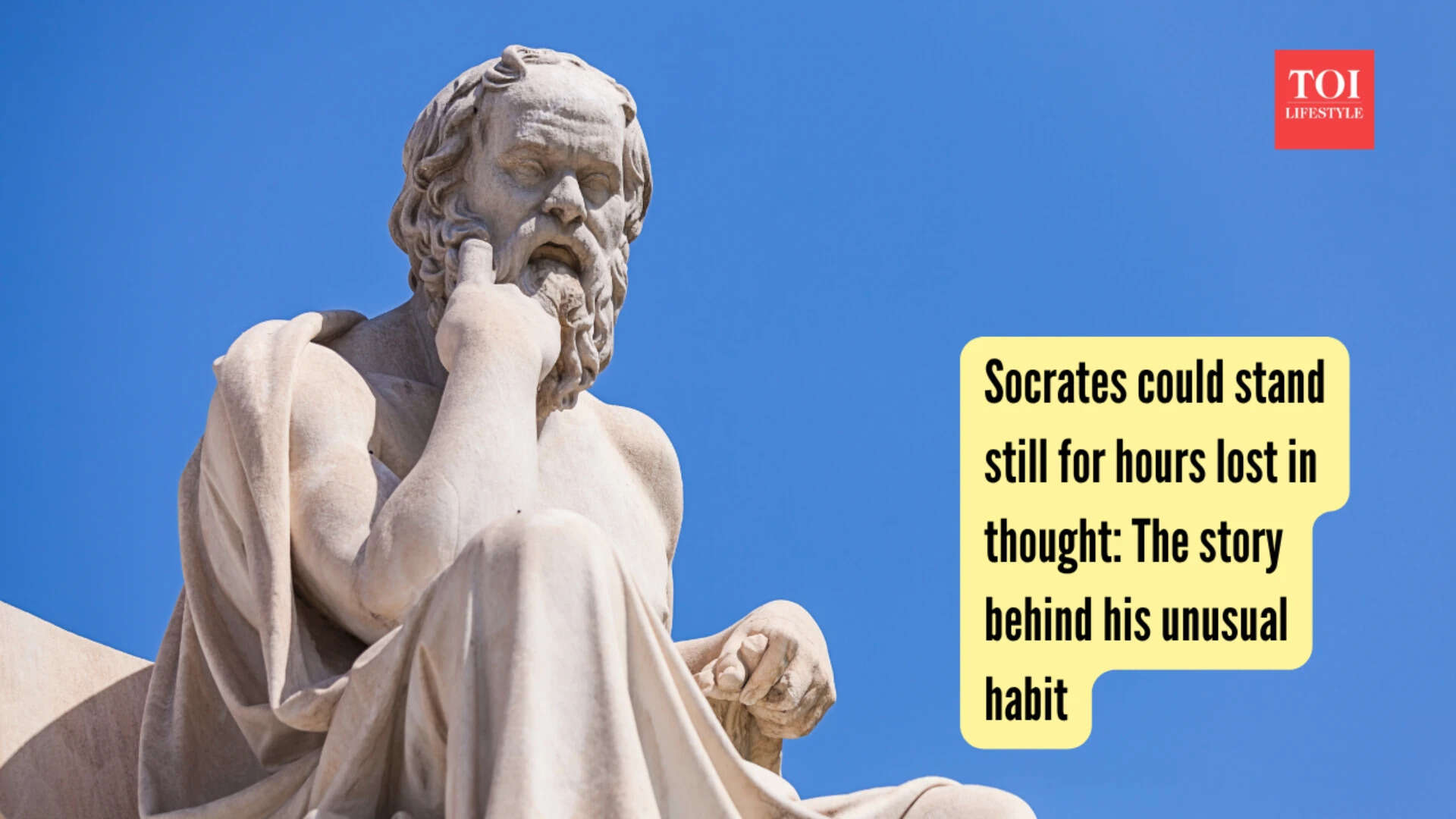
Representative Image
The night Socrates froze mid-thought
The story comes from Plato’s Symposium, where Alcibiades, a soldier and one of Socrates’ companions, describes their time together at the siege of Potidaea. One morning, according to the text, Socrates became absorbed in a problem and stood rooted in the same spot considering it from dawn onward. He simply wouldn’t move. Soldiers noticed, then gathered to watch. By nightfall, some of them dragged their bedding outside just to see if he’d still be standing there in the morning.
Socrates full day and night without moving
He was. According to Alcibiades’ account, Socrates stood in that exact spot through midday, through the evening, and straight through the night, only breaking his stillness at sunrise, when he offered a prayer before walking off as if nothing unusual had happened. That’s roughly 24 hours of complete physical stillness, reportedly without food, sleep, or conversation, and it is an image so vivid it has survived almost two and a half thousand years in one of philosophy’s most famous texts.
What was really going through his mind
Plato never tells us what problem occupied him that day, which has left the door wide open for interpretation. The traditional reading treats it as intense logical concentration, Socrates working through some knot of abstract reasoning so demanding it blocked out everything else. But it can also be read differently, seeing it less as problem-solving and more as paralysis, a man frozen by the sheer weight of his own uncertainty, unwilling to move until he found solid ground to stand on.
Was it philosophy or something physical?
Not every explanation stays in the philosophical lane. Historian Bettany Hughes, writing in The Guardian, has suggested a more clinical possibility, that these episodes may have been symptoms of catalepsy, a nervous condition marked by muscular rigidity, rather than a purely mental exercise.
An anecdote that still divides scholars
What’s notable is that the ancient sources treat this as admirable, not alarming. Alcibiades tells it as proof of Socrates’ extraordinary self-command, along with his tolerance for cold, hunger, and drink. Nobody at the time seemed to think something was medically wrong. Whether it was philosophical trance, existential doubt, or an unrecognised physical condition, the episode has become one of the most quoted and most argued-over details of Socrates’ character.


