
Scientists recreated a dinosaur nest to uncover how eggs stayed warm 70 million years ago

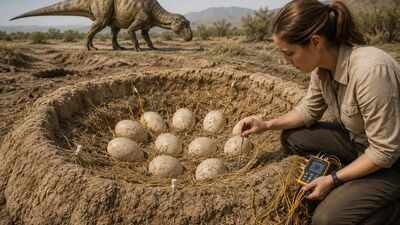
For decades, palaeontologists have puzzled over a scene preserved in rock across parts of Mongolia and China. Fossilised oviraptor dinosaurs were repeatedly found sitting over nests in a posture that looked strikingly familiar. Their forelimbs spread across the clutch, their bodies positioned above the eggs, almost as if they were brooding like modern birds.The image seemed straightforward. Yet a basic question remained unresolved. Were these dinosaurs actually warming their eggs with body heat, or were they simply guarding nests that relied on environmental warmth, According to the study published in Frontiers in Ecology and Evolution, titled “Heat transfer in a realistic clutch reveals a lower efficiency in incubation of oviraptorid dinosaurs than of modern birds”, has approached the problem from an unusual direction. Instead of relying only on fossils, researchers reconstructed a life-sized oviraptor nest, built artificial eggs, modelled the dinosaur’s body and tested how heat moved through the clutch. The results suggest that the answer lies somewhere between bird and reptile behaviour. As per the study, oviraptorids likely combined parental attendance with environmental heat rather than incubating eggs in the same way modern birds do.
The curious nest design that changed how scientists view dinosaur parenting
The challenge begins with the nest itself. Oviraptor eggs were arranged in a highly unusual pattern. Rather than being gathered in a compact cluster, they formed rings around an empty central space. In larger nests, an outer ring of eggs sat above an inner ring, separated by sediment. The eggs were elongated, partly buried and tilted at an angle, with only their upper ends exposed.As described in the paper, this architecture creates a problem for traditional bird-style incubation. Modern birds generally maintain contact with all eggs while acting as the primary source of heat. Oviraptor nests, by contrast, were structured in a way that made complete contact difficult.That raised doubts about a long-standing interpretation of the famous brooding fossils. Even if an adult sat on the nest, could it actually warm every egg effectively, To find out, the researchers decided to reconstruct the situation as realistically as possible.
Scientists recreated a life-sized nest to test dinosaur egg incubation
The team based its reconstruction on Heyuannia huangi, an oviraptor species from the Late Cretaceous. A life-sized body model was assembled using foam, wood, cloth and insulating materials to reproduce the shape of the animal’s trunk. Artificial eggs were cast to match the dimensions and thermal properties of fossil Oviraptor eggs. The researchers then arranged those eggs into realistic double-ring clutches based on fossil specimens. Heating elements beneath the model simulated body warmth. Temperature sensors were inserted throughout the eggs and nest structure. Outdoor experiments were conducted under different environmental conditions, while computer simulations tracked heat movement through the clutch.The goal was not simply to see whether the eggs became warm. The researchers wanted to understand how evenly heat was distributed and whether an attending adult could realistically function as the nest’s primary heat source.
Reconstructed dinosaur nest reveals uneven heating across oviraptor eggs
According to the study, the reconstructed adult failed to make contact with the entire clutch. The incubator only touched certain eggs in the outer ring, while eggs deeper within the nest remained beyond direct reach. That physical limitation produced uneven heating.Outer eggs positioned close to the dinosaur’s body became noticeably warmer than others. Inner eggs often experienced different temperatures despite sitting directly beneath outer-ring eggs. The arrangement created thermal gradients across the nest rather than the relatively uniform conditions typical of modern bird incubation.The researchers reported that temperature differences emerged between eggs in different parts of the clutch. In cooler conditions, these variations became particularly pronounced.As per the study, the findings do not support the idea that oviraptorids practised thermoregulatory contact incubation in the same manner as living birds.
Environmental heat helped incubate oviraptor eggs, study finds
The experiments revealed something else. Environmental warmth played a substantial role in determining egg temperatures. When the researchers simulated warmer conditions comparable to those inferred for parts of the Late Cretaceous, the differences between eggs became much smaller. Solar heating helped elevate temperatures across the clutch and reduced some of the disparities created by the nest’s unusual structure. This suggests that the adults were not solely responsible for incubation.Instead, the evidence points toward a shared system in which body heat and environmental heat worked together. The attending adult may have helped moderate temperature swings, shield eggs from thermal extremes and influence development rates, while sunlight and ambient warmth supplied much of the energy required for incubation.In practical terms, the nest appears to have functioned somewhere between the strategies used by modern birds and those used by reptiles that rely heavily on environmental heat.
How temperature variations affected oviraptor embryo growth
The study may also explain another puzzle preserved in the fossil record. Some oviraptor nests contain embryos that appear to have reached different stages of development. For years, researchers debated whether those differences reflected the order in which eggs were laid or the timing of incubation. The heat-transfer experiments suggest temperature itself may have contributed.Because eggs in different positions experienced different thermal conditions, embryos could have developed at different rates even within the same clutch. Depending on where an egg sat in relation to the attending adult and environmental heat sources, hatching could have occurred earlier or later than in neighbouring eggs.The interaction between nest structure, adult position and ambient warmth could have influenced patterns of asynchronous hatching observed in fossil specimens.
What the dinosaur nest experiment reveals about oviraptor parenting
The famous image of an oviraptor sitting over its eggs is unlikely to disappear. Fossils still show adults closely associated with their nests, indicating some level of parental involvement.What has changed is the interpretation of what that behaviour meant. Rather than acting as direct equivalents of modern brooding birds, oviraptorids may have occupied an intermediate stage in the evolution of incubation. Adults attended their nests and influenced temperatures, but environmental heat remained an essential part of the process.Seventy million years later, a nest rebuilt from foam, resin and computer models has offered one of the clearest glimpses yet into how these dinosaurs brought their young into the world. The answer turns out to be neither fully bird-like nor fully reptilian, but something uniquely their own.


