
Representative image NEW DELHI: You can eat right, exercise daily and avoid every bad habit — but your genes may still have a major say on how long you live. A major new study suggests that nearly half of human lifespan is determined by genetics, challenging the belief that lifestyle and environment shape longevity the most.Published in Science, the research shows that once deaths caused by accidents, infections and other external factors are excluded, about 55% of the human lifespan is heritable, meaning that more than half of the observed variation in longevity across a population is attributable to genetics. That is a much greater proportion than the previous estimates of 10-25%, according to the research, published on Jan 29.How much do genes decideThe findings are based on an analysis of more than a century of lifespan data from large Scandinavian twin cohorts in Denmark and Sweden. Researchers studied identical and non-identical twins raised together and apart, as well as siblings of US centenarians. Most participants were born between 1870 and 1935, a period marked by high mortality from infectious diseases and accidents.By separating such “extrinsic” deaths from those linked to biological ageing, the study found the true influence of genetics on longevity had been masked. Once these external causes were accounted for, lifespan similarities between identical twins became far stronger. It also helps explain why genetic influence on lifespan appears clearer today. As deaths from infections, violence and accidents have declined over time, role of genes in determining longevity has become more visible.Indian experts say the findings carry important public health implications. Dr Anoop Misra, chairman, Fortis C-DOC, said genetics plays a major role in biological ageing but warned that Indian conditions could blunt this advantage. “About half of human lifespan is genetically determined once external causes are excluded, but poor nutrition, air pollution, and rising diabetes and obesity can override genetic advantages and accelerate biological ageing,” he said.Dr Ambrish Mithal, group chairman, Endocrinology and Diabetes, Max Healthcare, said longevity reflects a balance between inheritance and environment. “Genetics provides a broad upper limit for lifespan, while epigenetics and lifestyle determine how close one comes to that limit,” he said, explaining that environmental factors can switch genes on or off without altering DNA itself. Scientists caution the findings do not mean that lifespan is fixed at birth. Nearly half of lifespan variation is still shaped by lifestyle, healthcare access and living conditions. However, the study suggests that genes set the biological ceiling — and the environment determines whether people reach it. Researchers say the findings could reshape debates on ageing and longevity, while reinforcing the urgency of tackling risks that shorten the biological lifespan.About the AuthorAnuja JaiswalAnuja Jaiswal is a Senior Assistant Editor at The Times of India, with an impressive 18-year career in narrative journalism. She specializes in health and heritage reporting, expertly simplifying complex health information to make it engaging and understandable for readers. Her deep dives into heritage topics are well-researched, resulting in captivating narratives that resonate with her audience. Over the years, she has worked in Chandigarh, Chhattisgarh and West UP, gaining diverse on-ground experience that shapes her storytelling.Read MoreEnd of ArticleFollow Us On Social MediaVideosTrump Announces India-US Trade Deal, Reduces Reciprocal Tariffs On Delhi To 18%; PM Modi ReactsAir India Grounds Dreamliner After Pilot Flags Fuel Control Switch Issue in London-Bengaluru Flight’Nonsense, Lies’: BJP Blasts Rahul Gandhi For Citing Ex-Army Chief Naravane’s Memoir, Oppn Hits BackChina Slams Dalai Lama’s Grammy Win, Calls It Political Manipulation Warns Against Anti-China MovesShowdown In Parliament As Rahul Gandhi Quotes Ex-Army Chief Naravane’s Book on China’Arrogant, Liar’: Bengal CM Mamata Banerjee Attacks CEC Gyanesh After SIR Meet In DelhiPak Analyst Rips Munir Over Trump Minerals Pitch And IMF Loans After US Snubs Pakistan On Pax SilicaBalochistan Crisis: Pakistan-Origin Commentator Takes Apart Islamabad, Exposes Lies On India’India Showed…’: Ex-Army Chief Naravane’s Remarks On Galwan Clash Resurface After Lok Sabha Row’Faster Than BrahMos’: DRDO Calls New Hypersonic Anti Ship Missile A Game Changer For India123PhotostoriesHow to make South Indian Beetroot and Paneer Paniyaram for breakfast at home10 best travel ideas for Valentine’s Day 2026 weekend9 comforting amla dishes ideal for winter months10 luxury bikes that blend power, precision, and prestige‘The 50’, ‘Bigg Boss’, ‘Laughter Chef’: Celebrity reality shows that never fail to entertainHrithik Roshan shares his post-workout meal photo and it is plateful of things we all loveKriti Sanon pens a special note for ‘Special Friend’ after Nupur Sanon’s Hindu wedding- See pictures8 ways to experience a different side of DelhiJustin Bieber’s performance to Lola Young’s win: Highlights from the 68th Annual Grammy Awards nightTop 10 countries in the world by GDP (2026 Projections); check India’s position123Hot PicksBudget 2026Gold Silver PricesCigarette Prices HikeIndia US TradeIncome Tax CalculatorPublic holidays February 2026Bank Holidays februaryTop TrendingSuper Bowl HalftimeMLB Trade RumorsFernando MendozaTom BradyTampa Bay LightningNHL Trade RumorsTop YouTube ChannelsRyan ClarkQuinn HughesJoel Embiid


NEW DELHI: You can eat right, exercise daily and avoid every bad habit — but your genes may still have a major say on how long you live. A major new study suggests that nearly half of human lifespan is determined by genetics, challenging the belief that lifestyle and environment shape longevity the most.Published in Science, the research shows that once deaths caused by accidents, infections and other external factors are excluded, about 55% of the human lifespan is heritable, meaning that more than half of the observed variation in longevity across a population is attributable to genetics. That is a much greater proportion than the previous estimates of 10-25%, according to the research, published on Jan 29.
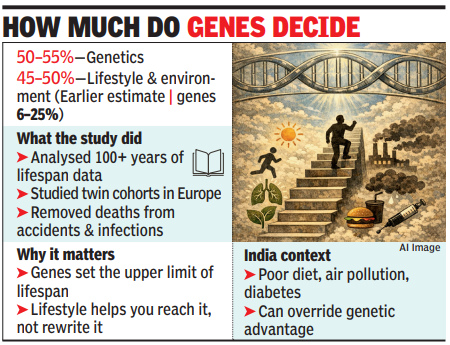
How much do genes decide
The findings are based on an analysis of more than a century of lifespan data from large Scandinavian twin cohorts in Denmark and Sweden. Researchers studied identical and non-identical twins raised together and apart, as well as siblings of US centenarians. Most participants were born between 1870 and 1935, a period marked by high mortality from infectious diseases and accidents.By separating such “extrinsic” deaths from those linked to biological ageing, the study found the true influence of genetics on longevity had been masked. Once these external causes were accounted for, lifespan similarities between identical twins became far stronger. It also helps explain why genetic influence on lifespan appears clearer today. As deaths from infections, violence and accidents have declined over time, role of genes in determining longevity has become more visible.Indian experts say the findings carry important public health implications. Dr Anoop Misra, chairman, Fortis C-DOC, said genetics plays a major role in biological ageing but warned that Indian conditions could blunt this advantage. “About half of human lifespan is genetically determined once external causes are excluded, but poor nutrition, air pollution, and rising diabetes and obesity can override genetic advantages and accelerate biological ageing,” he said.Dr Ambrish Mithal, group chairman, Endocrinology and Diabetes, Max Healthcare, said longevity reflects a balance between inheritance and environment. “Genetics provides a broad upper limit for lifespan, while epigenetics and lifestyle determine how close one comes to that limit,” he said, explaining that environmental factors can switch genes on or off without altering DNA itself. Scientists caution the findings do not mean that lifespan is fixed at birth. Nearly half of lifespan variation is still shaped by lifestyle, healthcare access and living conditions. However, the study suggests that genes set the biological ceiling — and the environment determines whether people reach it. Researchers say the findings could reshape debates on ageing and longevity, while reinforcing the urgency of tackling risks that shorten the biological lifespan.


