
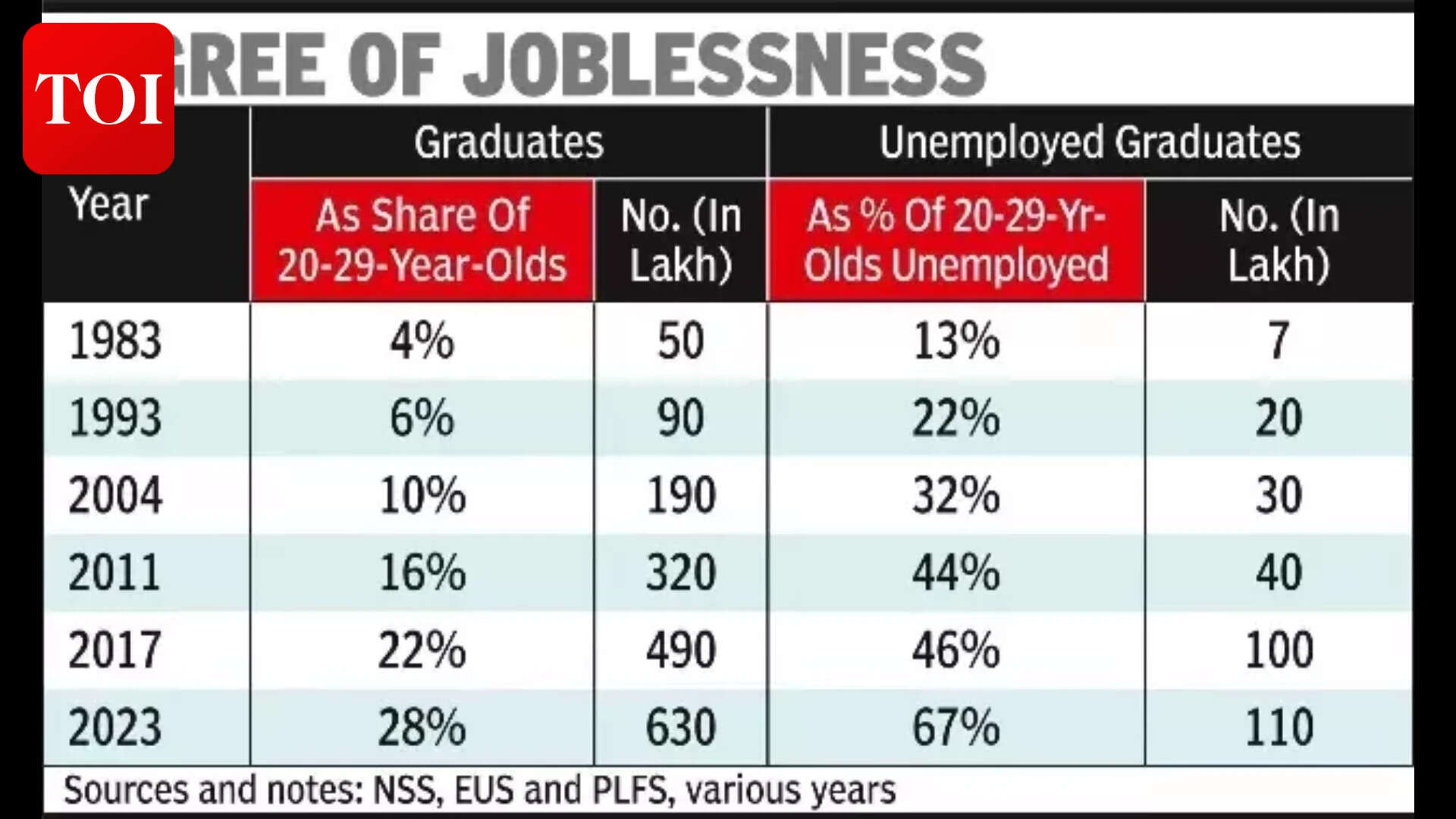
Representative image NEW DELHI: The share of graduates among unemployed youth (20-29 years of age) has more than doubled over the past two decades, at a time when India has made substantial progress in expanding access to higher education for its youth, said a report released by the Azim Premji University on Tuesday. Data showed that around 67% of unemployed youth in 2023 (around 1.1 crore) in the country were graduates, up from 32% in 2004 (30 lakh). At the same time, the share of graduates among youth has risen to 28% in 2023 (6.3 crore) from 10% in 2004 (1.9 crore). The report noted that between 2004 and 2023, approximately 50 lakh graduates were added every year, while the number of employed graduates rose by only around 28 lakh annually, out of which only 17 lakh were salaried.Israel Iran WarUS-Israel-Iran War News Live Updates: Iran calls Israeli bombing of fuel depots ‘ecocide’; Trump warns Nato over war fallout’We don’t need help!’ Trump explodes after Nato, other nations refuse to take part in Iran warAudio Details Iran Strike Aftermath: Mojtaba survives ‘Blue Sparrow’ hit; family and commanders killed “Graduate employment, therefore, has not kept pace with graduate supply,” the report titled ‘State of Working India 2026′ noted.The failure to create adequate jobs for the burgeoning population of graduates has resulted in a situation of too many graduates and too few jobs. This has also contributed to the slowdown in graduate earnings,” the report noted.It argued that there are several reasons, including concerns around employability of young graduates, their lack of experience or mismatch in skill.The report also said that there was a greater capacity among the youth to wait before finding a job, a phenomenon that included the poorer households as well, due to better income levels than earlier. Besides, the report noted that while young graduates continue to have more monthly earnings compared to the non-graduates in entry level jobs, this premium is narrowing over time. The gap between graduate and non-graduate earnings for youth increased substantially, especially between 2004 and 2011. Since 2017, however, there has been a slowdown in earnings growth for young men.The report also said that since 2017, the share of young men in education has fallen to 34% in 2024 from 38% in 2017, citing the need to support household incomes.In terms of access to higher education, the report added that financial barriers continue to restrict access, particularly in professional fields such as engineering and medicine, as the cost of pursuing these degrees often exceeds the annual per capita expenditure for poorer households. “This gap has narrowed somewhat between 2007 and 2017,” it said. The report drew on official databases going back four decades to see how youth’s participation in education and employment has changed, and the challenges and opportunities that arise in integrating them into the workforce.End of ArticleFollow Us On Social MediaVideos‘Will Maintain Exports Again’: Piyush Goyal Highlights India’s ‘Stable’ Trade Amid West Asia WarSupreme Court Strikes Down Three-Month Rule, Grants Equal Maternity Leave To Adoptive Mothers Too‘Culture Erased’ Claim Sparks Row Over Hindu Temple In Dallas Fort, Targets Indian Community OnlineIndia Urges UN Reform Amid Iran War, Seeks BRICS Unity As Conflict Divides Members’Bapu Wanted To…’: Shivraj Singh Chouhan Launches Scathing Attack On Congress Over VB-G RAM G BillNo Petrol Or Diesel Price Hike For Now Says Centre Amid West Asia Oil Market Volatility Crisis’Bundled Up And Thrown Into Jail’: Sonam Wangchuk In First Remarks After Release From NSA DetentionLok Sabha Revokes Suspension Of 8 Oppn MPs, Warns Against Placards, AI PicturesCentre Confirms All Indian Sailors, Ships Are Safe As LPG Vessels Shivalik, Nanda Devi Dock In IndiaDial PM Modi For Peace: Finland Backs India To Broker Ceasefire, Urges Trump To Call Delhi123Photostories5 reasons why people with strict parents struggle with boundaries in relationships– And how to fix itMeet 8 animals with strange noses that are not just for smellingTom Holland movies to watch before ‘Spider-Man: Brand New Day’: A complete MCU guide5 Mystical facts about Kashi Vishwanath templeFrom Sabyasachi to Gaurav Gupta: Indian designers who quietly dominated the Oscars 2026 red carpet15 die after drinking milk contaminated with ethylene glycol: How to do milk purity test and 5 other calcium-rich foods to consumeThe Great Indian Kapil Show 4 Finale: David Dhawan on Salman Khan asking him to tell Akshay Kumar not to touch him during ‘MSK’ Shoot; Kapil Sharma recalls doing Hans Baliye with wife GinniChaitra Navratri 2026: How to make Makhana Dosa for breakfast at home11 iconic Maharashtrian street foods that define regional flavours5 signs your workout routine is stressing you out instead of helping you123Hot PicksMaternity leaveBengal police reshuffleMatthew Van DykeGold rate todayIncome Tax CalculatorPublic holidays March 2026Bank Holidays MarchTop TrendingGreen card applicantsVisa Bulletin 2026Green Card HoldersUAE missile alertTulsi GabbardChief Ali LarijaniAssembly election dateBig Show rumoursSpurs Kings injury reportEid ul fitr 2026


NEW DELHI: The share of graduates among unemployed youth (20-29 years of age) has more than doubled over the past two decades, at a time when India has made substantial progress in expanding access to higher education for its youth, said a report released by the Azim Premji University on Tuesday. Data showed that around 67% of unemployed youth in 2023 (around 1.1 crore) in the country were graduates, up from 32% in 2004 (30 lakh). At the same time, the share of graduates among youth has risen to 28% in 2023 (6.3 crore) from 10% in 2004 (1.9 crore). The report noted that between 2004 and 2023, approximately 50 lakh graduates were added every year, while the number of employed graduates rose by only around 28 lakh annually, out of which only 17 lakh were salaried. “Graduate employment, therefore, has not kept pace with graduate supply,” the report titled ‘State of Working India 2026’ noted.The failure to create adequate jobs for the burgeoning population of graduates has resulted in a situation of too many graduates and too few jobs. This has also contributed to the slowdown in graduate earnings,” the report noted.It argued that there are several reasons, including concerns around employability of young graduates, their lack of experience or mismatch in skill.The report also said that there was a greater capacity among the youth to wait before finding a job, a phenomenon that included the poorer households as well, due to better income levels than earlier. Besides, the report noted that while young graduates continue to have more monthly earnings compared to the non-graduates in entry level jobs, this premium is narrowing over time.
The gap between graduate and non-graduate earnings for youth increased substantially, especially between 2004 and 2011. Since 2017, however, there has been a slowdown in earnings growth for young men.The report also said that since 2017, the share of young men in education has fallen to 34% in 2024 from 38% in 2017, citing the need to support household incomes.In terms of access to higher education, the report added that financial barriers continue to restrict access, particularly in professional fields such as engineering and medicine, as the cost of pursuing these degrees often exceeds the annual per capita expenditure for poorer households. “This gap has narrowed somewhat between 2007 and 2017,” it said. The report drew on official databases going back four decades to see how youth’s participation in education and employment has changed, and the challenges and opportunities that arise in integrating them into the workforce.


