
Representative image Despite collecting a cess specifically for health, the Centre’s spending on health is now lower than it was before the cess was imposed, both as a share of the total budget and as a proportion of the GDP.Before the health cess was introduced in 2018, the allocation for health was 2.4% of total govt expenditure in 2017-18. In the Budget Estimates for 2026-27, that is down to 1.9%. As a proportion of the GDP, the decline is from 0.28% to 0.26%. Money collected as health cess amounts to over 30% of the allocation for health and family welfare in 2026-27. Without the cess component, health would have accounted for just 1.3% of the total Budget, barely over half of the figure in 2017-18. 0.5 percentage point fall in 10 yearsWhen the health cess was introduced, the understanding was that it would boost health expenditure by topping up what the govt was already allocating. Clearly, that has not happened. Instead, cess is masking what would otherwise be a steep cut in the share of health in total Budget and in GDP. From 0.32% of the GDP in 2019, the year before Covid struck, the share has fallen to 0.27% even with the cess component. Remove the cess component and the share of health in the GDP is 0.18%. The target of the National Health Policy was 2.5% of the GDP by 2025 of which 35% was supposed to be the share of central govt, which works out to 0.9% of the GDP or Rs 3.5 lakh, over three times the current allocation.If we were to strip the cess money off the revised Budget allocation for 2025-26 which was Rs 92,926 crore, it would be Rs 78,279 crore. Do the same for the 2026-27 allocation and it falls to Rs 70,984 crore, which is 9.3% lower than the 2025-26 revised allocation without cess.We could look at it differently. If govt were to allocate the same share (2.4%) of the total Budget as it did in 2017, the allocation this year would have been Rs 1.2 lakh crore without the cess. Instead, even with cess the allocation has been just Rs 1 lakh crore.“The health and education cess flatters the health allocation without increasing allocation from the consolidated fund. Cess money flows from a reserve fund outside the regular Budget process, with no outcome monitoring requirements. Moreover, cess requires no parliamentary accountability. You create the impression of increased Budget allocation but in reality, states have no claim on cess. It is entirely the discretion of the central govt,” said economist Dr Varna Sri Raman.In 2018, then finance minister Arun Jaitley introduced the health cess, saying the 3% education cess was being increased to 4% health and education cess “in order to take care of the needs of education and health of BPL and rural families”. “Though it is assumed the additional 1% is for health, the Finance Act doesn’t prescribe how the 4% is to be divided between health and education. Central govt decides each year how much goes into Pradhan Mantri Swasthya Suraksha Nidhi (PMSSN) which is a fund created to hold the health component of the cess,” said Sri Raman. PMSSN was only created in 2021, two years after the cess was introduced.“The health cess collected from 2018-19 and 2019-20 went into the general revenues. That’s roughly Rs 20,600 crore collected in the name of health that went into general revenues with no earmarking,” she added.End of ArticleFollow Us On Social MediaVideos’India-US Trade Deal Removes Competitive Disadvantage’: Former Indian Envoy To WashingtonIndia-US Trade Deal: Trump Says India Won’t Buy Russian Oil; Rahul Gandhi Accuses PM of Selling Out’Symbol Of Negativity’: Goyal Rains Fire On Rahul Gandhi After US-India Trade Deal, Parl RuckusIndia-US Trade Deal: Moscow Contradicts Trump’s Claim On New Delhi ‘Stopping’ Russian Oil Imports’Called Me Yaar, Threw Papers’: TDP MP Tenneti Slams Eight Suspended Lok Sabha MPs’Dairy, Agriculture Protected’: Piyush Goyal Outlines ‘Historic’ US-India Trade Deal, Lauds PM ModiBudget 2026: Defence Expert Flags Committed Liabilities, Calls For Battlefield TransparencyPak Defence Minister Khawaja Asif Admits Terror Rooted In Corruption, Vindicates India In ParliamentGold, Silver Under Pressure After Peaks: Should You Invest And Hold Precious Metals Or Sell Off?India Moves To Secure Chicken’s Neck As Underground Rail Project Targets Strategic Vulnerabilities123PhotostoriesHow to make dhaba-style dal makhani at homeValentine Week 2026: Full list of important dates (7 Feb to 14 Feb) plus bonus Anti Valentine Week 2026 datesThere are only 6 countries whose names begin with the letter ‘U’Archana Puran Singh and Parmeet Sethi’s love story: From a ‘fling’ to three decades of togethernessA look into Yuvika Chaudhary and Prince Narula’s parenthood journeyFrom prehistoric sharks to unusual flowers: What’s inside the world’s largest cave6 common mistakes people make while cooking cauliflower6 luxury electric cars that blend sustainability with opulence‘Love Island’, ‘Love Is Blind’, and more: Reality TV couples who are still together in 2026Diljit Dosanjh makes Indian-style Masala Bread Omelette and we are absolutely loving it123Hot PicksBudget 2026Gold Silver PricesCigarette Prices HikeIndia US TradeIncome Tax CalculatorPublic holidays February 2026Bank Holidays februaryTop TrendingArtemi PanarinMLB Trade RumorsAyesha CurryKayla NicoleNHL Injury UpdatePuka NacuaRussell WilsonDenver Nuggets vs Detroit PistonsNikola JokicGold Riyadh Players Ranking

Despite collecting a cess specifically for health, the Centre’s spending on health is now lower than it was before the cess was imposed, both as a share of the total budget and as a proportion of the GDP.Before the health cess was introduced in 2018, the allocation for health was 2.4% of total govt expenditure in 2017-18. In the Budget Estimates for 2026-27, that is down to 1.9%. As a proportion of the GDP, the decline is from 0.28% to 0.26%. Money collected as health cess amounts to over 30% of the allocation for health and family welfare in 2026-27. Without the cess component, health would have accounted for just 1.3% of the total Budget, barely over half of the figure in 2017-18.
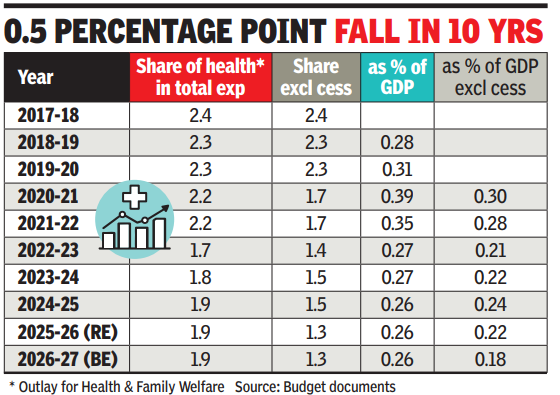
0.5 percentage point fall in 10 years
When the health cess was introduced, the understanding was that it would boost health expenditure by topping up what the govt was already allocating. Clearly, that has not happened. Instead, cess is masking what would otherwise be a steep cut in the share of health in total Budget and in GDP. From 0.32% of the GDP in 2019, the year before Covid struck, the share has fallen to 0.27% even with the cess component. Remove the cess component and the share of health in the GDP is 0.18%. The target of the National Health Policy was 2.5% of the GDP by 2025 of which 35% was supposed to be the share of central govt, which works out to 0.9% of the GDP or Rs 3.5 lakh, over three times the current allocation.If we were to strip the cess money off the revised Budget allocation for 2025-26 which was Rs 92,926 crore, it would be Rs 78,279 crore. Do the same for the 2026-27 allocation and it falls to Rs 70,984 crore, which is 9.3% lower than the 2025-26 revised allocation without cess.We could look at it differently. If govt were to allocate the same share (2.4%) of the total Budget as it did in 2017, the allocation this year would have been Rs 1.2 lakh crore without the cess. Instead, even with cess the allocation has been just Rs 1 lakh crore.“The health and education cess flatters the health allocation without increasing allocation from the consolidated fund. Cess money flows from a reserve fund outside the regular Budget process, with no outcome monitoring requirements. Moreover, cess requires no parliamentary accountability. You create the impression of increased Budget allocation but in reality, states have no claim on cess. It is entirely the discretion of the central govt,” said economist Dr Varna Sri Raman.In 2018, then finance minister Arun Jaitley introduced the health cess, saying the 3% education cess was being increased to 4% health and education cess “in order to take care of the needs of education and health of BPL and rural families”. “Though it is assumed the additional 1% is for health, the Finance Act doesn’t prescribe how the 4% is to be divided between health and education. Central govt decides each year how much goes into Pradhan Mantri Swasthya Suraksha Nidhi (PMSSN) which is a fund created to hold the health component of the cess,” said Sri Raman. PMSSN was only created in 2021, two years after the cess was introduced.“The health cess collected from 2018-19 and 2019-20 went into the general revenues. That’s roughly Rs 20,600 crore collected in the name of health that went into general revenues with no earmarking,” she added.


