
Rahul Gandhi’s new playbook shows a more persistent style, combining youth outreach, and surprise street protests. NEW DELHI: “I will not leave till you lodge an FIR. He has pellet injuries on his body, has lost his eye, and we are demanding an FIR for this… I will go outside and sit there until you lodge an FIR. I will sit for 10 days, 20 days, 30 days, 50 days, six months. Your government will have a problem.”There is a visible change in how Rahul Gandhi pushes through issues now. The leader of the opposition in Lok Sabha has a new weapon in his political arsenal: impromptu protests.For the second time in a month, the Congress leader caught the authorities and, to some extent, even his own party, off guard by taking to the streets of the national capital without prior warning.When Rahul reached the DCP office in Delhi on August 21 demanding an FIR for Sahil Lohchab, who sustained pellet injuries during the July 20 student protest, it was Act 2 of his new playbook of street protest politics.When the cops dilly-dallied, Rahul refused to budge and staged a sit-in protest outside the police station. Priyanka Gandhi Vadra joined him. Congress leaders began arriving. Rapid Action Force personnel were deployed outside. A visit to a police office turned into a high-voltage political stand-off and, after six hours of dharna, Delhi Police registered an FIR over the pellet firing.’Politics of anarchy’The BJP reacted sharply, calling Rahul’s sit-in the ‘politics of anarchy’. It argued that an FIR relating to the wider July 20 incident already existed, an investigation was under way and the Congress leader was turning police procedure into a political spectacle.For Lohchab, however, there was a sense of relief. His family had been trying to get his complaint registered since August 14, shuttling between police stations. The 19-year-old, who underwent surgery after pellets struck his right eye, finally had an FIR registered after Rahul’s intervention.For years, opponents have labelled Rahul Gandhi a ‘part-time politician’ who would raise an issue and then disappear. But this incident reinforced something that has changed about Rahul’s tactics over the past year. He is no longer content merely to raise an issue. He increasingly wants to enter it, stay with it and, if necessary, physically occupy the space.Rahul’s new playbookThe first display of this surprise street-politics instinct had come a month earlier during the NEET student protests.On July 21, a day after police used force to stop thousands of students attempting a ‘Sansad Chalo’ march over exam irregularities, Rahul suddenly headed towards Prime Minister Narendra Modi’s residence and staged a sit-in.Police had reportedly made arrangements anticipating a Congress protest at Vijay Chowk. Rahul went to Lok Kalyan Marg instead. The move caught security officials by surprise. Rahul, Priyanka and several other opposition leaders were later detained. The visual that immediately took over the news was hard to ignore: the leader of opposition physically struggling with police officers, being dragged away and getting a nosebleed in the chaos.Police personnel detained Rahul Gandhi during a sit-in protest near the Prime Minister’s residence.That was Act 1.It came at a time when the Congress was desperately trying to make its presence felt, with Abhijeet Dipke’s Cockroach Janata Party and climate activist Sonam Wangchuk already leading a massive student protest against the NEET paper leak.Congress had initially kept its distance, preferring to run its own youth outreach campaign, ‘Chhatron Ki Goonj’. But people asked a simple question: If Congress claimed to support student issues, why was it missing from the biggest student movement in Delhi?When the July 20 Jantar Mantar protest took place and massive outrage erupted over police action against the student protesters, Rahul’s approach changed.The very next day, he moved to the front lines. He stood outside the Prime Minister’s house, Congress leaders visited injured students, and police action became a major national debate. Rahul took the issue to Parliament and continued raising the pitch over injuries suffered by students.And when the larger protest began to recede from the headlines, Rahul stayed with one part of it: the use of pellet guns. He has affirmed that his party will keep raising the issue and demand accountability.Rahul’s changing styleThe first major image makeover was when Rahul Gandhi embarked on the ‘Bharat Jodo Yatra’ from Kanyakumari to Kashmir in 2022. Sceptics and rivals wondered if he would complete the journey. By the time he reached Kashmir months later, after walking thousands of kilometres in his now-signature white T-shirt, one charge had become considerably harder to make: that Rahul was unwilling to put in the physical grind that it takes in politics.The yatra, on its own, did not help the Congress much. What it did was change the way Rahul himself was seen as a politician.For months, people saw him walking with the common public rather than delivering a scripted speech from a podium. He met farmers, labourers and students, stopped for conversations, entered homes and sat and ate with people.The yatra experience also laid the foundation for his growing social media popularity. His online presence today increasingly relies on short, conversational exchanges that can easily travel as reels and clips.The second shift came in 2024, when he became the leader of the opposition.Since then, we have seen a more combative Rahul Gandhi. Whether one agrees with his politics or the issues he raises, he appears considerably more comfortable with confrontation than he once did.Congress’s protests in the Parliament complex have also become more visual and experimental under Rahul.He repeatedly joined opposition MPs at Makar Dwar over the Election Commission’s SIR exercise in Bihar, with MPs carrying ‘vote chori’ placards and demanding its rollback. The protest later moved beyond the Parliament gates, with Rahul and other opposition leaders marching towards the Election Commission before being stopped and detained.Rahul provokes ministers across the aisle and stays for the response. He takes an argument from the street into Parliament and, increasingly, carries it back outside again. This is also a part of his renewed Gen Z outreach. ‘Chhatron Ki Goonj’If Bharat Jodo helped Rahul Gandhi build the image of a politician who was more approachable and willing to listen, ‘Chhatron Ki Goonj’ took that idea to a more specific audience: Gen Z.The programme began in Kota, where students spoke about paper leaks, recruitment delays, coaching pressure and the uncertainty around exams and jobs. The format was less rally and more conversation, with Rahul asking questions, listening, and allowing individual experiences to shape the message. That made the outreach more relatable.His latest Pune edition further widened that outreach by putting young women at the centre of the conversation.Rahul’s call to ‘smash the patriarchy’ in a stadium full of women was a strong message that came with its own set of criticism. He spoke about different social expectations for boys and girls, cited the ‘Manusmriti’ while attacking the BJP-RSS worldview, and told women that they ‘belong’ to themselves rather than to fathers, husbands or sons, triggering huge applause from the crowd.While a large section of people lauded the focus on women, the ruling BJP immediately trained its guns on him and asked him to induct women ministers into the Karnataka cabinet, where Congress is in power.The Jharkhand dilemmaEven as Rahul attacked the BJP over issues such as NEET and paper leaks, major student protests broke out in Jharkhand, where the Congress shares power in the Hemant Soren government. Soon after the Jantar Mantar agitation ended, aspirants took to the streets in Ranchi over alleged irregularities and paper leaks in JPSC and JSSC examinations.This time, the criticism was closer to home. Protesters targeted not just chief minister Hemant Soren but Rahul as well, pointing to the irony of him speaking for students nationally while Congress was part of the ruling alliance in Jharkhand. Effigies of both leaders were burnt, and Rahul was accused of not speaking about Jharkhand issues.Eventually, Rahul was forced to react and intervene. He asserted that Congress supported students protesting peacefully and said that dialogue was the only way forward.Rahul wrote an open letter to Soren, requesting the CM to personally meet the students and hear out their grievances. The Jharkhand government later accepted the students’ demands.The episode helped Rahul avoid the charge of being selective on student issues, but it also showed the challenge of claiming an issue as your own: once you do that, you can be questioned even when the government under fire is run by an ally.Has Rahul evolved as a leader?For years, Rahul Gandhi was accused of being an inconsistent politician who would raise important issues and then disappear from the conversation. Rivals branded him as an “entitled leader” and took “Pappu” digs at him.Join conversationView All Comments →Share your thoughts in the commentsInsightfulAgreeDisagreeSkepticalConcerningPromisingWorth ReadingBig DevelopmentPost CommentBe respectful · TOI community guidelinesBut the old image of Rahul as a reluctant politician is certainly harder to sustain today. From Bharat Jodo to ‘Chhatron Ki Goonj’, fiery parliamentary confrontations and surprise dharnas, he appears more comfortable playing on the front foot.However, his latest round of street protests seems to stem from the crisis that the opposition in general and Congress in particular faced as Abhijeet Dipke-led CJP mobilised youth in large numbers and forced the government to make Dharmendra Pradhan resign as Union education minister.Rahul has made his presence felt, but we will have to wait and see if his new politics translates into electoral success for the Congress.Get the latest India News and Live updates. Download the TOI app.About the AuthorPriyanka MukherjeePriyanka Mukherjee is an Assistant News Editor at The Times of India, where deadlines rarely slow down. Often juggling breaking news, long-form explainers and the everyday chaos of the newsroom, she is usually managing stress, chasing clarity and trying to log off on time (rarely successful). She also cares deeply about stories around women’s rights and social change, while two very opinionated dogs make sure she never truly switches off.Read MoreEnd of ArticleFollow Us On Social MediaVideos’Ram-Ram Inside, Fish Feast Outside’: Yogi Adityanath Slams Cong Over Ayodhya Event; Ajay Rai ReactsDisplaced By Ken-Betwa Project, Tribals Now Struggle For Basic Amenities | ExclusiveIn Leaked Audio, Lawrence Bishnoi’s Aide Goldy Brar Claims He Killed Hardeep Nijjar In Canada‘Watching Your Every Move’: Fresh Threat Letter Targets Kashmiri Pandits In J&KChennai Murder Mystery: Woman’s Remains Found on Tamil Nadu Express, Police Hunt Couple in Odisha’No Full Press Conference’: US Envoy Gor On India’s ‘No Questions’ Request Before Modi-Trump Meet‘Represented India In 3 Nations’: Former Envoy Flags ‘Trouble Establishing Citizenship’ During SIRJaish Rebuilds Bahawalpur Complex Struck By India During Op Sindoor’India Can Attract Global Talent With Your Help’: PM Modi Meets Space Startups On National Space DayDelhi Cops Attacked With Chilli Powder & Bricks In Mukundpur; 17-Year-Old Arrested123PhotostoriesSreeleela’s fish-cut saree just gave traditional draping a seriously savage upgrade10 beautiful baby girl names that capture a sense of wonderOptical Illusion personality test: What you spot first reveals the weak spot in your love lifePriyanka Chopra’s architectural black gown just proved that red-carpet glam needs a little more attitude10 of the world’s most colourful birds to see in the wildBlood sugar running high despite cutting back on sweets? Doctors explain 5 nutrients that may help your body manage glucose better‘She believed in the old nuskhas’: Karisma Kapoor reveals her grandmother’s skincare secret that the Kapoor clan adoptedArchana Puran Singh’s son Aaryamann Sethi set to buy his first luxurious house; tells Parmeet, ‘Your son is becoming a man’Kiara Advani’s black velvet saree is proof that gothic glam looks better with a desi twistFrom water filters to kitchen bowls: 5 practical uses of coconut shell123Hot PicksTCS laptop monitoring softwareSchool holiday todayKPMG AustraliaTrump tariffIOB LBO recruitmentNEET UG 2026Parandur airportSIM card rulesNEET PG 2026 admit cardTop TrendingMumbai Auto Driver ProtestReservation Hatao AndolanKurukshetra MurderPunjab SIRCM VijayDelhi ITO AccidentChennai MurderGodhani Water Plant Gas LeakAmravati Hospital FireAston Martin Crash

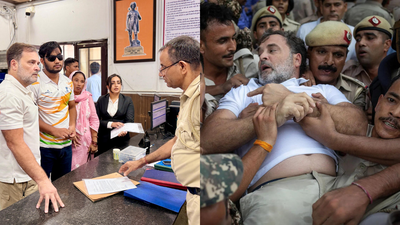
NEW DELHI: “I will not leave till you lodge an FIR. He has pellet injuries on his body, has lost his eye, and we are demanding an FIR for this… I will go outside and sit there until you lodge an FIR. I will sit for 10 days, 20 days, 30 days, 50 days, six months. Your government will have a problem.”There is a visible change in how Rahul Gandhi pushes through issues now. The leader of the opposition in Lok Sabha has a new weapon in his political arsenal: impromptu protests.For the second time in a month, the Congress leader caught the authorities and, to some extent, even his own party, off guard by taking to the streets of the national capital without prior warning.When Rahul reached the DCP office in Delhi on August 21 demanding an FIR for Sahil Lohchab, who sustained pellet injuries during the July 20 student protest, it was Act 2 of his new playbook of street protest politics.When the cops dilly-dallied, Rahul refused to budge and staged a sit-in protest outside the police station. Priyanka Gandhi Vadra joined him. Congress leaders began arriving. Rapid Action Force personnel were deployed outside. A visit to a police office turned into a high-voltage political stand-off and, after six hours of dharna, Delhi Police registered an FIR over the pellet firing.
‘Politics of anarchy’
The BJP reacted sharply, calling Rahul’s sit-in the ‘politics of anarchy’. It argued that an FIR relating to the wider July 20 incident already existed, an investigation was under way and the Congress leader was turning police procedure into a political spectacle.For Lohchab, however, there was a sense of relief. His family had been trying to get his complaint registered since August 14, shuttling between police stations. The 19-year-old, who underwent surgery after pellets struck his right eye, finally had an FIR registered after Rahul’s intervention.For years, opponents have labelled Rahul Gandhi a ‘part-time politician’ who would raise an issue and then disappear. But this incident reinforced something that has changed about Rahul’s tactics over the past year. He is no longer content merely to raise an issue. He increasingly wants to enter it, stay with it and, if necessary, physically occupy the space.
Rahul’s new playbook
The first display of this surprise street-politics instinct had come a month earlier during the NEET student protests.On July 21, a day after police used force to stop thousands of students attempting a ‘Sansad Chalo’ march over exam irregularities, Rahul suddenly headed towards Prime Minister Narendra Modi’s residence and staged a sit-in.Police had reportedly made arrangements anticipating a Congress protest at Vijay Chowk. Rahul went to Lok Kalyan Marg instead. The move caught security officials by surprise. Rahul, Priyanka and several other opposition leaders were later detained. The visual that immediately took over the news was hard to ignore: the leader of opposition physically struggling with police officers, being dragged away and getting a nosebleed in the chaos.
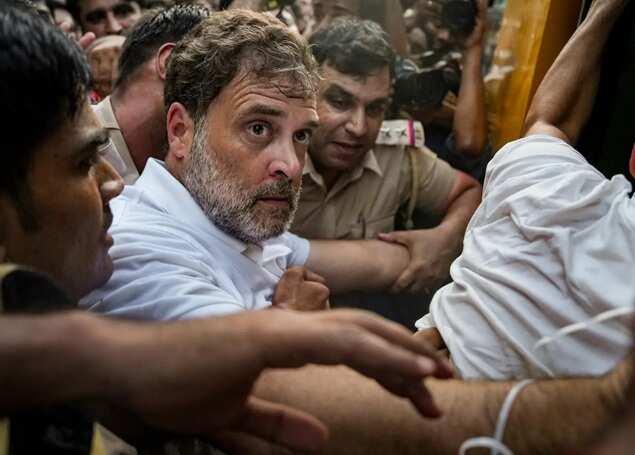
Police personnel detained Rahul Gandhi during a sit-in protest near the Prime Minister’s residence.
That was Act 1.It came at a time when the Congress was desperately trying to make its presence felt, with Abhijeet Dipke’s Cockroach Janata Party and climate activist Sonam Wangchuk already leading a massive student protest against the NEET paper leak.Congress had initially kept its distance, preferring to run its own youth outreach campaign, ‘Chhatron Ki Goonj’. But people asked a simple question: If Congress claimed to support student issues, why was it missing from the biggest student movement in Delhi?When the July 20 Jantar Mantar protest took place and massive outrage erupted over police action against the student protesters, Rahul’s approach changed.The very next day, he moved to the front lines. He stood outside the Prime Minister’s house, Congress leaders visited injured students, and police action became a major national debate. Rahul took the issue to Parliament and continued raising the pitch over injuries suffered by students.And when the larger protest began to recede from the headlines, Rahul stayed with one part of it: the use of pellet guns. He has affirmed that his party will keep raising the issue and demand accountability.
Rahul’s changing style
The first major image makeover was when Rahul Gandhi embarked on the ‘Bharat Jodo Yatra’ from Kanyakumari to Kashmir in 2022. Sceptics and rivals wondered if he would complete the journey. By the time he reached Kashmir months later, after walking thousands of kilometres in his now-signature white T-shirt, one charge had become considerably harder to make: that Rahul was unwilling to put in the physical grind that it takes in politics.The yatra, on its own, did not help the Congress much. What it did was change the way Rahul himself was seen as a politician.For months, people saw him walking with the common public rather than delivering a scripted speech from a podium. He met farmers, labourers and students, stopped for conversations, entered homes and sat and ate with people.The yatra experience also laid the foundation for his growing social media popularity. His online presence today increasingly relies on short, conversational exchanges that can easily travel as reels and clips.The second shift came in 2024, when he became the leader of the opposition.Since then, we have seen a more combative Rahul Gandhi. Whether one agrees with his politics or the issues he raises, he appears considerably more comfortable with confrontation than he once did.Congress’s protests in the Parliament complex have also become more visual and experimental under Rahul.He repeatedly joined opposition MPs at Makar Dwar over the Election Commission’s SIR exercise in Bihar, with MPs carrying ‘vote chori’ placards and demanding its rollback. The protest later moved beyond the Parliament gates, with Rahul and other opposition leaders marching towards the Election Commission before being stopped and detained.Rahul provokes ministers across the aisle and stays for the response. He takes an argument from the street into Parliament and, increasingly, carries it back outside again. This is also a part of his renewed Gen Z outreach.
‘Chhatron Ki Goonj’
If Bharat Jodo helped Rahul Gandhi build the image of a politician who was more approachable and willing to listen, ‘Chhatron Ki Goonj’ took that idea to a more specific audience: Gen Z.The programme began in Kota, where students spoke about paper leaks, recruitment delays, coaching pressure and the uncertainty around exams and jobs. The format was less rally and more conversation, with Rahul asking questions, listening, and allowing individual experiences to shape the message. That made the outreach more relatable.His latest Pune edition further widened that outreach by putting young women at the centre of the conversation.Rahul’s call to ‘smash the patriarchy’ in a stadium full of women was a strong message that came with its own set of criticism. He spoke about different social expectations for boys and girls, cited the ‘Manusmriti’ while attacking the BJP-RSS worldview, and told women that they ‘belong’ to themselves rather than to fathers, husbands or sons, triggering huge applause from the crowd.While a large section of people lauded the focus on women, the ruling BJP immediately trained its guns on him and asked him to induct women ministers into the Karnataka cabinet, where Congress is in power.
The Jharkhand dilemma
Even as Rahul attacked the BJP over issues such as NEET and paper leaks, major student protests broke out in Jharkhand, where the Congress shares power in the Hemant Soren government. Soon after the Jantar Mantar agitation ended, aspirants took to the streets in Ranchi over alleged irregularities and paper leaks in JPSC and JSSC examinations.This time, the criticism was closer to home. Protesters targeted not just chief minister Hemant Soren but Rahul as well, pointing to the irony of him speaking for students nationally while Congress was part of the ruling alliance in Jharkhand. Effigies of both leaders were burnt, and Rahul was accused of not speaking about Jharkhand issues.Eventually, Rahul was forced to react and intervene. He asserted that Congress supported students protesting peacefully and said that dialogue was the only way forward.Rahul wrote an open letter to Soren, requesting the CM to personally meet the students and hear out their grievances. The Jharkhand government later accepted the students’ demands.The episode helped Rahul avoid the charge of being selective on student issues, but it also showed the challenge of claiming an issue as your own: once you do that, you can be questioned even when the government under fire is run by an ally.
Has Rahul evolved as a leader?
For years, Rahul Gandhi was accused of being an inconsistent politician who would raise important issues and then disappear from the conversation. Rivals branded him as an “entitled leader” and took “Pappu” digs at him.
Share your thoughts in the comments
Be respectful · TOI community guidelines
But the old image of Rahul as a reluctant politician is certainly harder to sustain today. From Bharat Jodo to ‘Chhatron Ki Goonj’, fiery parliamentary confrontations and surprise dharnas, he appears more comfortable playing on the front foot.However, his latest round of street protests seems to stem from the crisis that the opposition in general and Congress in particular faced as Abhijeet Dipke-led CJP mobilised youth in large numbers and forced the government to make Dharmendra Pradhan resign as Union education minister.Rahul has made his presence felt, but we will have to wait and see if his new politics translates into electoral success for the Congress.


