
Quote of the day by Stephen Hawking: “I have lived with the prospect of an early death for the last 49 years. I’m not afraid of death, but I’m in no hurry to die” – the secret to living fully despite uncertainty

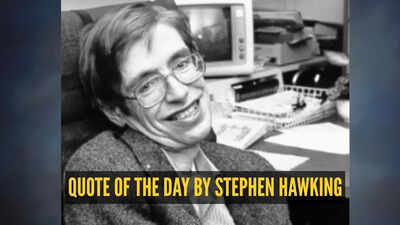
Today’s quote of the day comes from Stephen Hawking, the theoretical physicist who spent more than five decades living with a diagnosis that was originally expected to kill him within two years. He said, “I have lived with the prospect of an early death for the last 49 years. I’m not afraid of death, but I’m in no hurry to die. I have so much I want to do first.” The words came from a 2011 interview with The Guardian, by which point Hawking had already outlived his original prognosis by decades. Rather than framing his illness as a tragedy, he described it almost as a fact of scheduling, something he had simply learned to live alongside while continuing to do the work that mattered to him.
Quote of the day by Stephen Hawking
“I have lived with the prospect of an early death for the last 49 years. I’m not afraid of death, but I’m in no hurry to die”
Where and when Stephen Hawking said this
Hawking gave this answer to The Guardian in May 2011, when he was 69 years old, in response to a question about what he feared about death. By then, he had lived with amyotrophic lateral sclerosis, commonly known as ALS or motor neurone disease, for almost half a century, since being diagnosed at the age of 21 while a graduate student at Cambridge.Doctors at the time gave him roughly two years to live. The prospect of dying young was not an abstract fear for Hawking. It was a concrete number he had been carrying since his early twenties, one that kept being revised as he continued to outlive every estimate given to him.
Understand the meaning behind the quote by Stephen Hawking
The quote separates two things that are often treated as the same: fear of death and reluctance to die. Hawking is drawing a clear line between them. He is not claiming to have made peace with mortality by pretending it does not matter, and he is not claiming to feel no urgency about his remaining time either. He is saying something more specific, that the absence of fear does not remove his desire to keep living and working for as long as possible.That distinction matters because it reframes what it means to live with a serious illness. Hawking is not describing calm acceptance in the sense of giving up on ambition. He is describing a decision to keep pursuing unfinished work precisely because time remains valuable, regardless of how much or how little of it he had left.
Decades of outliving a two-year prognosis
What makes this quote land with real weight is the length of time behind it. Hawking did not say this shortly after his diagnosis, when defiance might be expected from anyone facing bad news. He said it 49 years later, after living through the steady physical decline that ALS brings, the loss of his ability to walk, and eventually the loss of his natural speech, which he regained only through a computerised speech synthesiser.Across those decades, he continued producing some of the most significant work in theoretical physics, including his research on black holes and the origins of the universe, and became one of the most recognisable scientists in the world. His life became a rare, extended case study in exactly the tension his quote describes, an ongoing negotiation between limited time and an unwillingness to let that limitation define what he attempted.
Why this outlook resonates far beyond illness
Very few people will ever live with a decades-long terminal prognosis the way Hawking did, but the underlying idea in his quote applies more broadly than that. Almost everyone operates with some version of limited time, whether that limitation comes from health, age, circumstances or simply the fact that nobody has an unlimited number of years available to them.Hawking’s answer suggests a specific way of relating to that limitation. Rather than either denying it or being consumed by it, he treated it as a reason to keep working on what he considered worthwhile. The urgency in “I have so much I want to do first” is not panic. It is closer to focus, a clear sense of priorities sharpened by an awareness that time was not guaranteed.
How to apply Stephen Hawking’s quote in daily life
A practical way to use this quote is to ask yourself, honestly, what you would keep doing if you knew your time for it was limited, and then notice whether you are actually spending your time that way. Most people already sense which pursuits matter most to them. The harder part is protecting time for those pursuits instead of letting them get pushed aside by whatever feels urgent in the moment but matters less in the long run.This does not require a health scare or a dramatic wake-up call to put into practice. It simply requires borrowing Hawking’s framing: acknowledging limited time without being paralysed by it, and using that awareness to be more deliberate about how you spend the time you do have.
Other famous quotes by Stephen Hawking
- “My expectations were reduced to zero when I was 21. Everything since then has been a bonus.”
- “Remember to look up at the stars and not down at your feet.”
- “We should seek the greatest value of our action.”
- “Although I cannot move and I have to speak through a computer, in my mind I am free.”
Read together with today’s quote, these lines show a consistent thread running through how Hawking spoke about his own limitations, treating them as conditions to work within rather than reasons to stop working at all.That thread is really the most useful thing to take from his life beyond the physics itself. Hawking never pretended his illness was easy, and he never claimed to have transcended the fear or frustration that came with it. What he modelled instead was a practical discipline: keep working, keep asking questions, and let the shortage of time sharpen your focus rather than shrink your ambitions.


