
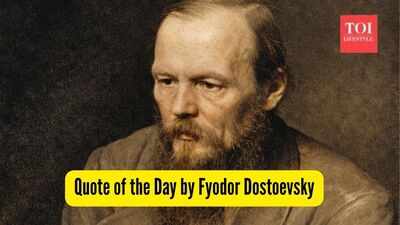
Quote of the Day by Fyodor Dostoevsky, “Pain and suffering are always inevitable, the really great men must…”

Few writers have explored the depths of the human mind more deeply than Fyodor Dostoevsky . His novels are not stories but psychological journeys into guilt, faith, suffering, morality, freedom and redemption. Over 140 years after his death, his writings still impact literature, psychology, philosophy and even neuroscience. Philosophers such as Friedrich Nietzsche admired him, psychologists such as Sigmund Freud considered him to be one of the greatest psychologists of the human psyche.Childhood and Early LifeFyodor Mikhailovich Dostoevsky was born on November 11, 1821 in Moscow, Russia, in a middle class family. His father was a military doctor who worked in a hospital for the poor. His mother was a gentle and religious woman who encouraged her children to read. Dostoevsky grew up near a charity hospital and was exposed to poverty, sickness and human suffering from his childhood. These experiences would later become themes in his novels. He liked to read the classics by William Shakespeare, Miguel de Cervantes, Walter Scott and Russian authors, including Alexander Pushkin. After his mother died of tuberculosis and his father mysteriously died a few years later, Dostoevsky entered the St Petersburg Military Engineering Academy. He graduated successfully but he was not interested in engineering. But literature was his passion.The Start of His Literary CareerDostoevsky’s first novel, Poor Folk, was published in 1846 when he was 25. It was a touching story of two poor people exchanging letters. The novel garnered instant critical acclaim and launched him as a promising new voice in literature. But after an early success he fell into political troubles. Dostoevsky was exposed to liberal ideas, joining a discussion group that debated censorship and social reforms under Tsar Nicholas I . In 1849 the government arrested the group’s members on charges of plotting against the state. The punishment was terrible.Dostoevsky and others were sentenced to death. On the day of execution they were taken out to the firing squad. At the very last moment before the execution a messenger arrived with the news that the Tsar had commuted their sentences. It had been a psychological punishment, staged as an execution. Dostoevsky was sentenced to four years of hard labour in a Siberian prison camp and then to compulsory military service instead of death. This near-death experience changed his outlook on life forever.Siberia: The Point of No ReturnDostoevsky later wrote of his years in Siberia that they were brutal and illuminating. He lived among murderers, thieves and political prisoners, and came to know the worst of human cruelty, but also unexpected kindness and resilience. During this time he was allowed to read only the Bible, which strengthened his Christian faith. His imprisonment convinced him that in every human being there is a possibility of redemption even in the worst criminal. Many scholars think that this experience is the foundation of his mature philosophy and writing.His Best WorksWhen he was released, Dostoevsky entered the most productive period of his career. His works are:Notes from Underground (1864) Considered by many to be the first existentialist novel, it explores alienation, self-destruction and the irrationality of human behaviour.Crime and Punishment (1866) The novel, one of his most famous, tells the story of Raskolnikov, a poor student who murders a pawnbroker because he thinks that extraordinary people are allowed to commit crimes for a greater good. The novel deals with guilt, conscience, justice and redemption.The Idiot, 1869The protagonist Prince Myshkin is innocence and compassion in a corrupt society. Dostoevsky questions whether there can be any real goodness in the real world.1872. DevilsA political novel about radical ideology, extremism and moral deca…The Karamazov Brothers (1880)This is regarded by many as his greatest work . It deals with issues of faith , free will , morality , family conflict , and the existence of God . It is still one of the greatest novels ever written.Writing Style of DostoevskyDostoevsky changed the novel by paying attention not to the external events, but to the inner life of his characters. There are a few signature traits to his style.Depth of psychologyWhat Dostoevsky gives us are not heroes and villains in black and white, but people who are deeply conflicted. His characters are always fighting guilt, fear, pride, love and faith. This psychological realism had an impact on later writers and thinkers around the world.Dynamic emotionalityHis stories are full of dramatic emotional conflicts, sudden revelations, moral crises, and spiritual transformations.The world’s been changed by himDostoevsky’s influence extends beyond literature. His work helped shape modern psychology, well before psychology became an academic discipline. Sigmund Freud appreciated his insights into guilt and the unconscious mind. His exploration of morality and freedom was praised by philosophers including Friedrich Nietzsche. Nietzsche famously said of him, ‘Dostoevsky is the only psychologist from whom I have anything to learn.’ His influence on modern literature was recognised by writers such as Franz Kafka, Albert Camus, Jean-Paul Sartre, Ernest Hemingway and Virginia Woolf.His novels are still taught in universities around the world today because they ask universal questions about what it means to be human. Quote of the DayQuote of the Day, by Fyodor Dostoevsky, “Pain and suffering are always inevitable for a large intelligence and a deep heart. The really great men must, I think, have great sadness on earth”This quote is from Crime and Punishment. Dostoevsky is reflecting one of the central philosophical ideas of the novel. It was written more than 150 years ago and is still remarkably relevant. Here “large intelligence” does not mean a high IQ, but a person who thinks hard about life. Such people see details that others cannot see. They are constantly asking questions about justice, morality, suffering and human behaviour. The more you understand wiser you become but also more anxious as intelligent people often see problems that are not easily solved. A “deep heart” is a heart that goes deep in empathy and emotional sensitivity. Such people feel pain not only their own, but the pain of others. Compassion is taxing emotionally because caring so much opens us to disappointment, grief, and heartbreak. “Pain and suffering are inevitableDostoevsky doesn’t glorify suffering, or say that sadness is somehow good. Those who understand life more fully, he says, cannot avoid being touched by its tragedies. They see injustice, death, isolation, poverty and human weakness. This consciousness naturally brings sadness. By “great men” Dostoevsky means men of extraordinary moral, intellectual or spiritual depth, not merely men of fame or power. History is full of examples. Leaders like Mahatma Gandhi went to jail and made sacrifices. Despite personal hardship, scientists like Marie Curie gave their lives to difficult work. Humanitarians often bear the emotional weight of seeing suffering while trying to alleviate it. Greatness in this sense involves responsibility, not comfort. “Great sadness on earth” This last phrase implies that those who love mankind cannot altogether escape sorrow. Their pain is that they know this, and they know this, and they know this. But Dostoevsky also thought suffering could bring compassion, humility and spiritual growth. In many of his novels, the characters become better people not because life gets easier, but because hardship teaches them empathy and resilience.Modern society places a lot of pressure on us to be happy, successful and positive all the time. Social media is full of pictures of perfect lives, so carefully curated. Dostoevsky takes a more realistic view. He reminds us that intelligence often poses hard questions, not easy answers. Compassion can be painful, because when you care, you feel. You feel the struggles of other people. Along with that, the quote has hope. It indicates that sadness is not a sign of weakness or failure. Instead it can be a sign of a thinking mind, a compassionate heart and an honest engagement with the complexities of life.Fyodor Dostoevsky changed literature by plumbing the darkest depths of the human soul. His own life had known suffering and redemption, blighted by poverty, jail, disease, gambling addiction and personal tragedy. He did not shy away from the dark realities of life, he faced them with a singular honesty. His famous quote is a reminder that wisdom and compassion come with an emotional cost. Those who think and feel are more likely to grieve because they can see the imperfections of the world more readily. But Dostoevsky never thought suffering was meaningless. Pain for him could be a path to compassion, moral development, and a deeper understanding of what it means to be human.A hundred years after his death, his words still ring true because they express a timeless truth: the greatest strength is often found not in avoiding suffering, but in allowing suffering to deepen our humanity.


