
Quote of the Day by Confucius, “When you see a worthy person, endeavor to emulate him. When you see an unworthy person, then….”

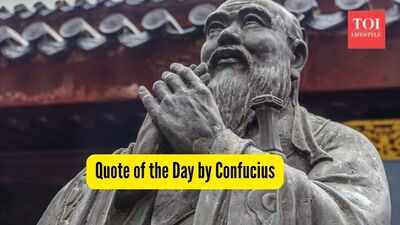
Confucius is one of the most famous and impactful thinkers in history. His teachings have shaped the cultures, governments, educational systems, and moral values of China, Korea, Japan, Vietnam, and many other parts of Asia. His ideas still inspire people today who seek wisdom about relationships, leadership, learning and self-improvement. Many philosophers were busy with abstract theories, but Confucius was of the opinion that a better society starts with better individuals. His teachings emphasised honesty, kindness, humility, discipline, respect for others and lifelong learning. Life of ConfuciusConfucius was born in 551 BCE in the state of Lu in present-day Shandong Province, China. His name was Kong Fuzi, or Master Kong. He lived during the Spring and Autumn period, which was marked by political disorder, wars between competing states, and a decline in moral values. Confucius was left an orphan at a tender age and his family was in modest financial circumstances. His mother believed in education, even if they were not rich. Confucius was extraordinarily curious as a child. He enjoyed studying history and rituals, poems, music and the legacy of former rulers who inspired him with their wisdom and virtue in government.Unlike many of his contemporaries, Confucius believed that education should not be limited to the wealthy and the elite. He admitted students from various social backgrounds, provided that they were ready to learn. The notion that talent and character were of greater account than birth was revolutionary in its day. Confucius held several government positions as he grew older. He wanted rulers to put his ideas of ethical governance, justice and public service into practice. He was in high administrative positions for a brief period, but political infighting kept him from carrying out many of his reforms.Disappointed, but not disheartened, Confucius spent many years travelling from state to state in China with his disciples, offering advice to kings and officials. Few rulers accepted his ideas during his lifetime, but he continued to teach because he believed the moral principles would win through in the end. He died in 479 BCE at the age of 72, unaware that his teachings would become one of the world’s greatest philosophical traditions.His philosophyConfucius was not so much concerned with the mysteries of the universe as with the practical question of how people ought to live together. His answer was character of morality. He thought discipline, education, and self-reflection could make any person better. Confucius thought that a society would be peaceful if people were virtuous.His philosophy comprises a few basic principles
- Ren (benevolence or humaneness): That is kindness, compassion and empathy for others. It was the greatest moral virtue in the eyes of Confucius.
- Li (proper conduct): Harmony in families and communities is achieved through respectful behaviour, good manners, traditions, and social responsibility.
- Yi (righteousness): People should do what is morally right, not what is personally profitable.
- Xin (trustworthiness): Being honest and keeping your word are important to building strong relationships.
- Xiao (filial piety): Honouring parents, elders and ancestors makes families and society stronger.
Together, these values provided a framework for ethical living that would affect generations to come.Contributions towards educationOne of the greatest legacies of Confucius was the revolution of education. At a time when formal learning was usually only for aristocrats, he said that anybody who wanted to learn ought to be given the opportunity to study. This belief helped to lay the foundation for merit-based education in China. His way of teaching was different from the usual methods. He urged that students be required to question, discuss, observe and reflect rather than just memorise facts. He thought that wisdom consisted in understanding, and not in repeating what one knows. Many later Chinese civil service exams ( designed to select government officials on the basis of knowledge, rather than family background ) were heavily influenced by Confucian thought. His emphasis on life-long learning is very much on point today. As Confucius said, ” Learning without thought is labour lost ; thought without learning is perilous. ” Knowledge should be combined with critical thinking .Impacts on the government and the societyConfucius thought leaders should rule by virtue rather than fear. He believed that the common people would naturally follow the example of rulers who governed with honesty and humanity. He believed that the quality of a leader was more in his moral character than in his military strength or harsh laws. Chinese emperors have built their government on Confucian principles for centuries. Officials were to display integrity, learning, fairness and responsibility. His influence spread beyond politics. Confucian ideals influenced family relationships, educational institutions, business ethics and social customs throughout East Asia. Even today, leadership experts still refer to his ideas, including empathy, accountability and leading by example.Worldwide impactConfucius was from ancient China , but his ideas have spread around the world. His teachings have been translated into hundreds of languages and are taught in schools, universities, business programs and leadership courses around the world. Many of the modern concepts like emotional intelligence, servant leadership, ethical management, continuous learning and personal accountability are akin to the themes that Confucius spoke about more than two millennia ago. His influence is felt in diplomacy, corporate leadership, and education, where respect, cooperation, and integrity remain core values.Quote of the DayOne of the most iconic lines of Confucius are, “When you see a worthy person, endeavor to emulate him. When you see an unworthy person, then examine your inner self.”This quote is surprisingly practical advice for self-improvement. The first sentence is that we should learn from admirable people. When we see a man who is honest, generous, disciplined, courageous, patient, or wise, we should not be envious or contemptuous, says Confucius. Instead, we should ask, What can I learn from this person?Each role model is an opportunity to get better. The second sentence is more profound still. When we meet someone who behaves badly – maybe they are dishonest, arrogant, impatient or selfish – our first reaction is to criticise them. But Confucius asks us to do something much harder. Instead of just looking at the faults of others, we should be asking ourselves if we have the same weaknesses in our own lives.Maybe we have been impetuous. Perhaps we have been unfair to other people. Maybe we have been loose with our words. When we make criticism a mirror of ourselves, we are better people. The quote doesn’t say to dismiss bad behaviour or act like bad behaviour is good. Instead it reminds us that every encounter is an opportunity to learn. Good people inspire us by their example and difficult people teach us humility and honest self-examination.Today the comparison is often the matter of life. Social media lures us into envying the successful and condemning the mistakes of others too quickly. But Confucius offers a healthier alternative. We should learn from each experience instead of comparing ourselves with others. If someone passes through discipline, learn discipline. Be kind to people who are kind to you. If someone is mean to you, take that as an opportunity to learn not to make the same mistakes.This attitude encourages growth, not judgement, all the time. It also helps to develop emotional maturity. It turns out that those who regularly reflect on their own behaviour are more compassionate, self-aware and resilient.Confucius was much more than an ancient philosopher. He was an educator who felt that enduring social change starts with the individual character. His ideas changed education, influenced governments and contributed to the moral foundations of civilisations for more than two thousand years. And he says in his famous quote that every person we meet can be a mirror. The admirable challenge us to be better; the imperfect, to reflect on our own character, honestly and humbly.


