
Quarries were once dug out for rocks and minerals, but abandoned sites can slowly fill with plants, water and wildlife

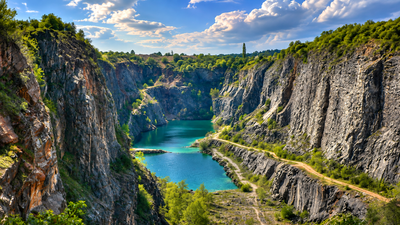
For decades, quarries have been places where the landscape was deliberately cut, blasted and reshaped for industry. Rock was extracted, hillsides were carved away and deep pits were left behind once the material was no longer economically useful. But when the machinery finally stops, the story of a quarry does not necessarily end.Across the world, abandoned extraction sites can begin undergoing another transformation. Vegetation colonises exposed ground, water can collect in excavated depressions and animals may begin using habitats that did not exist before industrial activity. What was once an intensely disturbed industrial landscape can gradually acquire ecological value.This transformation is the subject of Katia Talento, Miguel Amado and José Carlos Kullberg’s 2020 review, ‘Quarries: From Abandoned to Renewed Places,’ published in Land. The researchers examine what happens to industrial pits after exploitation ends and argue that abandoned quarries should not simply be viewed as damaged or useless landscapes. With appropriate recovery and management, they can become places for biodiversity, recreation, conservation and other forms of sustainable reuse.
From industrial excavation to an entirely different landscape
A working quarry is designed around extraction. Its slopes, floors, access roads and drainage systems are shaped according to industrial requirements rather than ecological ones. The result can be a landscape that looks dramatically different from what existed before mining began.Once extraction stops, however, those industrial priorities disappear. The enormous pit remains, but its purpose has changed. Without constant excavation and heavy machinery, natural processes can begin to operate across the site. Rainwater can accumulate in depressions, wind and animals can transport seeds, and plants can gradually establish themselves on disturbed surfaces.Talento, Amado and Kullberg describe this as part of a broader problem created by abandoned industrial pits around the world. Human activity has fundamentally altered the original morphology of these landscapes, leaving behind what the researchers describe as a “new” landscape that society often treats as empty or degraded. Their review asks a different question: what can these transformed places become?
Why abandoned quarries can become valuable habitats
The ecological potential of a former quarry comes partly from its unusual physical structure. A large excavation can contain steep rock faces, shallow areas, deeper depressions, exposed mineral surfaces and pockets of vegetation at different stages of succession. If water accumulates, the site may also develop aquatic environments alongside terrestrial ones.That combination can create a patchwork of habitats within a relatively small area. Instead of being ecologically uniform, the former industrial site can contain multiple microenvironments. Different plants and animals can occupy different parts of the landscape depending on soil depth, moisture, exposure and vegetation cover.This does not mean every abandoned quarry automatically becomes a thriving ecosystem. The researchers stress that the future of such sites depends on their individual characteristics and on how they are managed. Some require active restoration, while others may be better suited to allowing ecological processes to develop with limited intervention.
Nature does not erase the quarry, it transforms it
One of the most interesting aspects of quarry recovery is that nature does not necessarily return the landscape to its original condition.The rock has already been removed. The contours have changed. In some cases, water bodies may occupy spaces that were once part of a solid hillside. The resulting ecosystem can therefore be something new rather than a recreation of the landscape that existed before extraction.That distinction is important. Talento and her colleagues argue that abandoned quarries should be considered in terms of reconversion and recovery, rather than simply being treated as scars that must be hidden. Their review examines different approaches to quarry reuse and proposes a framework for understanding recovery methods, with biodiversity, geodiversity, environmental control and sustainability among the major considerations.In other words, an industrial landscape does not necessarily have to be returned to exactly what it was before humans altered it. It can be given another ecological or social purpose.
The surprising value of landscapes people once considered damaged
This changes the way an abandoned quarry can be viewed. At first glance, a giant excavation may seem like evidence of environmental destruction, and its creation may indeed have involved substantial disturbance. But the same physical features produced by extraction can later provide opportunities for ecological recovery.This is why quarry restoration has become an important part of discussions about sustainable land management. Instead of leaving industrial pits as unmanaged spaces, planners can assess their geology, vegetation, water conditions and surrounding landscape before deciding what form of recovery makes the most sense.Some sites may be restored primarily for biodiversity. Others may support recreation, cultural uses or landscape regeneration. The researchers’ review highlights this diversity rather than proposing a single solution for every quarry.
A former quarry can become part of the landscape again
The transformation of an abandoned quarry is therefore less about nature simply “taking back” a place and more about a new relationship forming between geology, vegetation, water and human planning.What began as an industrial void can become a landscape with its own ecological identity. That is the larger lesson highlighted by the authors of the previously mentioned study. Quarries are created to extract value from the ground, but once extraction ends, the land itself can acquire a different kind of value. Rather than being regarded only as leftover industrial spaces, abandoned pits can become opportunities for ecological recovery and sustainable reuse.The machinery may have disappeared, but the landscape keeps changing. And in the silence left behind by industry, nature can begin writing the next chapter.


