
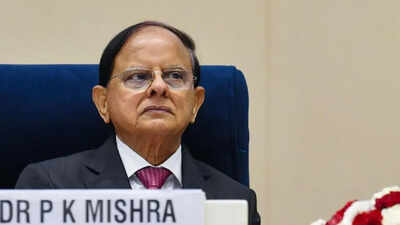
Principal secretary to PM PK Mishra NEW DELHI: India must increasingly build an “antifragile system” that emerges stronger through uncertainties and disruptions, principal secretary to PM, PK Mishra said on Saturday while highlighting that the nature of risks and vulnerability is changing. He also stressed on the need to “introspect and analyse” why all ideas and insights known and often talked about are not implemented and delivered on ground.Mishra’s observations at the golden jubilee celebrations of National Institute of Urban Affairs (NIUA) are significant in the light of multiple global disruption since the Covid-19 pandemic, including the current West Asia conflict, that have impacted nations and the chronic governance issue of gap between ideas and implementation on ground.Country’s top bureaucrat said that disruptions are no longer isolated or temporary and they can cascade rapidly across sectors, institutions and economies. “This requires us to think differently about development itself where resilience must be understood as the capacity to anticipate, absorb, adapt, transform and increasingly build antifragile systems that emerge stronger through uncertainty and change,” Mishra said.He said that as cities remain at the forefront of climate related stresses, future urban development must focus on proactive planning, nature-based solutions, green infrastructure and sustainable urban systems to build resilient, inclusive and climate sensitive cities.Mishra added while traditional approaches often focus on ‘bouncing back’ after disruption, the emerging paradigm requires systems that can learn, adapt, and emerge stronger through disruption, moving towards bouncing forward and increasingly becoming antifragile systems. “The objective today is not only recovery but building stronger institutions, infrastructure and governance systems capable of managing future shocks and uncertainties,” he added.Highlighting how implementation of ideas remains a challenge, he said, “The issues of implementation and effective delivery of services need deeper research because we see people always talk about this can be done, this should be done but the question always is how it can be done, why it is not being done. I think these are some of the challenges which possibly should be the focus of research.”Urban affairs secretary Srinivas Katikithala said India’s journey towards a developed nation requires cities to be planned not only for growth, but also for resilience, sustainability and long-term adaptability.Get the latest India news and live updates. Download the TOI App.End of ArticleFollow Us On Social MediaVideosCong Leaders Demand Accountability, Apology From US After Three Indian Sailors Killed In StrikeRubio Tells EAM All Vessels Must Follow US Orders In Hormuz; India Protests Death Of 3 MarinersKalyan Banerjee Targets Rebel TMC Leaders: ‘If TMC Wins In 2029, Will They Resign?’Joint Tribes’ Council Accuses Kuki Cadres Of Killing Six Naga Captives, Seeks Immediate ArrestsCentre’s High-Level Committee On Demographic Changes Begins Work With Focus On Border RegionsYogi Orders FIR Over Remarks on Akhilesh’s Daughter, Says No Insult Against Women Is AcceptableHyderabad Cadet Nidhi Makes History With AIR 6, Fulfills Father’s Dream Of Serving The NationAssam Notifies New Excise Rules With Stricter Liquor Norms And Support For Indigenous BeveragesGovernment Appoints Lt Gen Dhiraj Seth As Next Army Chief, To Take Charge On June 30India, France Expected To Deepen Defence Cooperation With Focus On Submarines And Fighter Jets123Photostories6 most prestigious residential neighbourhoods in Thane for homebuyersNot every cancer begins with pain: Doctors reveal the everyday symptoms people often ignore for too longCrossover of Imtiaz Ali’s characters: Director says at a dinner table, ‘Geet will make bad order; Tara will help’ – Exclusive7 social skills that can help children become confident and make friends easily5 ancient temples in Karnataka that are architectural marvelsLong before becoming the world’s first trillionaire, Elon Musk survived on hot dogs and oranges for $1 a day in CanadaWhat people who stay healthy into their 80s do differently every day5 signs life’s hardest phase is finally behind you5 animals that are often called the world’s dumbestHave you done the “sun test” before investing in a house123Hot PicksHardeep SinghUS Trade DealBullet Train ProjectBeijing ProtestYogi AdityanathPM ModiSpaceX IPORohit SharmaFortnite Gold Sprite Power Hour Start TimingTop TrendingAsha Sharma Net WorthUPSC Prelims ResultSpaceX IPOFIFA World Cup 2026Women T20 World CupPune Techie SuicideAbhishek BanerjeeComedian PranitTMC Leader Kunal GhoshCBSE Class 10 Second Board Result

NEW DELHI: India must increasingly build an “antifragile system” that emerges stronger through uncertainties and disruptions, principal secretary to PM, PK Mishra said on Saturday while highlighting that the nature of risks and vulnerability is changing. He also stressed on the need to “introspect and analyse” why all ideas and insights known and often talked about are not implemented and delivered on ground.Mishra’s observations at the golden jubilee celebrations of National Institute of Urban Affairs (NIUA) are significant in the light of multiple global disruption since the Covid-19 pandemic, including the current West Asia conflict, that have impacted nations and the chronic governance issue of gap between ideas and implementation on ground.Country’s top bureaucrat said that disruptions are no longer isolated or temporary and they can cascade rapidly across sectors, institutions and economies. “This requires us to think differently about development itself where resilience must be understood as the capacity to anticipate, absorb, adapt, transform and increasingly build antifragile systems that emerge stronger through uncertainty and change,” Mishra said.He said that as cities remain at the forefront of climate related stresses, future urban development must focus on proactive planning, nature-based solutions, green infrastructure and sustainable urban systems to build resilient, inclusive and climate sensitive cities.Mishra added while traditional approaches often focus on ‘bouncing back’ after disruption, the emerging paradigm requires systems that can learn, adapt, and emerge stronger through disruption, moving towards bouncing forward and increasingly becoming antifragile systems. “The objective today is not only recovery but building stronger institutions, infrastructure and governance systems capable of managing future shocks and uncertainties,” he added.Highlighting how implementation of ideas remains a challenge, he said, “The issues of implementation and effective delivery of services need deeper research because we see people always talk about this can be done, this should be done but the question always is how it can be done, why it is not being done. I think these are some of the challenges which possibly should be the focus of research.”Urban affairs secretary Srinivas Katikithala said India’s journey towards a developed nation requires cities to be planned not only for growth, but also for resilience, sustainability and long-term adaptability.


