
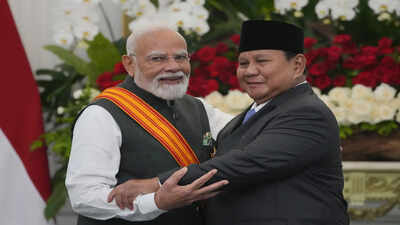
Prime Minister Narendra Modi and Indonesian President Prabowo Subianto embrace after a joint press conference following their meeting, at Merdeka Palace in Jakarta, Indonesia. (AP Photo/PTI) India and ASEAN giant Indonesia signed over a dozen agreements in key areas like maritime security, critical minerals and defence, including major contracts for supply of BrahMos supersonic cruise missile system and Astra air-to-air missiles to Indonesia, while reaffirming their commitment to jointly developing the strategic Sabang port overlooking the entrance to the Strait of Malacca. The agreements followed PM Narendra Modi’s meeting with Indonesian President Prabowo Subianto which, Modi said, marked a golden chapter in ties that would have a positive influence on the 21st-century world and humanity at large. Cognisant of the southeast Asian country’s close ties with Palestine, Modi said in his media remarks India “steadfastly” supports a 2-state solution. Addressing the Indonesian Parliament later, he also said India stands for growth, not expansionism. Prabowo backed joint development of the Sabang Port in Aceh – located barely 100 nautical miles from India’s southernmost Indira Point in the Great Nicobar Island – as a strategic link between the 2 countries, which India sees a key element of shared interests in the Indo-Pacific that the 2 sides agreed to work on in 2018. Both leaders recognised in a joint statement that a project like Sabang — spanning cruise and marine-tourism facilities, maritime industries (ship-repair and shipbuilding), and shore-based services supporting offshore energy activities in the Andaman Sea — would foster links between Andaman and Nicobar Islands (ANI) and Sumatra that could contribute to generating investment, employment, transfer of technology and shared regional prosperity. Modi said that growing trust between the 2 countries had led to stronger defence, security, and maritime cooperation and, as close maritime neighbors, India and Indonesia would boost cooperation in the blue economy, port development, and maritime trade. He also announced that the Indian and Indonesian Coast Guard Coast will work closely to ensure maritime safety and security in the Indian Ocean. Modi and Prabowo welcomed the elevation of defence cooperation, including through cooperation on BrahMos Missile System, which is co-owned by India and Russia, and India’s indigenous Astra air-to-air missile cooperation agreement. BrahMos and Astra agreements, worth hundreds of millions of dollars, can help India expand its defence exports and at the same time elevate its profile as a possible counterweight to China’s dominance in the region. The defence agreements come on the back of concerted attempts by both sides for collaboration in defence industry and technology. Modi and Prabowo agreed to further expand collaboration between the defence industries for joint production of equipment, technology transfer, technical assistance and capacity building. In their discussions on the West Asia situation, the leaders underlined the importance of de-escalation and reiterated that all issues must be resolved through dialogue and diplomacy. They also shared, according to the joint statement, the same view to respect freedom of navigation, global flow of commerce and the implementation of transit passage through the Strait of Hormuz, in accordance with international law including the provisions of UNCLOS. Modi said that resilience of technology supply chains holds massive significance, as the 2 countries signed crucial agreements in critical minerals and steel. “A new partnership is beginning between our companies concerning stainless steel and rare earth magnets,” said Modi, while also announcing an agreement for technology collaboration covering areas like AI, telecom, and Digital Public Infrastructure (DPI). The PM announced an MoU for cooperation between the election commissions that he said would enhance “democratic cooperation” between the 2 countries, while lauding the synergy in India and Indonesia’s outlook towards the Indo-Pacific and the focus on ASEAN. “India has always accorded special importance to ASEAN Centrality. In this era of global turmoil, India firmly believes that the role of dialogue and diplomacy has become more critical than ever,” said the PM, adding that a golden era was knocking on the doors of both the countries. “We have a shared culture in our history, mutual trust in our present, and shared prosperity in our future,” he said. Seeking deeper economic integration, the leaders also called for a timely conclusion of ASEAN India Trade in Goods Agreement (AITIGA) review for a “balanced, mutually beneficial and facilitative trade environment, followed by a comprehensive deeper bilateral trade engagement to enhance bilateral trade”.Get the latest India news and live updates. Download the TOI App.End of ArticleFollow Us On Social MediaVideosWATCH: PM Modi Invokes ‘Kuch Kuch Hota Hai’; Indonesia President Admits He Has Indian DNAIndia Set To Supply Two BrahMos Missile Batteries Worth $200 Million To Indonesia: ReportThree Dead, Several Missing After Massive Landslide Near Kerala Tunnel Project SiteWhy Does Mumbai Flood Every Monsoon? The Real Reasons Explained’New Species Of Girgit’: Yogi Adityanath Slams SP, Congress Over Ram Temple Donation Theft CaseWho Was Jaswant Singh Khalra? The Story Behind Diljit Dosanjh’s SatlujThree Key Aides Of Union Minister Bhupender Yadav Relieved In Sudden Administrative MovePM Modi Announces IIM Bangalore’s First Overseas Campus In Indonesia’s Malang RegionSupreme Court Rejects DMK Plea Against Vijay Remarks In Karur Stampede InvestigationPM Modi’s Indonesia Visit : BrahMos, Astra Missiles, Critical Minerals And Big Outcomes123PhotostoriesFrom recalling a 72-hour non-stop Kasautii Zindagii Kay shoot to being a strict mom to Palak: When Shweta Tiwari spoke about her journey5 powerful spiritual practices that can strengthen your soul from withinSobhita Dhulipala brings heritage weaves back into the traditional spotlight with this gorgeous Gadwal sareeDid you know your vitamin D3 could be coming from sheep’s wool? Doctor explains how it happens and why it matters5 rain-soaked destinations in India that are magical during the monsoon, and how to explore them safelyFrom SUVs to Hatchbacks: What your rental car choice says about your travel personalityHow to visit 3 countries in one trip: These unique places let travellers cross international borders on footFrom nostalgia to kitchen essentials: Foods NRIs often pack before leaving IndiaEver wondered why popcorn explodes? The science behind your favourite movie snackInside India’s oldest libraries that survived the Mughal era and the British rule123Hot PicksArgentina vs EgyptLionel Messi vs Mahamed SalahWayanad LandslideNovak DjokovicNavodaya RegistrationWhere to Watch FIFA World CupMohamed Salah and Magi Sadeq Net WorthQuote of the Day by Saddam HusseinMumbai-Pune expresswayTop TrendingIran-US WarMumbai FloodsBengal Rape CaseFIFA World Cup 2026CBSE Class 10 ResultRam temple donationMumbai rainStock Market TodayMumbai Rain DeathKCET mock seat allotment

India and ASEAN giant Indonesia signed over a dozen agreements in key areas like maritime security, critical minerals and defence, including major contracts for supply of BrahMos supersonic cruise missile system and Astra air-to-air missiles to Indonesia, while reaffirming their commitment to jointly developing the strategic Sabang port overlooking the entrance to the Strait of Malacca. The agreements followed PM Narendra Modi’s meeting with Indonesian President Prabowo Subianto which, Modi said, marked a golden chapter in ties that would have a positive influence on the 21st-century world and humanity at large. Cognisant of the southeast Asian country’s close ties with Palestine, Modi said in his media remarks India “steadfastly” supports a 2-state solution. Addressing the Indonesian Parliament later, he also said India stands for growth, not expansionism. Prabowo backed joint development of the Sabang Port in Aceh – located barely 100 nautical miles from India’s southernmost Indira Point in the Great Nicobar Island – as a strategic link between the 2 countries, which India sees a key element of shared interests in the Indo-Pacific that the 2 sides agreed to work on in 2018. Both leaders recognised in a joint statement that a project like Sabang — spanning cruise and marine-tourism facilities, maritime industries (ship-repair and shipbuilding), and shore-based services supporting offshore energy activities in the Andaman Sea — would foster links between Andaman and Nicobar Islands (ANI) and Sumatra that could contribute to generating investment, employment, transfer of technology and shared regional prosperity. Modi said that growing trust between the 2 countries had led to stronger defence, security, and maritime cooperation and, as close maritime neighbors, India and Indonesia would boost cooperation in the blue economy, port development, and maritime trade. He also announced that the Indian and Indonesian Coast Guard Coast will work closely to ensure maritime safety and security in the Indian Ocean. Modi and Prabowo welcomed the elevation of defence cooperation, including through cooperation on BrahMos Missile System, which is co-owned by India and Russia, and India’s indigenous Astra air-to-air missile cooperation agreement. BrahMos and Astra agreements, worth hundreds of millions of dollars, can help India expand its defence exports and at the same time elevate its profile as a possible counterweight to China’s dominance in the region. The defence agreements come on the back of concerted attempts by both sides for collaboration in defence industry and technology. Modi and Prabowo agreed to further expand collaboration between the defence industries for joint production of equipment, technology transfer, technical assistance and capacity building. In their discussions on the West Asia situation, the leaders underlined the importance of de-escalation and reiterated that all issues must be resolved through dialogue and diplomacy. They also shared, according to the joint statement, the same view to respect freedom of navigation, global flow of commerce and the implementation of transit passage through the Strait of Hormuz, in accordance with international law including the provisions of UNCLOS. Modi said that resilience of technology supply chains holds massive significance, as the 2 countries signed crucial agreements in critical minerals and steel. “A new partnership is beginning between our companies concerning stainless steel and rare earth magnets,” said Modi, while also announcing an agreement for technology collaboration covering areas like AI, telecom, and Digital Public Infrastructure (DPI). The PM announced an MoU for cooperation between the election commissions that he said would enhance “democratic cooperation” between the 2 countries, while lauding the synergy in India and Indonesia’s outlook towards the Indo-Pacific and the focus on ASEAN. “India has always accorded special importance to ASEAN Centrality. In this era of global turmoil, India firmly believes that the role of dialogue and diplomacy has become more critical than ever,” said the PM, adding that a golden era was knocking on the doors of both the countries. “We have a shared culture in our history, mutual trust in our present, and shared prosperity in our future,” he said. Seeking deeper economic integration, the leaders also called for a timely conclusion of ASEAN India Trade in Goods Agreement (AITIGA) review for a “balanced, mutually beneficial and facilitative trade environment, followed by a comprehensive deeper bilateral trade engagement to enhance bilateral trade”.


