
Parked vehicles and stored goods occupy a footpath, obstructing pedestrian movement, at Lajpat Nagar, in New Delhi. (PTI Photo) A five-year-old child was killed by a tanker on his way to school with his father. At the site of the tragedy, there was no footpath or a proper pedestrian crossing.On June 19, in a compensation case (Maniyar Iliyaz @ Shaik Riyaz v. P. Ayyappan) delivered by a bench of Justices P S Narasimha and A S Chandurkar, Supreme Court declared the right to walk on safe, demarcated footpaths as a fundamental right under the right to free movement under Article 19(1)(d) and the right to life under Article 21.The bench said that accidents like this continue and perhaps they are inevitable until our rights regime is restructured regarding access to roads.It further stated that the Motor Vehicles Act of 1988 neither recognises nor has ever recognised a fundamental right to walk and in fact, the law has actually hindered this right, weakening pedestrians’ rights in many respects.“The irony all along has been that we have often celebrated flyovers, expressways and large road projects, but have ignored the most basic unit of movement i.e. the pedestrian. The judgment should change how footpaths are imagined. They must be continuous, walkable, safe, accessible and free from obstruction,” said advocate Mayank Arora with The Chambers of Bharat Chugh.Data shows that from January to March this year, Delhi traffic police handed out 4,30,202 on-the-spot fines for improper or obstructive parking, making it the city’s most frequently committed traffic offence. Crisis of pedestrian fatalityA simple stroll around Delhi reveals how non-functional most of its footpaths are. Broken slabs, potholes and garbage strewn everywhere are a common sight. They are dug up or interrupted abruptly. This forces dwellers onto the main road, where they face the threat of collision with vehicles.India Status Report on Road Safety, compiled by the Transportation Research and Injury Prevention Centre (TRIPC) at IIT Delhi, indicates that footpath availability ranges from as low as 3% in Jammu and Kashmir to about 73% in Maharashtra. In states like Bihar, Haryana and Puducherry, usable pavements remain scarce.Recent data released by road transport ministry for 2024 revealed that more than 1.8 lakh pedestrians were killed in road crashes across India between 2019 and 2024. It averages to an annual of 30,500 pedestrian fatalities. National Highway (NH) network accounted for nearly 31% of these deaths.Around 54% of pedestrian deaths involved collisions with two-wheelers and cars, claiming 19,680 lives. The absence of safe footpaths and pedestrian crossing infrastructure is behind the country’s pedestrian fatality toll, which is among the highest globally.Right reserved for the privilegedThe bench called it strange that it escaped them to focus on recognizing and securing this right to walk. “It may be because wheels eclipsed our imagination, and our municipal administration was busy creating roads suitable for motorized vehicles,” said the court.“It could also be elitism to start with, for machines with wheels were only for the rich, but as economies progressed and cheaper motor vehicles were introduced, the entire spectrum of motorized transportation dominated the roads, pushing aside the walkers to the extent that they are treated as a nuisance for the drivers who routinely run over the walkers and their footpaths.”Shweta Raj, who comes from Bihar’s Samastipur, says the concept of footpaths ends once you leave Patna. “As soon as you deviate from the capital, you will see the footpaths disappearing,” she said. “In the rural areas, even the main roads aren’t properly built. Functional footpaths are out of the question.”In her own city, footpaths only exist on bridges. Even then, they are blocked by vegetable stalls or parked motorcycles. Question of hawkers and homeless peopleThe question of hawkers, encroached spaces and the right to earn a livelihood has dominated the contemporary Indian discourse as of late.Walk around any Indian city and one will see many hawkers, street food stalls, cigarette stores, and florists who have set up shop right on a footpath. In fact, many have been earning a livelihood from the same store on the same footpaths for decades.In a 2021 report by the TOI, it was revealed that homeless people in the country often prefer to sleep on pavements and footpaths over night-shelters due to the fear of theft, drugs and mosquitoes. Footpaths also gave them respite from the stubborn heat that is inescapable in enclosed spaces.Gap in enforcementAdvocate Arora said that the real test of the judgment will not be in its declaration, but in the final implementation on the ground. State governments and municipal bodies must now frame enforceable laws to protect citizens’ right to walk freely with ease and without fear or inconvenience.A 23-year-old Mumbai resident, Protichi Chatterjee, said that an entire road including the footpaths was dug up for four months right in front of her apartment. Consequently, she couldn’t leave her area most times, causing her to be routinely late for law college and internships.“A child’s life was lost, which led the court to declare walking a fundamental right under Article 21 but granting any right to citizens also entails the duty of enforcement. Under the same Article, there is also the Right to a Pollution-free environment and the right to live with dignity,” said Protichi, a student at Government Law College, Mumbai. “We still live in an extremely polluted environment, to the point I have breathing struggles. Rights without enforcement serve little purpose.”While South Mumbai has wider streets, making them relatively walkable, congestion seeps in as one moves towards the suburbs. “The potholes, constantly dug up footpaths and the congestion make them inaccessible for persons with disability,” said Protichi.Sahukari Ruchita, diagnosed with brittle bone disease, talks about the difficulty of navigating Delhi’s footpaths in her wheelchair. “The street poles and trees have been placed right in the middle of many footpaths, which are often narrow in the first place, and that is a barrier for people with disability,” she said.She narrated an incident where, while going to the park, her mother had to ask a stranger to help lift Ruchita’s wheelchair because barriers on the footpaths made navigation unfeasible. Beyond safetyA 2019 report by BBC examined how 100 km of new footpaths affected Chennai’s environment, economy, public health and safety.The study found that 9% to 27% of people surveyed shifted from motorized transport to walking because of the new footpaths, cutting down on greenhouse gas emissions and particulate pollution. The research also showed that the footpaths created opportunities for women and lower-income residents, including financial savings for these groups.This is a testament to how functional footpaths can offer more than safety and navigation on Indian roads. When planned and maintained properly, they can be reimagined as vital public spaces like parks or libraries.The Supreme Court, in its judgement, said that walking has always captured the Indian imagination, with roots running deep through culture, society, religion, politics and reform movements. “It is struggle for the not-so-fortunate, meditation in motion for many, resistance for others, discovery for the inquisitive, a cohesive strategy for sharp socio-political minds,” it said. Walking even helped inspire some of the ideals behind the freedom struggle.“The message of the Supreme Court is clear: roads are not the monopoly of motor vehicles. If a road exists, a safe footpath must exist. Walking is not a privilege given by the State, it is in fact a constitutional right owed to every citizen,” said Arora.In the wake of an unthinkable, avoidable tragedy, the Supreme Court of India has upheld the right to walk. It is now a question of whether the country will follow in its footsteps.Get the latest India news and live updates. Download the TOI App.About the AuthorAnanya PodderAnanya Podder, a news intern at the Times of India, is a political science major who completed a PG Diploma from the Indian Institute of Mass Communication. Currently working across diverse beats.Read MoreEnd of ArticleFollow Us On Social MediaVideosPrashant Kishor To Finally Contest Bankipur Bypoll, Jan Suraaj Names Founder As CandidateWhy Did China Reacted Sharply To Japan PM Sanae Takaichi’s India Visit?Govt Cracks Down on Meta Over Alleged Child Sexual Abuse-Linked Instagram Ads, Seeks Reply in 7 DaysMamata Reassumes TMC Leadership As Dilip Ghosh Claims Party Is Crumbling Amid ResignationsWhy Adani’s $1.4 Billion Vizhinjam Port Stake Sale To MSC Has Triggered A Political RowWhy the NDA Still Faces an Uphill Battle to Pass the Women’s Reservation Bill Despite Higher Numbers8 Officials Suspended After Books Allegedly Glorifying Separatists : J&K School Book RowArmy, J&K Police And CRPF Surround Two LeT Terrorists In Shopian As Gunfight ContinuesLove Across The LoC: PoK Youth Sent Back Home After Court Accepts He Crossed Border To Meet BelovedMamata Calls TMC Rebels ‘Traitors’, Dares Rivals To ‘Kill Me’ As Party Split Deepens123PhotostoriesAamir Khan weds Gauri Spratt: Before saying ‘I Do,’ Aamir Khan dropped these 5 surprisingly honest quotes on loveFrom Krushna Abhishek’s California house to Vicky Jain’s Rs 50 crore home: Celebrities who own several luxurious properties5 best hair oils for frizzy locks during monsoon that actually tame humidityPersonality test: The first detail that you spot in this optical illusion reveals a surprising truth about youCharlie Chaplin and more: 7 Old Hollywood icons married to Partners 30 years younger7 Surprising facts about ring-necked parrots you probably didn’t knowBride-to-be Anshula Kapoor’s stunning blue Patola lehenga for mehendi celebrations is a look rooted in Indian craftsmanshipWhy old Indian sweets lasted longer without preservativesWhy does Mawlynnong stop tourists on Sundays? And 4 others things travellers didn’t know about Asia’s cleanest village8 things children secretly wish parents knew123Hot PicksNHL Trade RumorHarrison ButkerTaylor and Travis Wedding PhotosIndia Passport Ranking SlipsBSUSC applicationsMumbai rainDelhi MurderBrittany MahomesTrumpTop TrendingNHL TradeDelhi rainBrittany MahomesFIFA World Cup 2026Mamata BanerjeeBengaluru Capgemini DaycareKetan AgarwalFrance FIFA World CupNFL Trade RumorVozinha

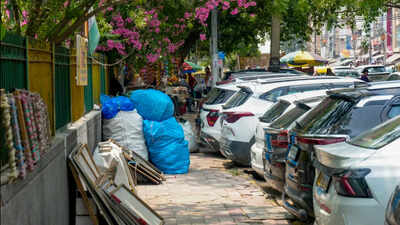
Parked vehicles and stored goods occupy a footpath, obstructing pedestrian movement, at Lajpat Nagar, in New Delhi. (PTI Photo)
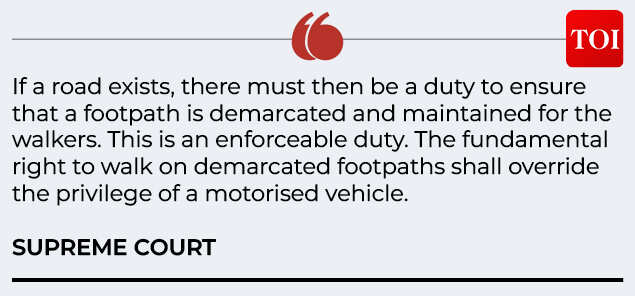
A five-year-old child was killed by a tanker on his way to school with his father. At the site of the tragedy, there was no footpath or a proper pedestrian crossing.On June 19, in a compensation case (Maniyar Iliyaz @ Shaik Riyaz v. P. Ayyappan) delivered by a bench of Justices P S Narasimha and A S Chandurkar, Supreme Court declared the right to walk on safe, demarcated footpaths as a fundamental right under the right to free movement under Article 19(1)(d) and the right to life under Article 21.The bench said that accidents like this continue and perhaps they are inevitable until our rights regime is restructured regarding access to roads.It further stated that the Motor Vehicles Act of 1988 neither recognises nor has ever recognised a fundamental right to walk and in fact, the law has actually hindered this right, weakening pedestrians’ rights in many respects.“The irony all along has been that we have often celebrated flyovers, expressways and large road projects, but have ignored the most basic unit of movement i.e. the pedestrian. The judgment should change how footpaths are imagined. They must be continuous, walkable, safe, accessible and free from obstruction,” said advocate Mayank Arora with The Chambers of Bharat Chugh.Data shows that from January to March this year, Delhi traffic police handed out 4,30,202 on-the-spot fines for improper or obstructive parking, making it the city’s most frequently committed traffic offence.
Crisis of pedestrian fatalityA simple stroll around Delhi reveals how non-functional most of its footpaths are. Broken slabs, potholes and garbage strewn everywhere are a common sight. They are dug up or interrupted abruptly. This forces dwellers onto the main road, where they face the threat of collision with vehicles.India Status Report on Road Safety, compiled by the Transportation Research and Injury Prevention Centre (TRIPC) at IIT Delhi, indicates that footpath availability ranges from as low as 3% in Jammu and Kashmir to about 73% in Maharashtra. In states like Bihar, Haryana and Puducherry, usable pavements remain scarce.Recent data released by road transport ministry for 2024 revealed that more than 1.8 lakh pedestrians were killed in road crashes across India between 2019 and 2024. It averages to an annual of 30,500 pedestrian fatalities. National Highway (NH) network accounted for nearly 31% of these deaths.Around 54% of pedestrian deaths involved collisions with two-wheelers and cars, claiming 19,680 lives. The absence of safe footpaths and pedestrian crossing infrastructure is behind the country’s pedestrian fatality toll, which is among the highest globally.Right reserved for the privilegedThe bench called it strange that it escaped them to focus on recognizing and securing this right to walk. “It may be because wheels eclipsed our imagination, and our municipal administration was busy creating roads suitable for motorized vehicles,” said the court.“It could also be elitism to start with, for machines with wheels were only for the rich, but as economies progressed and cheaper motor vehicles were introduced, the entire spectrum of motorized transportation dominated the roads, pushing aside the walkers to the extent that they are treated as a nuisance for the drivers who routinely run over the walkers and their footpaths.”Shweta Raj, who comes from Bihar’s Samastipur, says the concept of footpaths ends once you leave Patna. “As soon as you deviate from the capital, you will see the footpaths disappearing,” she said. “In the rural areas, even the main roads aren’t properly built. Functional footpaths are out of the question.”In her own city, footpaths only exist on bridges. Even then, they are blocked by vegetable stalls or parked motorcycles.
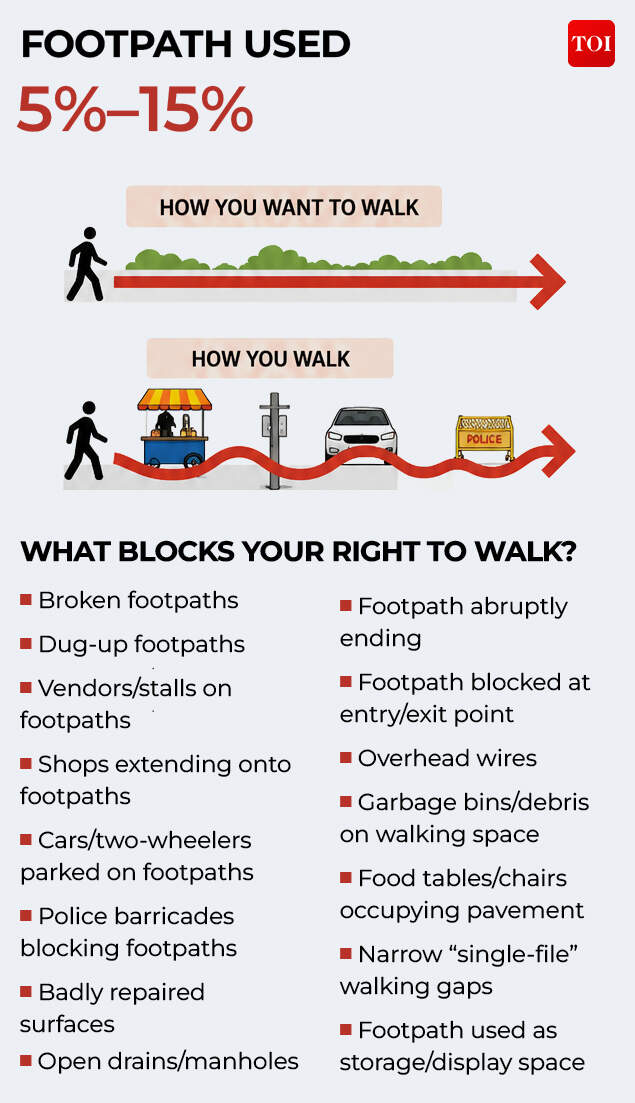
Question of hawkers and homeless peopleThe question of hawkers, encroached spaces and the right to earn a livelihood has dominated the contemporary Indian discourse as of late.Walk around any Indian city and one will see many hawkers, street food stalls, cigarette stores, and florists who have set up shop right on a footpath. In fact, many have been earning a livelihood from the same store on the same footpaths for decades.In a 2021 report by the TOI, it was revealed that homeless people in the country often prefer to sleep on pavements and footpaths over night-shelters due to the fear of theft, drugs and mosquitoes. Footpaths also gave them respite from the stubborn heat that is inescapable in enclosed spaces.Gap in enforcementAdvocate Arora said that the real test of the judgment will not be in its declaration, but in the final implementation on the ground. State governments and municipal bodies must now frame enforceable laws to protect citizens’ right to walk freely with ease and without fear or inconvenience.A 23-year-old Mumbai resident, Protichi Chatterjee, said that an entire road including the footpaths was dug up for four months right in front of her apartment. Consequently, she couldn’t leave her area most times, causing her to be routinely late for law college and internships.“A child’s life was lost, which led the court to declare walking a fundamental right under Article 21 but granting any right to citizens also entails the duty of enforcement. Under the same Article, there is also the Right to a Pollution-free environment and the right to live with dignity,” said Protichi, a student at Government Law College, Mumbai. “We still live in an extremely polluted environment, to the point I have breathing struggles. Rights without enforcement serve little purpose.”While South Mumbai has wider streets, making them relatively walkable, congestion seeps in as one moves towards the suburbs. “The potholes, constantly dug up footpaths and the congestion make them inaccessible for persons with disability,” said Protichi.Sahukari Ruchita, diagnosed with brittle bone disease, talks about the difficulty of navigating Delhi’s footpaths in her wheelchair. “The street poles and trees have been placed right in the middle of many footpaths, which are often narrow in the first place, and that is a barrier for people with disability,” she said.She narrated an incident where, while going to the park, her mother had to ask a stranger to help lift Ruchita’s wheelchair because barriers on the footpaths made navigation unfeasible.
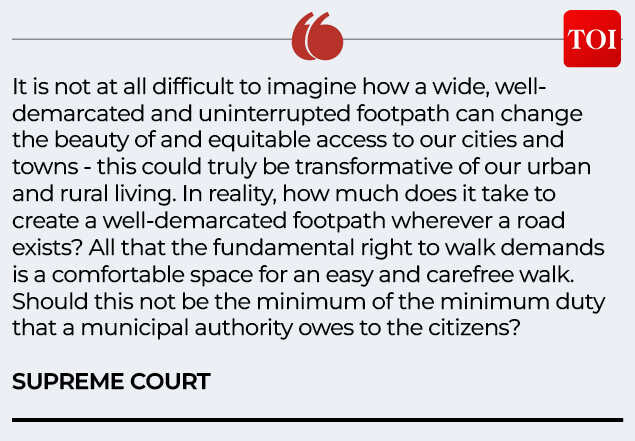
Beyond safetyA 2019 report by BBC examined how 100 km of new footpaths affected Chennai’s environment, economy, public health and safety.The study found that 9% to 27% of people surveyed shifted from motorized transport to walking because of the new footpaths, cutting down on greenhouse gas emissions and particulate pollution. The research also showed that the footpaths created opportunities for women and lower-income residents, including financial savings for these groups.This is a testament to how functional footpaths can offer more than safety and navigation on Indian roads. When planned and maintained properly, they can be reimagined as vital public spaces like parks or libraries.The Supreme Court, in its judgement, said that walking has always captured the Indian imagination, with roots running deep through culture, society, religion, politics and reform movements. “It is struggle for the not-so-fortunate, meditation in motion for many, resistance for others, discovery for the inquisitive, a cohesive strategy for sharp socio-political minds,” it said. Walking even helped inspire some of the ideals behind the freedom struggle.“The message of the Supreme Court is clear: roads are not the monopoly of motor vehicles. If a road exists, a safe footpath must exist. Walking is not a privilege given by the State, it is in fact a constitutional right owed to every citizen,” said Arora.In the wake of an unthinkable, avoidable tragedy, the Supreme Court of India has upheld the right to walk. It is now a question of whether the country will follow in its footsteps.


