
Olympus Mons: The giant Martian volcano nearly three times taller than Mount Everest

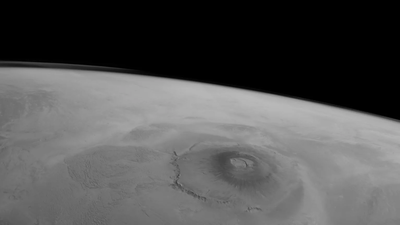
Mount Everest is widely recognised as Earth’s highest mountain, standing as the ultimate symbol of altitude and exploration. According to NASA, beyond our planet lies a volcanic giant that dwarfs every mountain on Earth. Olympus Mons, an enormous shield volcano on Mars, rises to a height of around 27 kilometres, nearly three times taller than Everest, measured above sea level and stretches across an area comparable to the size of Italy. Its immense scale has fascinated planetary scientists for decades, offering clues about how Mars evolved differently from Earth. Researchers say the volcano’s extraordinary dimensions were made possible by geological conditions that simply do not exist on our planet, making Olympus Mons one of the most remarkable landforms in the Solar System.
How Olympus Mons became the tallest volcano in the Solar System
Located in the Tharsis volcanic region of Mars, Olympus Mons is the largest known volcano and the tallest planetary mountain ever discovered. According to NASA, the volcano measures approximately 27 kilometres high from its surrounding plains and spans about 600 kilometres (370 miles) across, giving it a footprint roughly comparable to that of Italy.Unlike steep volcanic peaks such as Mount Fuji or Mount St. Helens, Olympus Mons is a shield volcano. According to the National Park Service, shield volcanoes are formed by repeated eruptions of highly fluid lava that spreads over vast distances before cooling, gradually building broad, gently sloping mountains over millions of years.Scientists believe Olympus Mons remained active for an exceptionally long period because Mars lacks the moving tectonic plates found on Earth. Instead of the crust shifting over volcanic hotspots, as it does on our planet, the Martian crust remained largely stationary. This allowed countless lava flows to erupt from the same location, steadily increasing the volcano’s height and width over hundreds of millions of years.Images captured by orbiting spacecraft reveal enormous lava flows, overlapping volcanic layers and a summit caldera, indicating a long and complex eruptive history.
Why is Olympus Mons nearly three times taller than Mount Everest
At first glance, comparing Olympus Mons with Mount Everest seems straightforward, but the two mountains formed through entirely different geological processes.According to the National Ocean Service, Everest reaches 8,848 metres (29,032 feet) above sea level and was created when the Indian Plate collided with the Eurasian Plate, forcing Earth’s crust upwards to form the Himalayas. Its height is continually influenced by plate tectonics, erosion and the immense weight of the mountain itself.Olympus Mons, by contrast, owes its size to Mars’ lower gravity and unique geology. According to NASA, the planet’s gravity is about 62.5% less as experienced on Earth, allowing volcanic structures to grow much taller before collapsing under their own weight. At the same time, the absence of active plate tectonics meant lava continued erupting from the same volcanic source for millions of years rather than being carried away by moving crustal plates.The volcano’s base is so extensive that an observer standing on its lower slopes would find it difficult to distinguish where the mountain begins. Because of the gentle incline and enormous diameter, much of Olympus Mons would disappear below the Martian horizon before its summit became visible.
Could a volcano the size of Italy ever form on Earth
Planetary geologists consider it extremely unlikely that Earth could produce a volcano comparable to Olympus Mons under present-day conditions. Earth’s constantly moving tectonic plates prevent volcanic hotspots from remaining fixed beneath the same location for extended periods.A well-known example is the Hawaiian Islands, which formed as the Pacific Plate moved over a stationary mantle hotspot. As the plate drifted, volcanic activity shifted, creating a chain of islands instead of one enormous volcano.Earth’s stronger gravity also limits the maximum height that volcanic structures can reach. As mountains grow taller, the weight of the rock increases, making them more susceptible to collapse, erosion and structural instability.Mars presents a very different geological environment. With weaker gravity, little surface erosion and a crust that remained relatively stationary for much of its history, the planet allowed Olympus Mons to continue growing into a scale unmatched anywhere else in the Solar System.Although the volcano is considered dormant today, Olympus Mons remains one of the clearest examples of how planetary environments shape landscapes. It demonstrates that the tallest mountain known to science does not stand on Earth, but on a neighbouring world where geology followed an entirely different path.


