
NEW DELHI: US President Donald Trump on Thursday praised Prime Minister Narendra Modi, saying that Washington and New Delhi will soon reach a trade agreement.While talking to reporters in the Oval Office, Trump said that India had benefited for years from the trade imbalance, but the situation has now changed.“I like your Prime Minister a lot. He is a good friend of mine, and we get along well. We have a good relationship,” Trump said.“For years, India took advantage of the United States. They charged us tremendous tariffs and paid nothing. Now it is the exact reverse and we are making a lot of money with India. But we will get to a deal,” he added.This comes amid ongoing efforts by both countries to strengthen economic ties and address long-standing trade issues.India and the United States wrapped up four days of trade negotiations in New Delhi between June 1 and June 4, with officials from the Office of the United States Trade Representative (USTR), led by its chief negotiator, holding discussions with Indian counterparts on issues such as trade in goods, customs procedures, trade facilitation, non-tariff barriers and economic security cooperation.Both sides termed the talks constructive and said efforts were underway to conclude a mutually beneficial interim trade pact, while negotiations on a broader Bilateral Trade Agreement (BTA) continue in parallel.Momentum towards a deal has strengthened in recent weeks. US Ambassador to India Sergio Gor said the negotiations were nearing completion, with only a limited number of issues still unresolved. Commerce and Industry Minister Piyush Goyal has similarly indicated that most matters have been settled, with discussions now centred on finalising the remaining details before the first phase of the agreement is unveiled.Even as talks advance, concerns persist over a potential move by the Trump administration to impose an additional 12.5% tariff on imports from 60 economies, including India.A separate USTR proposal could further complicate negotiations. The review, conducted under Section 301 of the US Trade Act of 1974, covers 60 economies and focuses on concerns surrounding imports allegedly linked to forced labour.Under the proposal, economies that have introduced restrictions on such imports could face tariffs of 10%, while those without comparable measures may be subjected to duties of up to 12.5%. India, China, Japan, South Korea, the United Kingdom, Bangladesh and Vietnam are among the economies under review.US Trade Representative Jamieson Greer said countries that do not adequately address imports associated with forced labour create an uneven playing field for American workers. Despite the uncertainty surrounding tariffs, both New Delhi and Washington have continued to express confidence that an interim trade agreement can be finalised soon.About the AuthorTOI World DeskAt TOI World Desk, our dedicated team of seasoned journalists and passionate writers tirelessly sifts through the vast tapestry of global events to bring you the latest news and diverse perspectives round the clock. With an unwavering commitment to accuracy, depth, and timeliness, we strive to keep you informed about the ever-evolving world, delivering a nuanced understanding of international affairs to our readers. Join us on a journey across continents as we unravel the stories that shape our interconnected world.Read MoreEnd of ArticleFollow Us On Social MediaVideos’I Saw Four Bodies At One Spot’: Local Hero Recounts Horror Of Delhi Fire | Watch’Did Not Tell Me…’: RJD MP Breaks Silence On Helping Cockroach Janta Party In Holding Presser’Whatever I Am Today Is Because Of Mamata’: Humayun Kabir Offers Rejinagar Seat To TMC Chief’We Are No More In INDIA Bloc, Will Not Attend June 8 Meet’: DMK After Congress ‘Betrayal’ In TNHijab, No Music, Separate Timings: Kerala’s ‘Islam-Friendly’ Gym Sparks Row, BJP Slams CongressAfter TCS Nashik Case, Ex-Wipro Pune Employee Alleges Religious Conversion, Forced ResignationNo Woman In Karnataka Cabinet: Margaret Alva ‘Deeply Disappointed’ Over DK Shivakumar Oath CeremonyPune IT Firm Abruptly Closes Operations, Over 700 Employees And Interns Left JoblessCongress Tells Cadre To Ignore CJP, Stay Focused On NEET-CBSE AgitationWhy IRCTC Is Verifying 6 Crore Users And Deploying AI Cameras In 800 Kitchens123Photostories5 most venomous sea snakes travellers should know aboutWant melt-in-the-mouth mutton dishes? 5 lesser-known secrets to follow at homeSambhavna Seth breaks down in tears as she welcomes twins via surrogacy with husband Avinash Dwivedi; cuts her babies’ umbilical cords, Says ‘Family Complete Ho Gayi’6 lakes in India with fascinating myths about their origins3 types of people you should remove from your life, as per Gauranga DasMMA legend Conor McGregor’s Las Vegas mansion is a millions-worth property defined by world-class luxury, private elevator and Strip viewsThe 5 numbers cardiologists want every adult to know before it’s too lateChild behavior expert says these 5 common phrases parents say to their children can hurt them psychologically8 words that women hate from the core of their heart: Which one can YOU not standGetting married soon? 10 common questions women should ask themselves before tying the knot123Hot PicksDelhi Restaurant FireLauren FryerAbhishek BanerjeeLos Angeles Airport DetentionAuston MatthewsSean StricklandKylian MbappeNuclear Scientist DeathNHL Trade RumorsTop TrendingDelhi Malviya Nagar Restaurant FireBengaluru MurderK AnnamalaiAnnapurna BhandarFirhad HakimDK ShivakumarKerala MonsoonAbhishek BanerjeeMamata BanerjeeKoyambedu Baw Brawl

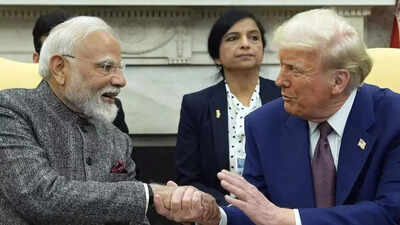
NEW DELHI: US President Donald Trump on Thursday praised Prime Minister Narendra Modi, saying that Washington and New Delhi will soon reach a trade agreement.While talking to reporters in the Oval Office, Trump said that India had benefited for years from the trade imbalance, but the situation has now changed.“I like your Prime Minister a lot. He is a good friend of mine, and we get along well. We have a good relationship,” Trump said.“For years, India took advantage of the United States. They charged us tremendous tariffs and paid nothing. Now it is the exact reverse and we are making a lot of money with India. But we will get to a deal,” he added.This comes amid ongoing efforts by both countries to strengthen economic ties and address long-standing trade issues.India and the United States wrapped up four days of trade negotiations in New Delhi between June 1 and June 4, with officials from the Office of the United States Trade Representative (USTR), led by its chief negotiator, holding discussions with Indian counterparts on issues such as trade in goods, customs procedures, trade facilitation, non-tariff barriers and economic security cooperation.Both sides termed the talks constructive and said efforts were underway to conclude a mutually beneficial interim trade pact, while negotiations on a broader Bilateral Trade Agreement (BTA) continue in parallel.Momentum towards a deal has strengthened in recent weeks. US Ambassador to India Sergio Gor said the negotiations were nearing completion, with only a limited number of issues still unresolved. Commerce and Industry Minister Piyush Goyal has similarly indicated that most matters have been settled, with discussions now centred on finalising the remaining details before the first phase of the agreement is unveiled.Even as talks advance, concerns persist over a potential move by the Trump administration to impose an additional 12.5% tariff on imports from 60 economies, including India.A separate USTR proposal could further complicate negotiations. The review, conducted under Section 301 of the US Trade Act of 1974, covers 60 economies and focuses on concerns surrounding imports allegedly linked to forced labour.Under the proposal, economies that have introduced restrictions on such imports could face tariffs of 10%, while those without comparable measures may be subjected to duties of up to 12.5%. India, China, Japan, South Korea, the United Kingdom, Bangladesh and Vietnam are among the economies under review.US Trade Representative Jamieson Greer said countries that do not adequately address imports associated with forced labour create an uneven playing field for American workers. Despite the uncertainty surrounding tariffs, both New Delhi and Washington have continued to express confidence that an interim trade agreement can be finalised soon.


