
NEW DELHI: The Tamil Nadu govt’s 2023 writ petition accusing the governor of deliberately not acting on 10 bills passed by the state assembly had led a two-judge Supreme Court bench to pen a 415-page judgment on April 8, stripping the constitutional heads of states of the minimal discretionary power conferred on them by the Constitution.Alarmed by the strong forays made by the judiciary into the legislative powers of the constitutional heads of the country and states, the President on May 14 sent a 14-question reference in exercise of her powers under Article 143 to seek SC’s opinion, virtually on each ruling of the two-judge bench as also whether the ambit of SC’s exclusive powers under Article 142 included granting deemed assent to bills.In its 111-page judgment, a bench of CJI B R Gavai, and Justices Surya Kant, Vikran Nath, P S Narasimha and A S Chandurkar tested the reasoning of the two-judge bench on the constitutional touchstone and found that the directions were beyond the mandate of the Constitution.The only point of convergence of views between the two-judge and the five-judge benches was that the governor could not sit on a bill indefinitely. In such a situation, the five-judge bench said the aggrieved state could move SC. Even then, SC could only ask the governor to act expeditiously and not fix a timeline, it said.The two-judge bench had said, “There is no expressly specified time-limit for the discharge of the functions by the governor under Article 200 of the Constitution. Despite there being no prescribed time-limit, Article 200 cannot be read in a manner which allows the governor to not act upon bills which are presented to him for assent and thereby delay and essentially roadblock the lawmaking machinery in the state.”Assuring itself that prescribing a timeline for the governor was not akin to amending the Constitution, the two-judge bench had said, “In case of either withholding of assent or reservation of the bill for the consideration of the President, upon the aid and advice of the state council of ministers, the governor is expected to take such an action forthwith, subject to a maximum period of one month.” It had said the governor must return the bill to the House, if he was withholding assent, within three months or decide within the same timeline reserving it for President’s consideration.Turning to the President, the two-judge bench had said, “There is no ‘pocket veto’ or ‘absolute veto’ available to the President in discharge of functions under Article 201. The use of the expression ‘shall declare’ makes it mandatory for the President to make a choice between the two options available under the substantive part of Article 201, that is, to either grant assent or to withhold assent to a bill.” The two-judge bench fixed a three-month timeline for the President and then granted deemed assent to the 10 Tamil Nadu Bills.In declaring all the above components of the two-judge bench’s rulings as impermissible under the Constitutional scheme, the five-judge bench said, “The governor enjoys discretion in choosing from these three constitutional options and is not bound by the aid and advice of the council of ministers, while exercising his function under Article 200. The discharge of the governor’s function under Article 200, is not justiciable. The court cannot enter a merits review of the decision so taken.”However, in case of glaring circumstances of inaction that is prolonged, unexplained and indefinite, “the court can issue a limited mandamus for the governor to discharge his function under Article 200 within a reasonable time, without making any observations on the merits of the exercise of his discretion”. It said, “The President, too, cannot be bound by judicially prescribed timelines in the discharge of functions under Article 201…the President’s assent under Article 201 too, is not justiciable.”Annulling another ruling by the two-judge bench making it virtually mandatory for the President to seek the court’s opinion on bills whose constitutionally she doubts, the five-judge bench said, “In our constitutional scheme, the President is not required to seek advice of this court by way of reference under Article 143, every time a governor reserves a bill for the President’s assent.”End of ArticleFollow Us On Social MediaVideosIndia And Israel Launch FTA Talks; Piyush Goyal, Nir Barkat Sign Terms Of ReferenceDelhi’s Pollution Forces Australian Foreign Minister Penny Wong To Cough, Stop Her Speech MidwayJaishankar Meets Afghan Commerce Minister Azizi In Delhi; Trade, Connectivity DiscussedMEA Outlines Agenda For PM Modi’s South Africa Visit For G20 Summit In JohannesburgPenny Wong’s Cricket Banter With Jaishankar Highlights Warm, Confident India-Australia PartnershipJaishankar, Penny Wong Send A Strong India-Australia Message To China And The World on Indo-PacificIFFI 2025 Opens With A Surprise As Korean Minister Sings Vande Mataram And Wins Standing OvationPiyush Goyal’s 10 D’s Pitch in Israel Recasts India As Future-Ready for Worldwide InvestmentsDelhi Student Suicide Case: Massive Protest Outside School After Note Alleges Harassment By TeachersPiyush Goyal Links India, Israel Through Shared Adversities, Predicts 7% Percent GDP Growth For FY26123PhotostoriesAkkineni Nagarjuna Rao shaping Telugu cinema with iconic performances and a magnetic presence on screenHow top Bollywood actresses are embracing a life changing new lifestyleFrom better brain function to stronger heart: 5 reasons why backward walking is excellent for youPrincess Diana finally enters the Grévin Wax Museum and yes, she’s wearing the iconic ‘Revenge Dress’Dipika Kakar breaks down after meeting her oncologist amid liver cancer treatment; says, ‘The reports are normal, but there is a constant fear and anxiety’Peripheral Artery Disease: 5 major causes, and ways to prevent it9 must-try street foods in Udaipur5 expert-approved best foods to control diabetes5 spectacular animals with the biggest horns on their heads10 father-son duos who left a mark on cricket history123Hot PicksDelhi AQI TodayBihar Minister List 2025Bihar CM Oath CeremonyGold rate todaySilver rate todayPublic Holidays NovemberBank Holidays NovemberTop TrendingJoel EmbiidSavannah JamesGiannis AntetokounmpoTrevon DiggsKris KnoblauchAdin RossCandace OwensKona TakahashiKatie JohnsonOlivia Dunne


NEW DELHI: The Tamil Nadu govt’s 2023 writ petition accusing the governor of deliberately not acting on 10 bills passed by the state assembly had led a two-judge Supreme Court bench to pen a 415-page judgment on April 8, stripping the constitutional heads of states of the minimal discretionary power conferred on them by the Constitution.Alarmed by the strong forays made by the judiciary into the legislative powers of the constitutional heads of the country and states, the President on May 14 sent a 14-question reference in exercise of her powers under Article 143 to seek SC’s opinion, virtually on each ruling of the two-judge bench as also whether the ambit of SC’s exclusive powers under Article 142 included granting deemed assent to bills.In its 111-page judgment, a bench of CJI B R Gavai, and Justices Surya Kant, Vikran Nath, P S Narasimha and A S Chandurkar tested the reasoning of the two-judge bench on the constitutional touchstone and found that the directions were beyond the mandate of the Constitution.The only point of convergence of views between the two-judge and the five-judge benches was that the governor could not sit on a bill indefinitely. In such a situation, the five-judge bench said the aggrieved state could move SC. Even then, SC could only ask the governor to act expeditiously and not fix a timeline, it said.The two-judge bench had said, “There is no expressly specified time-limit for the discharge of the functions by the governor under Article 200 of the Constitution. Despite there being no prescribed time-limit, Article 200 cannot be read in a manner which allows the governor to not act upon bills which are presented to him for assent and thereby delay and essentially roadblock the lawmaking machinery in the state.”
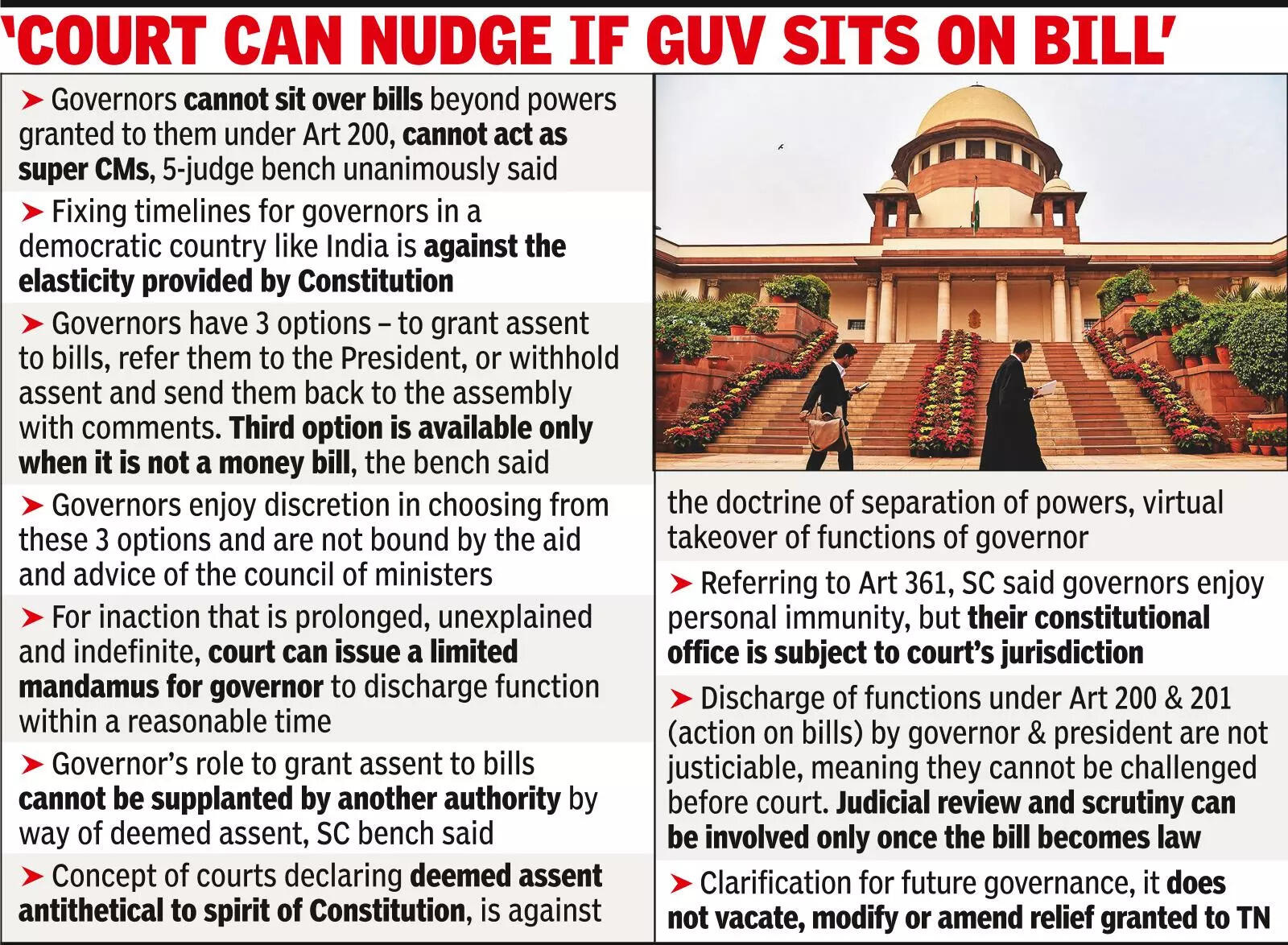
Assuring itself that prescribing a timeline for the governor was not akin to amending the Constitution, the two-judge bench had said, “In case of either withholding of assent or reservation of the bill for the consideration of the President, upon the aid and advice of the state council of ministers, the governor is expected to take such an action forthwith, subject to a maximum period of one month.” It had said the governor must return the bill to the House, if he was withholding assent, within three months or decide within the same timeline reserving it for President’s consideration.Turning to the President, the two-judge bench had said, “There is no ‘pocket veto’ or ‘absolute veto’ available to the President in discharge of functions under Article 201. The use of the expression ‘shall declare’ makes it mandatory for the President to make a choice between the two options available under the substantive part of Article 201, that is, to either grant assent or to withhold assent to a bill.” The two-judge bench fixed a three-month timeline for the President and then granted deemed assent to the 10 Tamil Nadu Bills.In declaring all the above components of the two-judge bench’s rulings as impermissible under the Constitutional scheme, the five-judge bench said, “The governor enjoys discretion in choosing from these three constitutional options and is not bound by the aid and advice of the council of ministers, while exercising his function under Article 200. The discharge of the governor’s function under Article 200, is not justiciable. The court cannot enter a merits review of the decision so taken.”However, in case of glaring circumstances of inaction that is prolonged, unexplained and indefinite, “the court can issue a limited mandamus for the governor to discharge his function under Article 200 within a reasonable time, without making any observations on the merits of the exercise of his discretion”. It said, “The President, too, cannot be bound by judicially prescribed timelines in the discharge of functions under Article 201…the President’s assent under Article 201 too, is not justiciable.”Annulling another ruling by the two-judge bench making it virtually mandatory for the President to seek the court’s opinion on bills whose constitutionally she doubts, the five-judge bench said, “In our constitutional scheme, the President is not required to seek advice of this court by way of reference under Article 143, every time a governor reserves a bill for the President’s assent.”


