
NEW DELHI: Prime Minister Narendra Modi on Friday said the world is looking at India as a “bright spot of growth and hope”, stressing that the country’s reform journey has shifted from a “punishment model” under the earlier licence raj governments to an incentive-based approach.Addressing the Economic Times World Leaders Forum 2026, PM Modi said the world had witnessed several ups and downs in recent years and that the future of all nations was interconnected.”The world has witnessed many ups and downs over the past few years, and these experiences have made one thing abundantly clear: whether one likes it or not, the futures of all nations are interconnected. Nothing is possible in isolation,” the Prime Minister said.”‘One Earth, One Family, One Future’ was India’s guiding mantra during its G20 presidency. This spirit of a shared future, along with the accompanying sense of responsibility, offers solutions to many of the challenges facing the 21st-century world. There are various concerns regarding global growth. The world has witnessed a grim scenario recently; resources are being weaponized, and an atmosphere of mistrust is giving rise to numerous new challenges. Yet, even in such times, the world views India as a bright spot of growth and hope,” he added.From ‘production-linked punishment’ to PLIPM Modi criticised the earlier licence raj governments, saying they followed a “Production Linked Punishment” (PLP) model that penalised companies for increasing production.“Today’s younger generation will be surprised to hear that there was a time in our country when if a company produced more than the prescribed limit, it was punished. This was the PLP, or Production Linked Punishment, model of the earlier licence raj governments,” he said.“Those who make fun of the Make in India and Atmanirbhar Bharat campaigns today are rooted in the same thinking of the past — PLP, or Production Linked Punishment,” he said.’Prohibited unless permitted’ to ‘permitted unless prohibited’PM Modi also said the government is changing the country’s regulatory philosophy by moving away from the earlier approach of requiring permission for activities unless explicitly allowed.“Earlier, the approach to regulations was ‘prohibited unless permitted’ — meaning you could not do something unless the government gave you permission. We are changing this approach to ‘permitted unless prohibited’. That means, for anything that is not explicitly prohibited by law, there should be no need to seek permission at every step.”He said the shift was intended to recast the relationship between the state, citizens and businesses around trust rather than suspicion.“The relationship between the government and citizens should be based not on suspicion, but on trust,” PM Modi added.The Prime Minister also highlighted legislative work undertaken during the Monsoon Session of Parliament.”In the Monsoon Session of Parliament, we have passed the Bankers’ Books Evidence Bill, even as the Opposition has continued to create disruptions in Parliament. We did not allow the work of serving the country to stop,” he said.”We are not just changing regulations, we are changing entire policy of regulations,” PM Modi said at the ET Global Leaders’ Forum.Speaking ahead of PM Modi’s keynote address at the summit, Times Internet chairman Satyan Gajwani said Modi had emerged as a source of stability in a world “lurching from one crisis to the next.”Join conversationView All Comments →Share your thoughts in the commentsInsightfulAgreeDisagreeSkepticalConcerningPromisingWorth ReadingBig DevelopmentPost CommentBe respectful · TOI community guidelinesGajwani said the global landscape was being reshaped by multiple, overlapping disruptions – two ongoing wars, an energy crisis, disrupted shipping routes, trade wars and the rapid AI revolution – creating unprecedented uncertainty for governments, businesses and economies.He said India’s political and economic stability, coupled with its growth and reform trajectory, had positioned the country as a reliable force amid growing geopolitical uncertainty.Gajwani said PM Modi’s leadership and policy continuity had helped provide businesses and investors with greater predictability, while giving India an opportunity to play a larger role in the evolving global order.Get the latest India News and Live updates. Download the TOI app.About the AuthorTOI News DeskThe TOI News Desk comprises a dedicated and tireless team of journalists who operate around the clock to deliver the most current and comprehensive news and updates to the readers of The Times of India worldwide. With an unwavering commitment to excellence in journalism, our team is at the forefront of gathering, verifying, and presenting breaking news, in-depth analysis, and insightful reports on a wide range of topics. The TOI News Desk is your trusted source for staying informed and connected to the ever-evolving global landscape, ensuring that our readers are equipped with the latest developments that matter most.”Read MoreEnd of ArticleFollow Us On Social MediaVideos4-Year-Old Viral Sensation Karga Tinkle EXCLUSIVE | “Don’t Call Me Chinese, I Am Indian”‘Making Provocative Remarks Against India For Years’: MEA Slams US Body Over RSS Sanctions CallRevanth Reddy’s US Trip Cancelled After MEA Denies Clearance, Telangana Delegation Goes AheadPellet-gun Row: Rahul Gandhi At Parliament Street Police Station To Lodge Complaint With DCP‘Don’t Politicise Our School’: Villagers Block CJP Visit As Party Alleges BJP Attack In RajasthanModi Pushes AI, Youth And Data Agenda, Tells Secretaries To Break Government Silos And InnovatePirates Hijack Two Ships Carrying 22 Indians Off Yemen And Somalia, Crew Safety Raises Concern‘NEET, Delimitation, Cauvery, Drugs’: Vijay’s Key Requests Before Amit Shah At Tamil Nadu MeetingPolicy Shift Or Just Words? Inside US Envoy Gor’s ‘Kashmir’ Remark That Rattled PakistanJharkhand High Court Stays Soren Govt’s Order To Cancel JPSC Exams, Appointments123Photostories10 baby boy names inspired by wisdom, knowledge and intelligenceOptical Illusion personality test: What you spot first reveals your secret dominant traitH1N1 is rising again: Doctors explain why swine flu cases are increasing and how to stay protectedWorking out in extreme heat? How dehydration can reduce kidney function and raise the risk of acute kidney injuryRoad to longevity: 7 simple habits that may help ‘super-agers’ stay healthy beyond 1008 foods you should never reheat in the microwave and why5 smart ways to protect yourself from office politics, according to entrepreneur Ankur WarikooThe 5 beauty trends dominating Instagram in 2026Ram Kapoor’s approximately Rs 20 crore Mumbai home: A coffin-shaped bar, private theatre room and stunning art collection7 health benefits of drinking coffee that go beyond boosting energy; new study links the drink to less body fat and more muscle123Hot PicksTCS laptop monitoring softwareTNEA counselling3 year practice ruleJEECUP counsellingAston Martin crashAbhijeet DipkeAnkur WarikooSIM card rulesManoj Mukund NaravaneTop TrendingHyderabad Aston Martin AccidentLadakh TouristMumbai Rape AirhostessMadhapur Road AccidentUKG Student DeathSalman Khan Gym FireAbhijeet DipkeRahul GandhiBengaluru RapidoBen Gvir

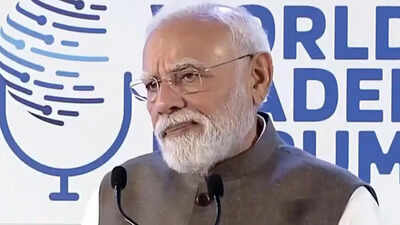
NEW DELHI: Prime Minister Narendra Modi on Friday said the world is looking at India as a “bright spot of growth and hope”, stressing that the country’s reform journey has shifted from a “punishment model” under the earlier licence raj governments to an incentive-based approach.Addressing the Economic Times World Leaders Forum 2026, PM Modi said the world had witnessed several ups and downs in recent years and that the future of all nations was interconnected.“The world has witnessed many ups and downs over the past few years, and these experiences have made one thing abundantly clear: whether one likes it or not, the futures of all nations are interconnected. Nothing is possible in isolation,” the Prime Minister said.“‘One Earth, One Family, One Future’ was India’s guiding mantra during its G20 presidency. This spirit of a shared future, along with the accompanying sense of responsibility, offers solutions to many of the challenges facing the 21st-century world. There are various concerns regarding global growth. The world has witnessed a grim scenario recently; resources are being weaponized, and an atmosphere of mistrust is giving rise to numerous new challenges. Yet, even in such times, the world views India as a bright spot of growth and hope,” he added.
From ‘production-linked punishment’ to PLI
PM Modi criticised the earlier licence raj governments, saying they followed a “Production Linked Punishment” (PLP) model that penalised companies for increasing production.“Today’s younger generation will be surprised to hear that there was a time in our country when if a company produced more than the prescribed limit, it was punished. This was the PLP, or Production Linked Punishment, model of the earlier licence raj governments,” he said.“Those who make fun of the Make in India and Atmanirbhar Bharat campaigns today are rooted in the same thinking of the past — PLP, or Production Linked Punishment,” he said.
‘Prohibited unless permitted’ to ‘permitted unless prohibited’
PM Modi also said the government is changing the country’s regulatory philosophy by moving away from the earlier approach of requiring permission for activities unless explicitly allowed.“Earlier, the approach to regulations was ‘prohibited unless permitted’ — meaning you could not do something unless the government gave you permission. We are changing this approach to ‘permitted unless prohibited’. That means, for anything that is not explicitly prohibited by law, there should be no need to seek permission at every step.”He said the shift was intended to recast the relationship between the state, citizens and businesses around trust rather than suspicion.“The relationship between the government and citizens should be based not on suspicion, but on trust,” PM Modi added.The Prime Minister also highlighted legislative work undertaken during the Monsoon Session of Parliament.“In the Monsoon Session of Parliament, we have passed the Bankers’ Books Evidence Bill, even as the Opposition has continued to create disruptions in Parliament. We did not allow the work of serving the country to stop,” he said.“We are not just changing regulations, we are changing entire policy of regulations,” PM Modi said at the ET Global Leaders’ Forum.Speaking ahead of PM Modi’s keynote address at the summit, Times Internet chairman Satyan Gajwani said Modi had emerged as a source of stability in a world “lurching from one crisis to the next.”
Share your thoughts in the comments
Be respectful · TOI community guidelines
Gajwani said the global landscape was being reshaped by multiple, overlapping disruptions – two ongoing wars, an energy crisis, disrupted shipping routes, trade wars and the rapid AI revolution – creating unprecedented uncertainty for governments, businesses and economies.He said India’s political and economic stability, coupled with its growth and reform trajectory, had positioned the country as a reliable force amid growing geopolitical uncertainty.Gajwani said PM Modi’s leadership and policy continuity had helped provide businesses and investors with greater predictability, while giving India an opportunity to play a larger role in the evolving global order.


