
NEW DELHI: India’s school education system has solved much of the “getting children into school” challenge, but is struggling with a tougher problem – keeping them there long enough to complete secondary and higher secondary education.The stress points are now visible higher up the schooling ladder – gross enrolment ratio (GER) drops from 90.9% at primary level to 58.4% at higher secondary, while secondary-stage dropout rate rises sharply to 11.5% from 0.3% at primary, according to a new Niti Aayog report.The report – School Education System in India: Temporal Analysis and Policy Roadmap for Quality Enhancement – paints a picture of a vast, but uneven system comprising 14.71 lakh schools, 24.69 crore students and about 1.01 crore teachers, with the sharpest cracks now emerging beyond the elementary stage.It says the system today is “strongest on basic access and weakest on continuity, inclusion, and learning depth”.The numbers illustrate the challenge clearly. India’s GER stands at 90.9% at primary stage and 90.3% at upper primary, but falls sharply to 78.7% at secondary, and further to 58.4% at higher-secondary level.Transition rates weaken steadily as students move up the system. While 92.2% of students move from primary to upper primary, the rate falls to 86.6% between upper primary and secondary, and to 75.1% between secondary and higher secondary. The secondary stage has emerged as the biggest stress point. The national dropout rate is just 0.3% at primary and 3.5% at upper primary, but jumps to 11.5% at secondary level. “While near-universal access has been achieved at the primary stage, enrolment at the higher secondary level… presents a significant opportunity to further expand participation,” the report states. It adds that “strengthening transition rates at each stage, particularly after upper primary…can help ensure smoother progression and sustained engagement in schooling.”The report says the next phase of reform can no longer focus only on expanding enrolment or infrastructure, but must address “fragmented school structures, foundational learning deficits, inequities in inclusion, gaps in teacher and leadership ecosystems, infrastructure disparities, and governance weaknesses”.Structural inefficiencies remain significant. More than one-third of schools have fewer than 50 students, while over 1.04 lakh schools continue to function as single-teacher institutions serving nearly 34 lakh students. At the same time, the report records major gains in infrastructure over the last decade. Functional electricity is now available in 91.9% of schools, girls’ toilets in 94%, computers in 64.7%, internet connectivity in 63.5%, and smart classrooms in 30.6% of schools nationally.About the AuthorManash Pratim GohainManash Pratim Gohain is a seasoned journalist with over two decades at The Times of India, where he has built a rich body of work spanning education policy, politics, and governance. Renowned for his incisive coverage of the National Education Policy (NEP) 2020, accreditation reforms, and skilling initiatives, he has also reported on student politics, urban policy, and social movements. His political reportage—both reflective and news-driven—adds depth to his writing, bridging policy with public impact. Through his 2,500 articles and related outlets, he has emerged as a trusted voice in national discourse, particularly in linking education reform to broader societal change.Read MoreEnd of ArticleFollow Us On Social MediaVideos‘Use Petrol Sparingly’: PM Modi Calls For WFH, Carpooling Amid West Asia WarFormer Bengal CM Mamata Banerjee’s Anti-BJP Unity Call Rejected By Left, Congress In Bengal TwistWill Vijay Join INDIA Bloc? ‘Secular’ Speech Sparks Fresh Political Speculation | WatchSuspended TMC Leader Riju Dutta Praises Bengal CM Suvendu Adhikari For Preventing Post-Poll ViolenceIndia Tests Advanced Agni-5 MIRV Missile With 5,000 KM Range, Multiple Warhead Capability | WatchPM Modi Urges Indians To Save Fuel As West Asia War Triggers Massive Oil CrisisBJP Bengal Chief Samik Bhattacharya Launches Sharp Attack On TMC Amid I-PAC ControversyVijay Faces Political Storm After Vande Mataram Played Before Tamil Thaai VaazhthuSecurity Scare In Bengaluru Ahead Of PM Modi Visit After Explosives Recovery | WatchSatheesan-Venugopal Face-Off Delays Congress Decision On Kerala Chief Minister123PhotostoriesUS turns 250: Where to witness best celebrations across South America in 2026Mother’s Day special: The everyday superfoods that help moms stay energised, strong, and healthy through life’s endless demandsGestational Diabetes may end after pregnancy, but its hidden impact on thyroid health could last for yearsPoet Kumar Vishwas’ lavish Noida bungalow is a five-floor, crores-worth property defined by private salon, lifts and artistic interiorsYour mum said it first! 5 health tips now backed by scienceIs fibremaxxing healthy? Harvard doc breaks down the pros and cons6 teas that can naturally reduce bloating and ease digestionHow to grow Hibiscus flowers throughout the yearPancreatic cancer often starts silently: Early symptoms you shouldn’t ignore6 ingredients chefs secretly rely on to deepen flavour123Hot PicksSBI Q4 resultsThane- Navi Mumbai corridorMaharashtra SSC ResultPune child rape-murder casePerambur election resultIndia-New Zealand FTASugarcane price hikeTop TrendingCSK Vs LSG IPL LiveHPBOSE Toppers ListToday IPL MatchUS Iran warHPBOSE 10th Result 2026How to check HPBOSE Result OnlineIPL Orange Cap 2026BAN vs PAKUFC 328 HighlightsWest Bengal Cabinet

NEW DELHI: India’s school education system has solved much of the “getting children into school” challenge, but is struggling with a tougher problem – keeping them there long enough to complete secondary and higher secondary education.The stress points are now visible higher up the schooling ladder – gross enrolment ratio (GER) drops from 90.9% at primary level to 58.4% at higher secondary, while secondary-stage dropout rate rises sharply to 11.5% from 0.3% at primary, according to a new Niti Aayog report.The report – School Education System in India: Temporal Analysis and Policy Roadmap for Quality Enhancement – paints a picture of a vast, but uneven system comprising 14.71 lakh schools, 24.69 crore students and about 1.01 crore teachers, with the sharpest cracks now emerging beyond the elementary stage.It says the system today is “strongest on basic access and weakest on continuity, inclusion, and learning depth”.The numbers illustrate the challenge clearly. India’s GER stands at 90.9% at primary stage and 90.3% at upper primary, but falls sharply to 78.7% at secondary, and further to 58.4% at higher-secondary level.Transition rates weaken steadily as students move up the system. While 92.2% of students move from primary to upper primary, the rate falls to 86.6% between upper primary and secondary, and to 75.1% between secondary and higher secondary. The secondary stage has emerged as the biggest stress point. The national dropout rate is just 0.3% at primary and 3.5% at upper primary, but jumps to 11.5% at secondary level.
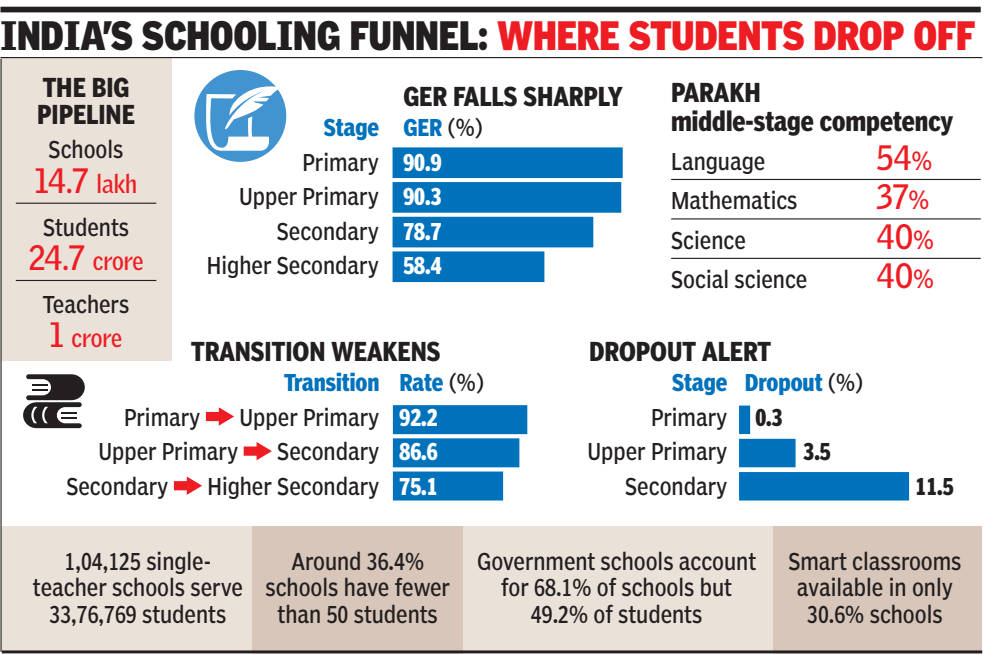
“While near-universal access has been achieved at the primary stage, enrolment at the higher secondary level… presents a significant opportunity to further expand participation,” the report states. It adds that “strengthening transition rates at each stage, particularly after upper primary…can help ensure smoother progression and sustained engagement in schooling.”The report says the next phase of reform can no longer focus only on expanding enrolment or infrastructure, but must address “fragmented school structures, foundational learning deficits, inequities in inclusion, gaps in teacher and leadership ecosystems, infrastructure disparities, and governance weaknesses”.Structural inefficiencies remain significant. More than one-third of schools have fewer than 50 students, while over 1.04 lakh schools continue to function as single-teacher institutions serving nearly 34 lakh students. At the same time, the report records major gains in infrastructure over the last decade. Functional electricity is now available in 91.9% of schools, girls’ toilets in 94%, computers in 64.7%, internet connectivity in 63.5%, and smart classrooms in 30.6% of schools nationally.


