
Nearly 81 years after Hiroshima, scientists discover a hidden metal alloy created by the atomic bomb blast

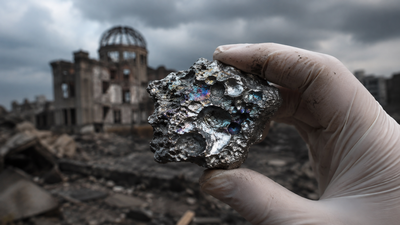
Nearly 81 years after the atomic bombing of Hiroshima, material recovered from the city’s shoreline is still yielding discoveries that scientists did not expect. Researchers examining tiny fragments preserved in beach sands have identified what appears to be a previously unknown metallic alloy that formed during the immense heat and rapid cooling triggered by the 6 August 1945 explosion.The finding is less about rewriting the history of the bombing than expanding what scientists know about how matter behaves under conditions that are almost impossible to recreate. According to a new study published in Science Advances, titled “Discovery of a multicomponent alloy forged by the Hiroshima atomic blast”, the alloy developed inside microscopic particles known as “hiroshimaites”, offering researchers an unusual glimpse into how extreme temperatures, vaporised building materials and rapid solidification combined to produce a material that has not previously been documented.
How the new Hiroshima metal alloy was discovered in beach sand samples
The newly identified alloy was discovered during an examination of 34 Hiroshimaite samples collected from Hiroshima Bay. While most of the metallic particles consisted of familiar iron-chromium-based alloys, one grain stood apart because of its unusually high silicon content and its distinctive chemical makeup.According to the researchers, the microscopic fragment contains iron, chromium, nickel, manganese, molybdenum, silicon and small amounts of aluminium arranged in a combination unlike previously reported natural or industrial alloys. Laboratory analysis showed that the particle was chemically uniform, suggesting it crystallised from a single molten droplet before cooling so rapidly that its internal structure remained locked in place.The team also determined that the alloy crystallised in an ordered AlAu₄-type crystal structure, a configuration that differs from the body-centred cubic or face-centred cubic structures commonly associated with stainless-steel-like materials.
How the Hiroshima atomic bomb blast created the new metal alloy
The atomic airburst generated temperatures exceeding 7,000°C within seconds, vaporising metals, concrete, soil, glass and other urban materials into an expanding fireball. As that cloud cooled, different elements condensed from the mixed vapour and rapidly solidified into microscopic droplets.The researchers suggest that the newly discovered alloy most likely formed through this sequence of vaporisation, condensation and ultrafast quenching rather than existing before the explosion. They also argue that its chemical composition and crystal structure do not match known industrial alloys, making it unlikely that the particle simply survived the blast intact.These fireball conditions are a rare natural environment where entirely new metallic phases can emerge because the cooling process happens too quickly for atoms to arrange themselves into the structures normally seen during conventional metal production.
Why the new Hiroshima metal alloy could help future materials science research
Although the alloy itself is not expected to become an engineering material, researchers believe it could help broaden understanding of complex multicomponent alloys. These materials are already of interest because certain compositions can combine strength, corrosion resistance and thermal stability in ways that conventional alloys cannot.The Hiroshima particle provides a real-world example of how extreme environments can stabilise unusual crystal structures that may inspire future laboratory research. They emphasise that the discovery points towards unexplored regions of alloy design rather than an immediately practical material.Earlier investigations of debris from the Trinity nuclear test identified an unusual quasicrystal formed under similar extreme conditions. The newly described Hiroshima alloy does not belong to the same category, but the researchers say both findings suggest nuclear fireballs can generate structures that rarely form through conventional geological or industrial processes.
How Hiroshima atomic bomb debris could help scientists study past nuclear explosions
Beyond materials science, the researchers argue that blast-derived particles may preserve detailed records of the conditions present during nuclear explosions. By analysing their chemistry, crystal structure and formation history, scientists may gain a better understanding of the temperatures, mixing processes and cooling rates that occurred during such events.Atomic-blast debris acts as an unintended record of extreme physical processes, preserving microscopic materials that could otherwise never have formed. The authors suggest that continued, carefully managed scientific examination of these particles may contribute both to future materials research and to nuclear forensics, while also offering new insight into one of the most significant events of the twentieth century.


