
NASA prepares Nancy Grace Roman Space Telescope for Florida launch from Kennedy Space Centre ahead of August launch

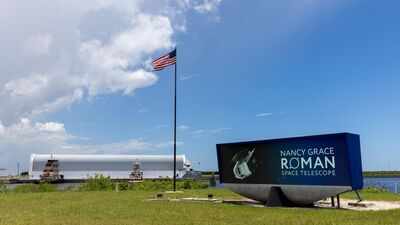
The journey is almost over for NASA’s next major space observatory, though its most important work has yet to begin. After years of design, assembly and testing, the Nancy Grace Roman Space Telescope has arrived at the agency’s Kennedy Space Centre in Florida, where teams will spend the coming weeks preparing the spacecraft for launch. The observatory travelled from Maryland to the Atlantic coast before making the final leg of its trip aboard NASA’s Pegasus barge, eventually reaching Florida on 21 June.Its arrival marks a shift from development and verification work to the final phase of launch processing. The telescope is expected to lift off later this summer and begin a mission that will examine some of the largest unanswered questions in astronomy, from the nature of dark energy to the abundance of planets beyond the Solar System.
How NASA moved the Roman Space Telescope to Florida
Before leaving NASA’s Goddard Space Flight Centre in Maryland, the observatory underwent its final rounds of integration and testing. Engineers then enclosed the spacecraft inside a specialised transport container designed to maintain stable environmental conditions during transit.According to NASA, the telescope was moved to the Port of Baltimore, where it was loaded onto the Pegasus barge for transport along the eastern seaboard. After reaching Kennedy Space Centre, ground crews transferred the observatory from the vessel and transported it to the Payload Hazardous Servicing Facility, a building that recently underwent upgrades in preparation for the mission.Transporting a space telescope is a slow and deliberate operation. Even after arrival, technicians must work through extensive cleaning procedures before the spacecraft can be exposed to the controlled conditions of a clean room. The process is intended to minimise contamination that could interfere with the telescope’s sensitive instruments once it begins observing the universe.
NASA begins launch preparations for the Roman Telescope
Over the next several weeks, engineers will carry out a series of inspections and readiness checks. Once removed from its shipping container, Roman will be positioned inside the facility’s high-bay work area, where specialised equipment allows technicians to access different parts of the spacecraft. Solar arrays will be tested, thermal protection systems examined, and external coverings checked for any signs of damage following transport.As per NASA, Fuel loading is also part of the schedule. Teams are expected to fill the spacecraft’s tanks with hydrazine, the propellant that will allow Roman to perform manoeuvres during its operational life in space.These activities may attract less attention than the eventual launch, yet they represent some of the most important work before liftoff. Every system must be confirmed ready before the observatory is handed over for integration with its launch vehicle.
Roman Telescope set for SpaceX Falcon Heavy launch
NASA is currently targeting no earlier than 30 August for launch aboard a SpaceX Falcon Heavy rocket from Launch Complex 39A at Kennedy Space Centre.The date places the mission several months ahead of its previously expected schedule, an outcome that reflects progress made during spacecraft development and testing.Once launched, Roman will not remain in Earth orbit. Instead, it will travel to the second Sun-Earth Lagrange point, commonly known as L2, a region of space located roughly 1.5 million kilometres from Earth. Several major observatories operate or have operated near this location because it provides a relatively stable environment for scientific observations.
How NASA’s Roman Telescope will search for exoplanets
Roman has often been described as a survey telescope because of its ability to observe large portions of the sky quickly while maintaining high sensitivity.Astronomers expect the mission to gather vast quantities of information about galaxies, black holes and other distant objects. Its observations will help researchers investigate how the universe has changed over cosmic time and may provide new clues about the force driving the universe’s accelerating expansion.The telescope is also expected to become an important tool in the search for planets beyond the Solar System. By scanning large areas of the Milky Way, Roman should identify huge numbers of previously unknown worlds and help scientists build a clearer picture of how common different planetary systems are across the galaxy.At the heart of the observatory is a powerful instrument equipped with a 300-megapixel camera. Alongside this, the mission will test advanced starlight-blocking technology designed to make direct observations of exoplanets and the discs of material where planets form around young stars.
Roman Telescope shared its journey with Artemis III hardware
Roman was not the only payload aboard the Pegasus barge during its trip to Florida. The vessel also transported a weather protection cover intended for use with hardware supporting NASA’s Artemis III mission. The cover will shield components of the Space Launch System rocket while they remain at Launch Complex 39B before launch preparations continue.The shared voyage offered a practical example of how different NASA programmes can make use of the same transportation resources when schedules align, supporting both human exploration and astrophysics missions through a single operation.


