
Monsoon on the back foot: IMD warns of over 10% rainfall deficit NEW DELHI: Rainfall deficit of 43% as on Saturday will be reduced once the monsoon covers the entire country next month but the season, already affected by El Niño, may not get the climatic cushion of Indian Ocean Dipole (IOD) to offset the impact this year. In effect, there is now a very high probability of the overall monsoon ending up in more than 10% deficit as predicted by IMD. Though a positive IOD does not guarantee a good monsoon rainfall, it often reduces the damage caused by El Niño. As a result, some El Niño years have still seen near-normal rainfall because a strong positive IOD supported the monsoon. In the recent past, 2023 is an example where positive IOD largely offset the strong El Nino, helping India get near-normal seasonal rainfall. IOD is a climate phenomenon that describes the difference in sea surface temperatures between the western and eastern parts of the Indian Ocean. It is one of the key factors that influences the summer monsoon, along with El Niño–Southern Oscillation (ENSO). . At present, neutral IOD conditions prevail over the Indian Ocean. “Forecasts from the Monsoon Mission Coupled Forecast System (MMCFS) indicate that neutral IOD conditions are likely to persist through the southwest (summer) monsoon season,” said the IMD. A neutral IOD means it does not actively strengthen or weaken the southwest monsoon. So other climate drivers such as El Niño become important in impacting the seasonal rainfall. Keeping in view the prevailing El Nino,IMD has already predicted ‘below normal’ rainfall this rainy season (June-Sept) with 60% probability of its being deficient (more than 10% of overall deficit during June-Sept), triggering a fear of drought. The nationwide deficit of 43% in cumulative rainfall (June 1-27) is already reflecting in states with many of them recording shortfall of 50% or more. Meghalaya recorded the highest deficit of 82% followed by Gujarat (79%), Manipur (71%), Chhattisgarh (68%), Jharkhand (66%), Maharashtra (59%), Uttar Pradesh (56%), Odisha (52%) and Bihar (50%). The situation in Madhya Pradesh with 41% shortfall also looks quite critical as the state falls in the ‘monsoon core zone’ – rain-fed area, which largely depends on monsoon rainfall for farming operations. Peninsular India, except Andhra Pradesh, also presents a scary picture as Karnataka, Kerala, Tamil Nadu and Telangana reported more than 30% deficit despite being covered by the monsoon 2-3 weeks ago. The rainfall data over four homogenous regions shows the highest deficit of 57% in central India followed by 44% in east & northeast India, 30% in south peninsular India and 27% in northwest India.Get the latest India news and live updates. Download the TOI App.About the AuthorVishwa MohanVishwa Mohan is Senior Editor at The Times of India. He writes on environment, climate change, agriculture, water resources and clean energy, tracking policy issues and climate diplomacy. He has been covering Parliament since 2003 to see how politics shaped up domestic policy and India’s position at global platform. Before switching over to explore sustainable development issues, Vishwa had covered internal security and investigative agencies for more than a decade.Read MoreEnd of ArticleFollow Us On Social MediaVideosKarnataka Man Pulls Out Crude Bombs After Lover ‘Refused’ To Marry Him, Dies In ExplosionNCB Report Warns Of Nitazenes, Myanmar Route; Flags Telegram As Key Hub For Drug AdsMaharashtra TET Exam Postponed After ‘Paper Leak’, 3 Arrested, CM Fadnavis Orders SIT ProbeFadnavis, Uddhav Share Flight Amid Shiv Sena Turmoil After Six MPs Switch Sides | WatchPM Modi Meets Jonathan, World’s Oldest Living Land Animal, During Seychelles VisitAkal Takht Summons Sikh MLAs; Bhagwant Mann Calls Crucial AAP Huddle In Punjab | WatchIndian Vessels Desh Suraksha, SSL Kaveri Sail Through Hormuz; Third Takes U-TurnDMK Alliance Rocked As Vaiko’s MDMK Quits SPA After Nine Years Of Partnership | WatchClass 12 Student Sarthak Sidhant, Who Exposed CBSE Tender Procedure, Launches 1.66 Cr Record Portal’India Deserves Permanent Seat At UNSC’: Seychelles Foreign Minister Ahead Of PM Modi’s Visit123Photostories6 high-protein cheela recipes for healthy weight lossEveryone else seems to have it figured out: Why young adults feel the pressure to be ‘sorted’ before they turn 30Bollywood stars who follow the early dinner rule for fitness: From Anushka Sharma to Akshay Kumar5 common mistakes people make while buying diamondsFrom the ‘Mahakumbh of Tantrics’ to the sacred red water: 5 fascinating facts about Ambubachi Mela, India’s unique Menstruation FestivalEating dinner too late? Doctors warn this everyday habit could quietly affect your kidneys and metabolism10 beautiful baby boy names inspired by ancient gods and their powerful meanings7 simple ingredients to add more fibre to your rajmaIs your desk snack stash secretly affecting your blood sugar? Doctors explainInside Sunita Ahuja’s lavish Rs 16 crore home: Stunning living room, stylish bar, scenic balcony and more123Hot PicksChinese proverb of the dayJapanese Proverb Of The DayErling Haaland and Isabel Haugseng Combined Net worthFIFA world cup 2026Rams FanRam Temple DonationNigerian Proverb of the dayUS Strike on IranKetan Agarwal MurderTop TrendingK BhagyarajMumbai Local Train DeathRam Temple Donation RowFIFA World Cup 2026NFL TradeUS Iran CeasefirePriyanka GandhiSergei IvanovMK StalinMumbai Local Train News


NEW DELHI: Rainfall deficit of 43% as on Saturday will be reduced once the monsoon covers the entire country next month but the season, already affected by El Niño, may not get the climatic cushion of Indian Ocean Dipole (IOD) to offset the impact this year. In effect, there is now a very high probability of the overall monsoon ending up in more than 10% deficit as predicted by IMD. Though a positive IOD does not guarantee a good monsoon rainfall, it often reduces the damage caused by El Niño. As a result, some El Niño years have still seen near-normal rainfall because a strong positive IOD supported the monsoon. In the recent past, 2023 is an example where positive IOD largely offset the strong El Nino, helping India get near-normal seasonal rainfall. IOD is a climate phenomenon that describes the difference in sea surface temperatures between the western and eastern parts of the Indian Ocean. It is one of the key factors that influences the summer monsoon, along with El Niño–Southern Oscillation (ENSO).
.
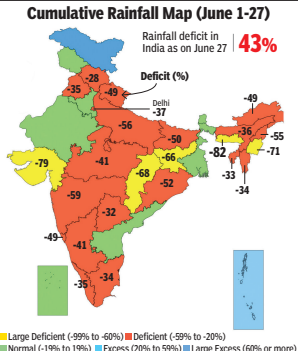
At present, neutral IOD conditions prevail over the Indian Ocean. “Forecasts from the Monsoon Mission Coupled Forecast System (MMCFS) indicate that neutral IOD conditions are likely to persist through the southwest (summer) monsoon season,” said the IMD. A neutral IOD means it does not actively strengthen or weaken the southwest monsoon. So other climate drivers such as El Niño become important in impacting the seasonal rainfall. Keeping in view the prevailing El Nino,IMD has already predicted ‘below normal’ rainfall this rainy season (June-Sept) with 60% probability of its being deficient (more than 10% of overall deficit during June-Sept), triggering a fear of drought. The nationwide deficit of 43% in cumulative rainfall (June 1-27) is already reflecting in states with many of them recording shortfall of 50% or more. Meghalaya recorded the highest deficit of 82% followed by Gujarat (79%), Manipur (71%), Chhattisgarh (68%), Jharkhand (66%), Maharashtra (59%), Uttar Pradesh (56%), Odisha (52%) and Bihar (50%). The situation in Madhya Pradesh with 41% shortfall also looks quite critical as the state falls in the ‘monsoon core zone’ – rain-fed area, which largely depends on monsoon rainfall for farming operations. Peninsular India, except Andhra Pradesh, also presents a scary picture as Karnataka, Kerala, Tamil Nadu and Telangana reported more than 30% deficit despite being covered by the monsoon 2-3 weeks ago. The rainfall data over four homogenous regions shows the highest deficit of 57% in central India followed by 44% in east & northeast India, 30% in south peninsular India and 27% in northwest India.


