
Meet Yanin ‘Proud’, a 17-year-old Thai student who built artificial hornbill nests from recycled plastic and won two global conservation awards | World News

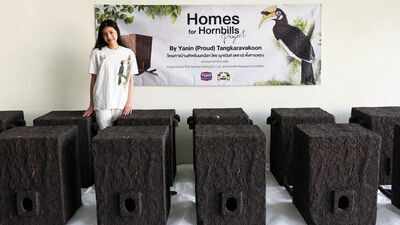
At just 17, Thai student Yanin ‘Proud’ Tangkaravakoon has turned a concern for endangered hornbills into a unique conservation project that gives discarded waste plastic a new purpose. Her initiative, ‘Homes for Hornbills’ creates artificial nests designed to provide breeding spaces for hornbills as natural tree cavities become harder to find. The project has now earned her two major international honours, including recognition from ‘The Earth Prize’ and National Geographic’s ‘Slingshot Challenge.’ According to Khaosod English, the project combines wildlife conservation, recycled materials and community involvement to address the declining populations of hornbills in Thailand. The Nation reported that the nests have been developed with attention to the birds’ behaviour, safety and the environmental conditions they face. What began with a young student’s fascination with these distinctive birds has grown into a practical conservation effort with encouraging early results.
How did this 17-year-old Thai student turn recycled plastic into artificial hornbill nests
According to Khaosod English, Yanin’s interest in hornbills began during a primary school field trip to Khao Yai National Park. Fascinated by the birds, she later learned more about the threats affecting their survival and began working towards a solution. The result was ‘Homes for Hornbills,’ a project built around the idea of creating durable artificial nesting spaces from upcycled materials, including discarded plastic bottles. The initiative was developed in collaboration with the ‘Thailand Hornbill Research Foundation’ and goes beyond simply placing artificial nests in forests.The wider conservation model has three main parts. Providing nests designed around hornbill behaviour, teaching students about conservation and developing long-term ways to work with communities in order to reduce pressures such as poaching and deforestation. The idea addresses a particularly important problem for hornbills. The Nation explained that, unlike many birds, hornbills cannot simply build their own nests. They depend on naturally formed cavities in large trees for breeding. As forests disappear and human activity alters their habitats, these suitable nesting sites are becoming increasingly difficult to find.
The nest design was developed to solve the weaknesses of older options
Artificial nests are not entirely new, but Yanin’s project sought to improve on some of the problems associated with existing designs. As per The Nation, traditional wooden nests can deteriorate within 2-3 years and require additional timber. Earthen jar nests may provide limited internal space, potentially restricting the movement and development of young birds. Fibreglass composite nests can last longer, but their glass fibres may also raise concerns about possible irritation over time. Homes for Hornbills therefore explored a different approach. ‘Discarded plastic bottles’ were transformed into resin-based materials, while natural fibres were used instead of conventional glass fibres.Yanin worked with researchers from the Thailand Hornbill Research Foundation to refine important features of the nests, including their size, ventilation, durability and safety for the birds. The project also received support from TOA Venture Holding’s polymer laboratory, where different natural fibres were tested. According to The Nation, hemp showed particularly strong performance during testing because of its ability to absorb the material effectively and resist bending. After adjustments to the fibre mixture and the plastic-based material, the resulting nests were designed to be durable enough to remain functional for up to 10 years.
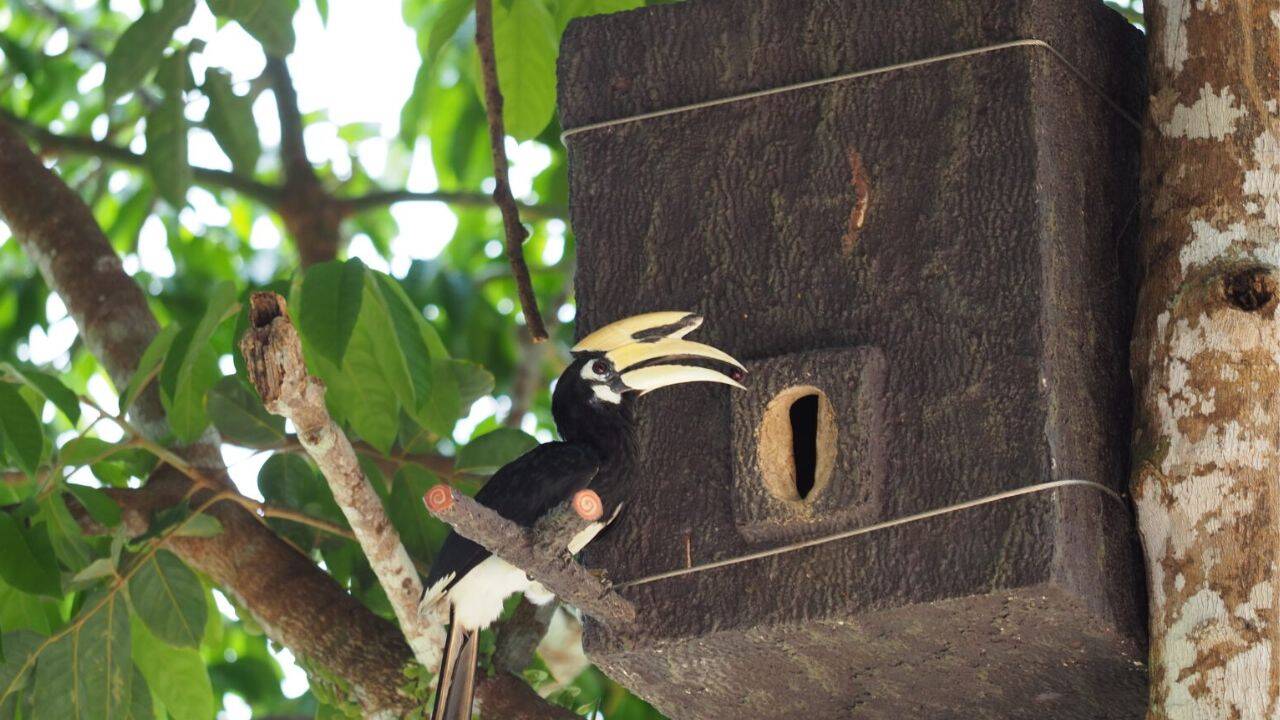
Hornbill showing interest in the artificial nest. Image Credit: The Earth Prize
The artificial nests are already giving hornbills new breeding opportunities
The project has moved beyond the testing stage and into the field. The Nation reported that ‘20 artificial nests’ have been installed on Yao Noi Island in southern Thailand. The early results have been encouraging. During the 2025 breeding season, 10 nests were occupied and 14 hornbill chicks successfully fledged. Khaosod English described the project as involving local students and community members, showing that the initiative is intended to create wider participation rather than operate solely as a scientific experiment. 60 local students had become involved in the project. The next stage is expected to expand the effort further. The Nation reported plans to install 10 large artificial nests in protected forest areas. Yanin has also been raising funds to support the installation of additional nests in ‘Su-ngai Padi National Park’ in Narathiwat province, which provides habitat for endangered hornbill species, including the Helmeted Hornbill and Rhinoceros Hornbill.
Why does education remain an important part of Homes for Hornbills
For Yanin, conservation does not end once an artificial nest is placed in a tree. The initiative also works with children and young people to explain the role hornbills play in forest ecosystems. Hornbills help disperse seeds, making them important to forest regeneration and biodiversity. Yanin has also used storytelling to spread awareness. According to Khaosod English, she produced the documentary ‘Homes for Hornbills,’ which ranked among Thailand’s top 10 youth documentaries. Her project shows how a conservation idea can begin with a simple observation that ‘a bird needs a safe place to breed, while plastic waste needs a better destination than the rubbish bin.’ By connecting those two problems, the 17-year-old has created a solution that has already helped hornbills and brought international attention to the challenges they face. More importantly, Homes for Hornbills demonstrates that meaningful conservation work does not always have to begin with a large organisation or decades of experience. Sometimes, it can start with an idea to make something that can actually be used in the forest.


