
Meet Vick Tan: The Minnesota student who turned a teabag into a low-cost filter that removed more than 90% of arsenic from water

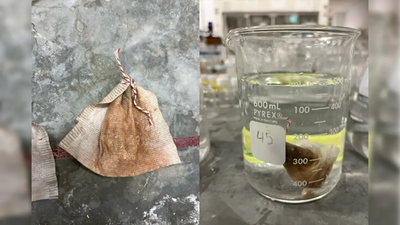
A small teabag may not seem like much of a solution to polluted drinking water, but for Minnesota student Vick Tan, it became the centre of a science project that went far beyond the classroom. Tan helped develop a simple-looking pouch designed to capture arsenic from contaminated water, using a mix of cellulose fabric, crushed eggshells and magnetic iron oxide particles. The idea earned Tan third place in the Medtronic Innovation Award category at the Minnesota State Science & Engineering Fair in 2025. A year later, the work appeared in a peer-reviewed paper in ACS Omega, where researchers reported that the most effective version of the teabag removed more than 98% of arsenic from a laboratory solution. The project also explored whether the bags could be reused, and how cheaply they could be produced.
How the Bemliese teabag uses eggshells and magnetic iron oxide to remove arsenic
Tan’s project first drew attention in Minnesota through the state’s science fair circuit. According to Eden Prairie Local News, Tan was among two Eden Prairie students recognised at the Minnesota State Science & Engineering Fair held in St Paul on March 28, 2025. Tan received third place in the Medtronic Innovation Award category for a project titled “A Reusable Teabag for Bioremediation of Arsenic from Drinking Water”. The award recognised projects judged on innovation, independent work and their potential impact, and Tan also received a $250 cash prize.The idea did not stop at the school competition. Tan later became a co-author of a research paper published in ACS Omega in March 2026, alongside Manuel A Lema, Keidy L Matos and Adam B Braunschweig. According to the paper published in the National Library of Medicine, titled ‘Detection of Arsenic at Micromolar Concentrations and Remediation of Arsenic from Drinking Water with a Bemliese Teabag’, both arsenic detection and removal. In the study, the researchers describe a teabag made from Bemliese cellulose fabric, with magnetic iron oxide nanoparticles incorporated into the material and pulverised eggshells placed inside.
What Bemliese fabric, eggshells and magnetic iron oxide do in the arsenic filter
The pouch itself was not an ordinary tea bag filled with tea leaves. The researchers used Bemliese, a cellulose-based non-woven fabric selected for its ability to absorb and retain liquid. The bag was modified with magnetic iron oxide nanoparticles, while uncharred eggshells were ground and placed inside it. Each part had a different job. The cellulose formed the container, the iron oxide provided additional surfaces capable of binding arsenic, and the eggshell material acted as another adsorbent.The combination mattered. Experiments with the individual components showed that ordinary Bemliese fabric could remove some arsenic, while adding eggshells improved its performance. The researchers then found that incorporating magnetic iron oxide nanoparticles increased the amount removed further. The strongest combination used a nanoparticle-embedded teabag containing uncharred eggshells. This version reduced arsenic in a 50 ml solution from 35 mg per litre to 0.69 mg per litre after six hours, representing a reduction of more than 98%.
Why arsenic contamination in groundwater is a major concern
The attraction of the idea comes partly from the difficulty of dealing with arsenic in groundwater. The published study says the World Health Organisation’s maximum permissible limit for arsenic in drinking water is 10 micrograms per litre, while dangerous concentrations occur in groundwater in several parts of South and Southeast Asia. The paper points to regions including Bihar in India, Bangladesh and Vietnam as places where groundwater contamination can be a serious concern. Long-term exposure to inorganic arsenic has been associated with several serious health problems, including cancers and cardiovascular disease.Existing treatment systems can be difficult to use in places where infrastructure and money are limited. The researchers specifically discuss reverse osmosis, a technology capable of removing arsenic but one that requires substantial infrastructure and can produce considerable water waste. That was part of the reasoning behind looking at materials that could be assembled into a smaller and cheaper system. The research team also developed a separate colour-based test for arsenic, in which a chemical reaction produces a yellow compound that can indicate the presence of arsenic.
How the teabag filter performed in laboratory tests
The experiments were carried out under controlled laboratory conditions rather than by simply placing a bag into an ordinary drinking-water glass. In one test, the most effective teabag configuration removed about 34 mg per litre of arsenic from a solution initially containing 35 mg per litre. The researchers also examined how performance changed with time and found that the high-performing combination reached its strongest result after six hours in the tested solution.The team also tested whether the same bag could be used again. The bags could be reused five times in the laboratory experiments, although their removal efficiency fell by roughly 19% with each reuse. The researchers say the repeated-use experiments were intended to demonstrate the possibility of regeneration rather than establish that repeated washing and drying would be necessary in real-world use. They also estimated the cost of materials at around seven US cents per teabag, with eggshells contributing almost no marginal cost because they were treated as a locally available waste.


