
Meet the red handfish, the critically endangered ‘walking’ fish that became Photo Ark’s 18,000th species

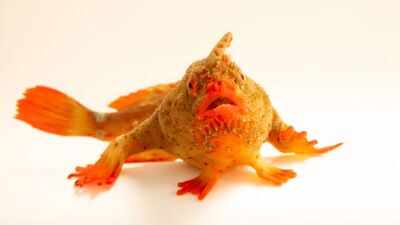
For 20 years, photographer Joel Sartore has been building a huge visual record of the world’s animals. His project, called the Photo Ark, has now reached another major milestone with its 18,000th species- the critically endangered red handfish. The milestone photo was announced by the National Geographic Society last week.The red handfish is a tiny marine fish that looks quite different from most fish. It uses its fins to move along the seafloor, almost as if it is walking. The animal is about the size of a thumb.Sartore photographed the red handfish at a breeding laboratory at the University of Tasmania’s Institute of Marine and Antarctic Studies. He set up a small photo tank on a tabletop and photographed them. “We put one in our little fish tank, and it kind of walks around,” Sartore says, as quoted by Smithsonian magazine.
How Photo Ark began
The first Photo Ark species was a naked mole-rat photographed at the Lincoln Children’s Zoo in Nebraska on August 9, 2006. Sartore had already worked as a field photographer for National Geographic magazine before.The idea for the project came after a difficult period in his personal life. In late 2005, his wife Kathy was diagnosed with breast cancer. Sartore stayed at home to care for her and their three children while she underwent treatment.“That year at home gave me a new perspective on the shortness and fragility of life,” Joel says. Kathy eventually made a full recovery. “She’s just fine to this day,” he adds.The experience also changed the way Sartore looked at animal life. He began creating portraits that showed animals clearly and individually, with the aim of documenting their existence and making people pay attention to the threats they face.Twenty years later, the Photo Ark contains photographs of fish, reptiles, amphibians, birds, mammals, insects and other forms of animal life. Sartore usually photographs several species in a day.
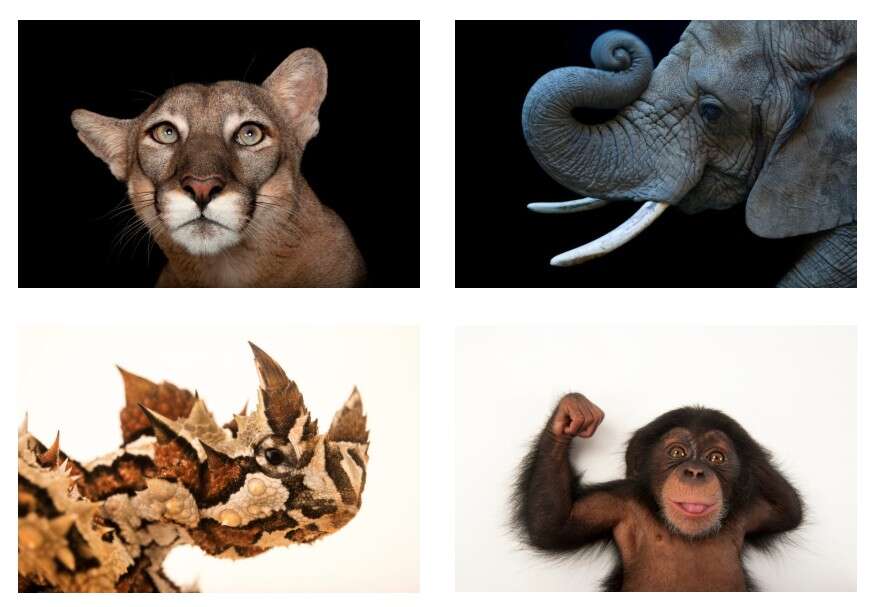
Some animals photographed by Photo Ark
Why Red Handfish is important
The species is critically endangered, making its place in the Photo Ark particularly significant. Its unusual way of moving makes it stand out from many other fish. In Sartore’s photograph, a female red handfish can be seen with its fins spread against the surface.Sartore’s goal is to photograph animals that can be seen with the naked eye, whether they live in trees, underground or in the ocean.He wants the photographs to help people understand what exists in the natural world while there is still time to protect it.“I want to get people to care while there’s still time to save habitats and all these other species,” Sartore saiys.The project also serves as a record. If some of the threatened animals photographed for the Photo Ark are eventually lost, their images will remain as a record that those species once existed.Sartore has already photographed species that are extinct in the wild and survive only because of conservation efforts in human care. These include the Guam kingfisher and the Monterrey platyfish.He has also photographed a preserved young thylacine, the extinct carnivorous marsupial also known as the Tasmanian tiger.
A closer look at tiny animals
Most of Sartore’s animal subjects are photographed in zoos, aquariums, wildlife sanctuaries and science laboratories. These locations allow him to get closer to animals and photograph them in controlled conditions.His portraits generally use black or white backgrounds. This keeps the focus on the animal and allows its natural colours to be seen clearly. “Just the animal, nothing else,” Sartore says.The approach also changes how people see small creatures. Without another object in the picture to show their size, even animals that could fit into a person’s hand can appear much larger. “You can look them in the eye, really see that there’s great intelligence there, and a basic right to exist, in my opinion,” Sartore says.The Photo Ark has grown beyond animals. Sartore also photographs corals, anemones and sponges.“We photograph a lot of animals that the world would never see without this project,” he says. Many of them, he adds, “can fit in the palm of your hand.”
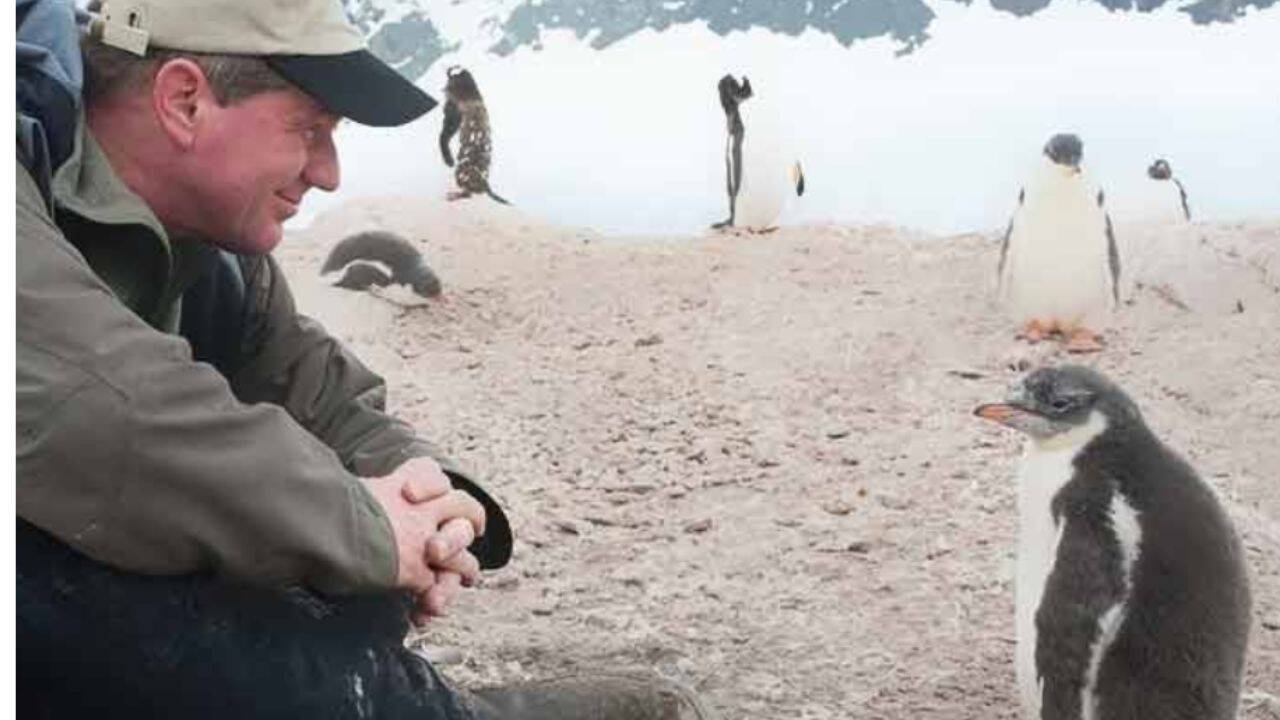
Joel with penguins (Photo Ark)
Photos support conservation
The Photo Ark is not only about creating a collection of animal portraits. Some of the photographs have also helped draw attention to species and habitats that need protection.One example is the Pine Rocklands in southeastern Florida. Ecological restoration expert George Gann describes the area as a “hyper-fragmented, hyper-rare, hyper-degraded ecosystem”.The habitat is home to threatened species including the Miami tiger beetle, Bartram’s scrub-hairstreak butterfly and the Florida bonneted bat. Sartore has photographed all three.In 2023, the project awarded its first Photo Ark Species Impact Initiative grant to Gann. The grant supports conservation work on the ground. Gann has been working to restore the area for decades.
From lost frogs to species found again
The project has also highlighted amphibians in Ecuador, where habitat loss and disease have put many species at risk. Luis A Coloma, director of Ecuador’s Jambatu Center for Amphibian Research and Conservation, says some amphibians had not been seen since the 1980s despite searches.The centre, which received a Photo Ark Species Impact Initiative grant in 2025, works to protect some of these animals. It breeds them under laboratory conditions and raises them with the aim of eventually returning them to nature.One of the species linked to this work is the longnose harlequin frog. Coloma and his team rediscovered the frog in 2016 after it had been considered extinct. “We were so happy to find them again,” Coloma says. “These are iconic animals in Ecuador. And we are trying to do our best to save these animals.” The species comes in different colours and has skin containing molecules that could have potential biomedical uses.Sartore photographed the longnose harlequin frog at the Jambatu Center in January 2019. At that time, only four individuals were known in Ecuador.
Photo Ark is still growing
Sartore is now 64, but the Photo Ark is not close to being finished. Around 25,000 animal species are in human care around the world, and Sartore wants to photograph all of them.His son Cole already joins him on foreign trips and is expected to continue the project in the future. “He’ll take over when I’m too old to do it anymore,” Sartore says.Sartore sees the project as something that should continue to have value beyond his own lifetime. “My thing is to give my life to this,” he says. “I’m a photographer and a storyteller; what else was I supposed to do? What else can you do?”He hopes that when people see the animals in his photographs, they will understand what exists in the natural world and think about whether those species should be protected. “They can see what it is that’s out there and decide whether or not they want to save it, because it really is a choice,” Sartore says.


