
Meet the ‘Dinosaur Bird’ Cassowary: World’s most dangerous bird that delivers kicks powerful enough to break your bones and is the closest dinosaur relative.

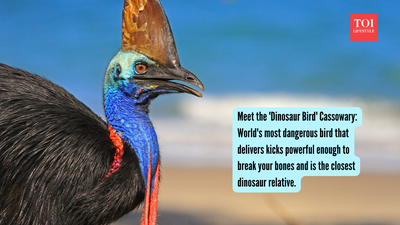
Dinosaurs roamed the Earth millions of years ago and left no living creature of their exact type alive, only through their discovered fossils can we gauge who they were and what their lifestyles might have been like.But there is one that stands as the closest relative of those humungous beasts, and it is more dangerous than the others!Many such creatures on the planet make us feel small the moment we spot them or hear about them, not because they are always loud or aggressive, but because everything about those beasts seems to nearly tell us who is in charge!The Cassowary bird is one such type.
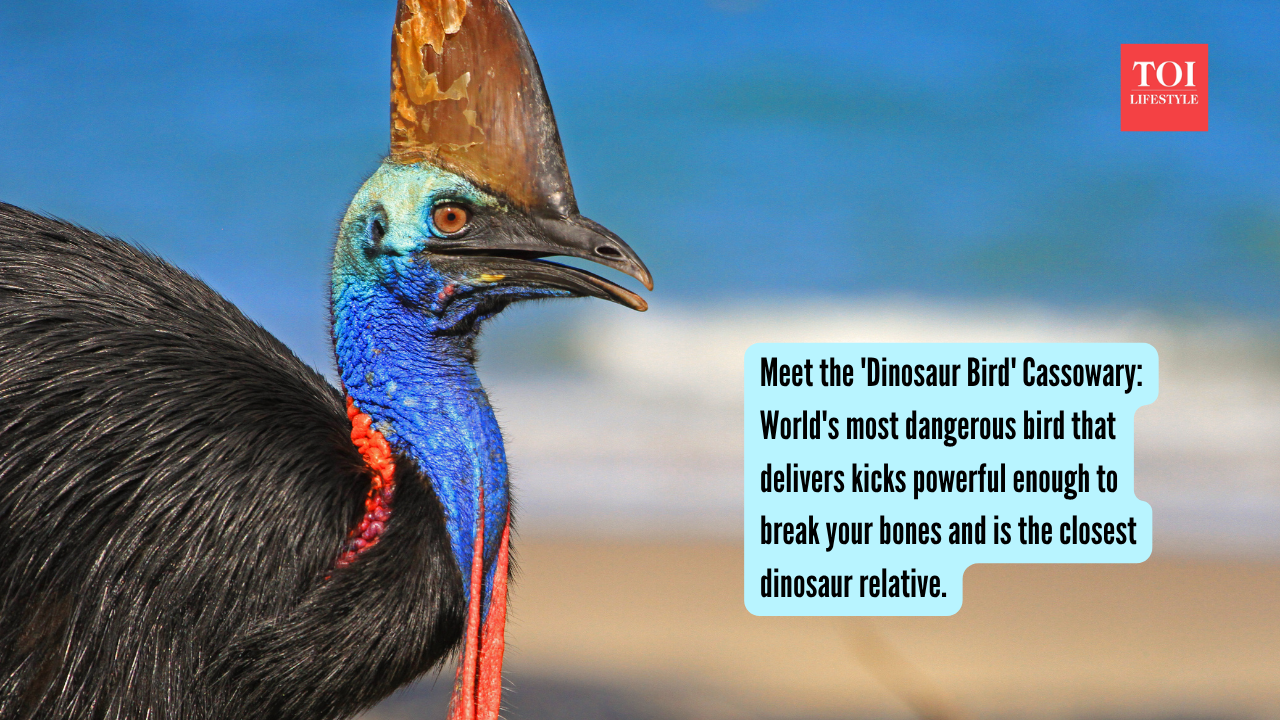
Photo via Canva
Meet the ‘dinosaur bird ’: the most dangerous bird in the world and the closest relative of the dinosaurs
Cassowaries aren’t called “dinosaur birds” for nothing. Genetically, they sit closer to ancient theropods than almost any other living bird, and it is clearly visible in their stiff, hair-like feathers, reptilian legs, and unmistakable prehistoric look. It has been labelled the world’s most dangerous bird by the Guinness World Records for a ‘deadly secret weapon’.Found only in the rainforests of Australia and New Guinea, the southern cassowary is nearly 1.5 to 1.8 metres tall and weighs over 58 kilograms, according to the Australian Museum. What makes it intimidating, however, are its sharp claws and a helmet-shaped casque.
Three species, one intimidating family
There are three cassowary species: southern, northern, and dwarf. The southern cassowary is the largest and best known, with females outweighing males, according to the San Diego Zoo Wildlife Alliance. The northern cassowary, found in New Guinea’s swampy lowlands, is shy but solitary, with males who raise chicks for around nine months. The dwarf cassowary, the smallest of the three, prefers higher mountain forests. All three belong to the bird family Casuariidae, along with the emu.
Its physical appearance is no less than a mystery
The cassowary’s casque is made of keratin, the same material as human nails, and remains one of nature’s most interesting mysteries. Scientists still debate whether it amplifies sound, regulates temperature, or simply helps the bird push through the thick trees and shrubs.Below it, vivid blue and red skin colours the face, neck, and wattle, which act as markers for health and age. Its glossy black feathers resemble coarse horsehair rather than typical feather cover. And the most powerful part of their body is the legs, which are powerful, scaled, and tipped with claws reaching up to 12 centimetres.
But why is the Cassowary the most dangerous bird in the world?
Ask most people to imagine a dangerous bird, and they’ll think of a hawk swooping down with talons out, but they either miss this unusual beast or don’t know of it at all!Cassowary attacks on humans do happen, usually triggered by habitat loss, provocation, or chicks needing protection—which is part of why it’s earned its “world’s most dangerous bird” reputation, even though, statistically, ostriches cause more human deaths worldwide.However, a comprehensive study on cassowary attacks was published in the Journal of Zoology by Christopher Kofron in 2006. He studied 221 cassowary attacks in total, and humans were on the receiving end in 150 of them.Interestingly, three out of four of those attacks happened because people were feeding the birds. When they did attack, cassowaries mostly just charged at people about 71% of the time, and only pulled out the dagger-claws in about 15% of cases.As for why they attacked at all, roughly a fifth of the incidents were the bird simply protecting itself or its eggs. The rest happened because a person walked up too close for comfort.Serious injuries were rarely noted, making it only about 3% of cases, and across the entire study, there was just one recorded death. A second fatal attack was later reported in Florida, after Kofron’s research had already wrapped up.
They can deliver bone-breaking, powerful kicks
Moreover, what makes it even more dangerous is that it can also run at speeds up to 50 km/h and leap over two metres, making it as agile as it is well-fed. They are equipped with 15cm claws on their middle toes, which they mainly use as a defence against dingos, pythons, and birds of prey, and when jumping, they deliver a mean kick that is capable enough to knock you down or simply break your bones.


