
Meet Seungah Chung, the US eighth-grader who used 200 ants and a maze to discover they navigate by landmarks

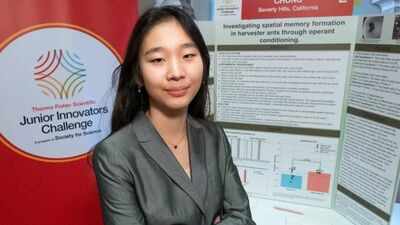
Most of us have seen ants marching across the ground without giving them much thought. Seungah Chung saw something different. She wondered how such tiny creatures, with brains no larger than a pinhead, manage to find food and then make their way back home without getting lost.That question led the eighth-grade student from Beverly Vista Middle School in California to design an experiment involving 200 red harvester ants and a maze. According to the Society for Science, her research found that red harvester ants don’t simply wander until they reach their destination; they rely on visual landmarks to help guide them. The project earned Seungah a place among the finalists in the 2025 Thermo Fisher Scientific Junior Innovators Challenge, one of the leading STEM competitions for middle school students in the US.
A simple observation became a science project
Seungah’s interest in ants began with everyday observations. Watching them move in neat lines made her curious about what was happening behind the scenes. Scientists have long known that ants leave chemical trails that other ants can follow, but Seungah wanted to know whether that was the whole story.Could the insects also recognise objects around them and use those as guides?To answer that question, she decided to build an experiment that would let the ants show her how they navigate rather than relying only on what previous studies had suggested.
Building a maze for 200 ants
For her project, Seungah worked with 200 red harvester ants (Pogonomyrmex barbatus). She placed 15 ants at a time in a T-shaped maze, where a small piece of tangerine served as a food reward.The maze wasn’t left empty. Along the path, she arranged artificial landmarks, including fake leaves, sea rocks and colourful building blocks. These objects acted as visual markers that the ants could potentially use while learning the route.After giving the ants time to explore the maze and become familiar with it, she tested whether they could remember the correct path. Repeating the experiment with many ants helped ensure that the results reflected a consistent pattern rather than chance.
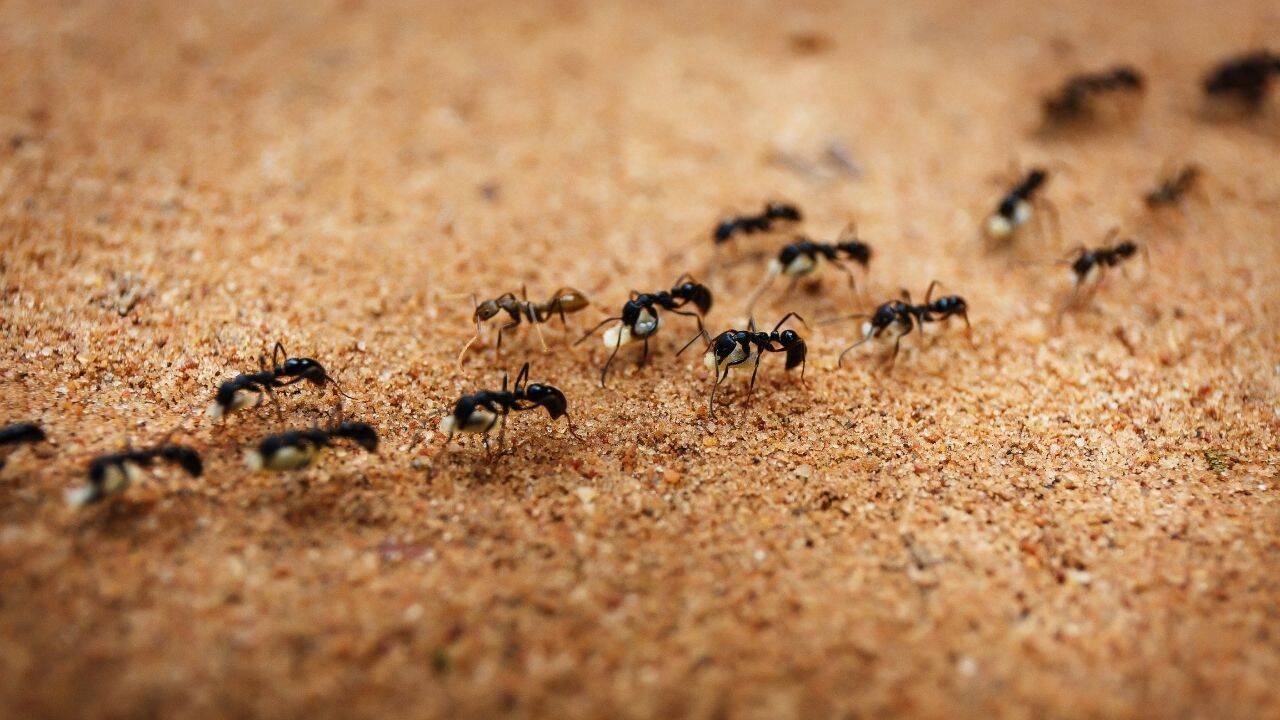
Representative Image (Canva)
The landmarks made all the difference
The most interesting part of the experiment came after the ants had learned where the food was. Instead of moving the food itself, Seungah rearranged the landmarks inside the maze. If the ants were relying only on memory of the route, changing the objects shouldn’t have affected them very much. But it did.Many ants became confused once the landmarks were moved. Some headed in the wrong direction even though the food remained in exactly the same place. Their behaviour suggested they were using the surrounding objects as reference points rather than simply remembering whether to turn left or right.The results showed that visual landmarks play an important role in helping red harvester ants navigate their surroundings.
Why this matters beyond ants
At first glance, studying ants might seem like a small project, but the question behind it has much broader significance.Scientists have long been fascinated by how insects perform surprisingly complex tasks despite having very small brains. Understanding how ants navigate could eventually help researchers develop smarter robots and autonomous machines that need to move through unfamiliar environments using limited information.Seungah’s project also demonstrates how behavioural studies can reveal the hidden abilities of animals. Sometimes, changing just one part of an experiment, in this case, the position of a few landmarks, is enough to uncover how an animal thinks and responds to its surroundings.
Recognition for thoughtful research
Seungah’s careful approach earned her national recognition as a finalist in the 2025 Thermo Fisher Scientific Junior Innovators Challenge. The competition celebrates middle school students who tackle scientific questions through original research and creative problem-solving.Outside the classroom, Seungah enjoys art and volunteers with Ariari21, helping paint murals at homeless shelters and senior living communities. She hopes to become a microbiologist one day, inspired by scientists whose work has improved lives around the world.
A reminder that curiosity can go a long way
The project started off with a phenomenon that Seungah Chung probably noticed like most people, a line of ants moving across the floor. But while others took this for granted, she asked questions and tried answering them herself.By constructing a maze and observing the behavior of 200 red harvester ants, Seungah provided evidence that these insects use landmarks for navigation. More than just supporting this idea, her experiment demonstrates that curiosity and careful observation can lead to meaningful scientific discoveries without expensive laboratory equipment. Breakthroughs, even those that might not have been made otherwise, start with curiosity and persistence.It is a lesson that goes far beyond the ant kingdom, as some of the most interesting science comes from a deeper look at all those commonplace things that surround us every day.


