
Meet Ishanvi Sabniveesu, the Florida 10th-grader whose AI-powered cane can describe a blind user’s surroundings, work offline and make emergency calls

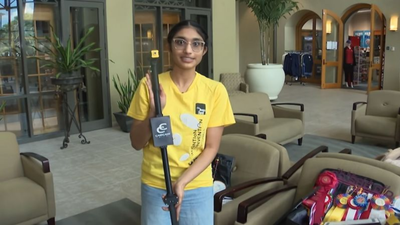
For Ishanvi Sabniveesu, the idea for an assistive device began with something she had experienced herself. The Florida student, who has worn glasses since she was two, began thinking about how difficult everyday activities could be for someone with severe visual impairment. She eventually developed CareCane, an AI-powered cane designed to help visually impaired users detect obstacles, understand their surroundings and receive emergency assistance. According to FOX 13 News, which interviewed Sabniveesu about her invention, the rising junior at Steinbrenner High School won second place at the Invention Convention U.S. Nationals with CareCane.
An idea born from experience
Sabniveesu’s interest in helping people with visual impairments stemmed from her own experience relying on glasses. She told FOX 13 that doing simple things without her glasses had always been difficult for her, which made her consider the challenges faced by people who cannot depend on their vision. Before developing CareCane, she researched products already available on the market and visited schools for visually impaired students to gather feedback and better understand their needs.She initially considered putting similar technology into glasses. However, she realised that stability was also an important consideration for people who are blind or visually impaired. That led her to consider a cane as a more practical way to combine mobility support with technology.
How CareCane works
CareCane combines a traditional cane with built-in sensors and a camera. The sensor detects when a user is getting close to a person or object. When an obstacle is detected, the cane produces a warning beep.If the sensor continues beeping for more than five seconds, the camera automatically activates. It can then identify the user’s surroundings and provide a description through connected Bluetooth speakers or headphones. The user can also activate the camera manually using a button on the cane’s handle.This gives the device a function beyond simply detecting an obstacle. Instead of only indicating that something is nearby, the system is designed to provide an audio description of the surrounding environment. For someone navigating an unfamiliar setting, that additional information could potentially help them understand their surroundings without relying solely on physical contact with obstacles.
It can work without internet
One notable feature of CareCane is its ability to operate with or without internet access. Sabniveesu told FOX 13 that she deliberately designed the system this way because she wanted the device to be accessible to people in places with limited or no internet connectivity.This is particularly relevant for assistive technology because relying entirely on an internet connection could limit where a device can be used. By designing CareCane to function offline as well, Sabniveesu is attempting to make the technology useful in a wider range of circumstances.
Emergency assistance
CareCane is also designed to provide an additional safety feature. Unlike some smart canes, the device includes a fall feature that can trigger emergency calls and send alerts to preset contacts through a mobile application.The feature is intended to help when a user falls and may not be able to make a call independently. Instead of functioning solely as a navigation aid, CareCane is therefore being developed as a device that combines environmental awareness with emergency communication.
From STEM fair to nationals
CareCane’s journey began at the Hillsborough County STEM Fair. Sabniveesu’s performance there led to an invitation to a state convention, before the invention eventually reached the national level. Earlier in June 2026, CareCane earned second place at the Invention Convention U.S. Nationals, giving Sabniveesu national recognition for the project.The award also came while the invention was still being developed, meaning the national recognition is part of an ongoing process rather than the final stage of the project.
What’s next for CareCane?
Sabniveesu is continuing to develop the device and plans to introduce additional features, including voice commands. She has also registered a startup, CareCane LLC, and has a patent pending for the device. CareCane remains in the startup-development phase, with the patent process and FDA approval still ahead.
Beyond visual impairment
Sabniveesu’s ambitions for the technology extend beyond CareCane itself. She hopes the same technology could eventually be adapted for other medical equipment, including hospital beds and wheelchairs. Her broader goal is to explore whether the technology could assist not only people with visual impairments but also people experiencing other mobility limitations.For now, CareCane remains a developing invention rather than a commercially available medical device. Its final form will depend on further development, patent processes and regulatory requirements.
A young inventor’s approach to accessibility
CareCane brings together several functions in an attempt to address everyday challenges faced by people with visual impairments. It is designed to detect nearby obstacles, describe surroundings through audio, function without constant internet access and provide emergency alerts after a fall.What makes Sabniveesu’s project notable is that the invention grew from her attempt to understand a problem beyond her own experience. Rather than replacing the traditional cane, she has tried to add technology to it while preserving its role as a mobility aid.At the national convention, that idea earned her second place. As development continues, Sabniveesu is now working to turn a high school invention into a technology that could eventually provide greater information, safety and independence to people with visual and mobility challenges.


