
Mayawati’s solo Punjab gamble tests whether the state’s 32% Dalit population can translate into a consolidated BSP vote. Bahujan Samaj Party (BSP) chief Mayawati has decided to go solo in the upcoming 2027 Punjab assembly election. This move has put the spotlight on a striking contradiction in the state’s politics: Punjab has India’s highest proportion of Scheduled Castes, but no political party has been able to turn that numerical strength into a durable Dalit vote bloc.On August 25, Mayawati announced that the BSP would contest the polls “alone without any alliance or compromise with anyone”, arguing that electoral tie-ups risked weakening the party’s vote share and demoralising its cadre.The decision carries particular significance in Punjab, where BSP founder Kanshi Ram began his political journey and where Scheduled Castes account for 31.94% of the population, according to the 2011 Census.Yet nearly one-third of Punjab’s population has never translated into nearly one-third of the vote for the BSP – or any other Dalit-centric political formation.Instead, the Dalit electorate has remained divided across caste, religious, regional and economic lines, allowing the Congress, AAP, SAD and BJP to each build pockets of support within it.That makes Mayawati’s 2027 gamble less about the size of Punjab’s Dalit population and more about a difficult political question: Can she turn the state’s 32% Dalit population into a coherent electoral bloc?Punjab’s number paradoxThe numbers explain why every major political party wants a share of the Dalit vote.Punjab had about 88.6 lakh Scheduled Castes in the 2011 Census, accounting for 31.94% of its population – the highest SC proportion among Indian states. The community is particularly concentrated in the Doaba region, which includes Jalandhar, Hoshiarpur and Nawanshahr.Eight of Doaba’s 23 assembly constituencies are reserved for SC candidates, while both Lok Sabha constituencies in the region, Jalandhar and Hoshiarpur, are reserved.Across Punjab, 34 of the 117 assembly seats are reserved for Scheduled Caste candidates. But the political influence of Dalit voters extends far beyond these constituencies.In Punjab, Dalits are divided into several sub-castes and religion. A 2021 analysis by Lokniti-CSDS professor Sanjay Kumar found that Dalits accounted for more than 30% of voters in 54 assembly constituencies and between 20% and 30% in another 45.In other words, Dalit voters can influence far more than the 34 seats formally reserved for them.But there is a crucial caveat: ‘Dalit’ is not a single political identity in Punjab.The community comprises several sub-caste and religious groups, including Ravidassias/Ad-Dharmis, Mazhabi Sikhs, Ramdasias and others. Their geographical distribution, religious affiliations, economic circumstances and political histories differ.That fragmentation has repeatedly prevented the kind of consolidated Dalit politics that emerged around the BSP in Uttar Pradesh.Punjab’s agrarian structure adds another layer. Land and economic power remain disproportionately concentrated among dominant agrarian communities, particularly Jat Sikhs. As a result, Dalit politics in the state often revolves around land rights, employment, reservation, social dignity and access to common resources, rather than caste identity alone.From Kanshi Ram’s Punjab to BSP’s high-water markMayawati pays tribute on death anniversary of Kanshi Ram. The irony is that Punjab was once among the BSP’s strongest political laboratories.Kanshi Ram, born in Punjab, built his early political movement around the mobilisation of Scheduled Castes and other marginalised communities before founding the BSP in 1984.The party’s breakthrough in Punjab came in the 1992 election. It won nine of the state’s 117 seats with 16.32% of the vote, emerging as the principal opposition party in the House. Six of those nine seats came from Doaba, underlining the region’s importance to the party’s political project.But the breakthrough proved difficult to sustain.In 1997, the BSP’s tally fell to one seat, although it still secured 7.48% of the vote. Its vote share then declined steadily — to 5.69% in 2002, 4.13% in 2007 and 4.29% in 2012. By 2017, it had fallen to 1.52%.In 2022, the BSP won just one seat with 1.77% of the vote, contesting as part of its alliance with the Shiromani Akali Dal.The steep decline in three decades captures the central problem Mayawati now faces.How 2022 exposed the paradoxIf the BSP’s decline showed the difficulty of sustaining Dalit-centric politics, the 2022 assembly election demonstrated how effectively mainstream parties can cut across caste identities.The AAP won 92 of Punjab’s 117 seats with 42.01% of the statewide vote, while Congress was reduced to 18 seats.The AAP’s performance was particularly striking in SC-reserved constituencies. It won 29 of the 34 reserved seats, while Congress won four and the SAD-BSP alliance one.The result also undercut the assumption that Congress’s elevation of Charanjit Singh Channi as Punjab’s first Dalit CM would automatically consolidate the Dalit vote behind the party. Channi became CM in September 2021, just months before the election. His elevation was widely viewed as an attempt to appeal to the state’s huge Dalit electorate.But in March 2022, Congress suffered a dramatic defeat.SAD and its alliance routeThe SAD has historically had its own Dalit support base, particularly among Sikh Dalits.Its alliance with Mayawati ahead of the 2022 election was an attempt to combine the Akali network among sections of the Sikh electorate with the BSP’s Dalit support base.The combination, however, failed to produce the revival the two parties had hoped for. The alliance won four seats – three for the SAD and one for the BSP – with a combined vote share of around 20%.BJP’s gamble: From alliance politics to going soloThe BJP faces perhaps the most difficult social-coalition challenge of all.Its long-standing electoral arrangement with the SAD ended after the Akali Dal walked out of the NDA at the Centre over the farm laws.The BJP is now trying to establish itself as an independent force in a state where it historically relied heavily on the Akali alliance to provide it with a rural and Sikh social base. That means the party needs to build coalitions beyond the constituencies it traditionally relied on, while also trying to repair its relationship with farmers.Dalit voters are an obvious part of that expansion strategy.But Punjab is not Uttar Pradesh or Bihar. There, the BJP has invested heavily in a social coalition involving non-Yadav OBCs and Dalits. A different caste and religious configuration shapes Punjab’s political landscape, while its agrarian structure and Sikh identity make the BJP’s social engineering considerably more complicated.For the BJP, winning Dalit voters is therefore not simply about adding another community to its support base. It is about constructing an entirely new political coalition in a state where its old alliance no longer provides the same electoral cushion.AAP’s pitch: Welfare, not identityThe AAP has already demonstrated why the size of the Dalit population does not automatically translate into BSP votes.In 2022, the party’s appeal cut across caste lines, combining welfare, anti-incumbency and the promise of an alternative to the traditional parties. It also had the ‘Delhi model’ to demonstrate its pitch.AAP sought to build a political vocabulary around BR Ambedkar, combining Ambedkarite symbolism with a broader welfare narrative.Rather than presenting Dalits as a separate electoral constituency, the party has sought to fold their concerns into a larger promise around government schools, healthcare, jobs, welfare delivery and social dignity.However, now the 2027 election will test whether AAP can retain that support after a full term in government.Congress has history, but not the Dalit lockCongress has historically had a strong base among both Hindu and Sikh Dalits in Punjab, but its 2022 performance showed the limits of that advantage. In the 2017 election, the party won 21 of 34 SC-reserved seats; by 2022, after making Charanjit Singh Channi the state’s first Dalit CM and projecting him as its CM face, Congress was reduced to just four reserved seats, while AAP won 29.The setback has not ended Congress’s Dalit outreach. In January 2026, Channi himself raised questions within the party over the representation of Dalit leaders, pointing out that several key Punjab Congress positions were held by Jat Sikhs.For Congress, the 2027 challenge is therefore not winning Dalit votes from scratch, but rebuilding a social coalition it once had, without reducing Dalit politics to the Channi factor alone.Mayawati’s real gambleMayawati’s decision to contest alone is therefore both ideological and organisational.The BSP has something only a few parties can claim: a political vocabulary explicitly built around Ambedkar, Kanshi Ram and Bahujan mobilisation. Punjab also provides the demographic foundation for such a project.But the party’s electoral history demonstrates the enormous gap between having a potential social constituency and converting it into votes and seats.The challenge is not simply to persuade Dalits to vote for the BSP. It is to persuade different Dalit communities that their interests are sufficiently common to vote for the same party. That is a much harder proposition in Punjab than the 32% figure suggests.Ready to play a spoilsport?There is, however, another reason Mayawati’s decision could matter even if the BSP does not return to anything close to its 1992 performance.Punjab’s 2027 contest is shaping up as a fragmented battle involving AAP, Congress, BJP and SAD, although the possibility of a BJP-SAD reunion remains open.In such a contest, even a relatively small but geographically concentrated BSP vote could become consequential.The party’s past performance offers a warning to the larger parties. In 2024, the BSP was reported to have remained a significant factor in parts of Doaba despite its shrinking statewide base, with observers pointing to its potential to influence contests in seats such as Anandpur Sahib, Jalandhar and Hoshiarpur.Join conversationView All Comments →Share your thoughts in the commentsInsightfulAgreeDisagreeSkepticalConcerningPromisingWorth ReadingBig DevelopmentPost CommentBe respectful · TOI community guidelinesThat is the paradox of Mayawati’s Punjab gamble.The BSP may no longer have the numbers to dominate Punjab’s Dalit politics, but it could still have enough votes to disrupt everyone else’s arithmetic.The 2027 election will therefore test not just whether Mayawati can revive the BSP in Kanshi Ram’s home state, but whether Punjab’s nearly 32% Dalit population can finally translate its demographic weight into political leverage – if not as a single bloc, then as the constituency no major party can afford to ignore.Get the latest India News and Live updates. Download the TOI app.Here are more Raksha Bandhan wishes, Bhadra kaal and Shubh Muhurat from The Times of India.About the AuthorPallaviNews desk journalist, digital, at The Times of India, with a focus on Indian politics. Over a decade of chasing stories, taming headlines and arguing with commas like they’re part of the opposition. Tracks elections, policy pivots, party drama and the fine print of power, where every word can tilt the narrative. Believes good journalism is clarity under pressure, ideally filed before the next breaking alert crashes in. Powered by deadlines, context, sharp edits and a steady supply of strong tea.Read MoreEnd of ArticleFollow Us On Social MediaVideosGovt Taps EIL For Quality Checks On 5,000 Km Of Road Projects After Modi’s ‘4th-Party Audit’ Jibe469 Dead In Nepal Floods; 3 Bodies Found In Uttar Pradesh; Kathmandu Declines Foreign Rescue TeamsCongress Alleges ₹36,000 Crore ‘Sugar Scam’, Slams Modi Govt Over Festive Price RisePM Modi’s Central Asia Visit: SCO Summit, Uzbekistan Ties, Putin Meet In FocusCM Suvendu Adhikari Urges Skilled Bengalis Abroad To Return, Promises Jobs Under Double-Engine Govt’Blind Pakistan Activated Spies To Locate India’s S-400′ During Op Sindoor, Ex-Air Marshal RevealsCamac Street Showdown: TMC Blocks Police During Billboard Removal, Banerjee Announces Court MoveNepal Floods: 288 Indians Uncontactable, 21 Rescued So Far, MEA Shares Key Updates | WatchFour Killed, One Missing In Manipur Ambush As Naga-Kuki Tensions Erupt Again, Probe Launch | WatchFake IAS Officer Tripti Rajput Under Probe, Police Recover CBI Cards And Government Documents123Photostories5 jewellery styling mistakes to avoid with traditional festive outfitsLock Upp 2 fame Akanksha Chamola’s luxurious Mumbai home: Elegant interiors, cosy living room and beautiful mandirH1N1 Or COVID-19? Symptoms may look the same, but the diagnosis can mean a very different treatment approachMakeup not lasting all day? Here’s why your base melts by noonThe ‘ick’ explained: 7 reasons attraction between partners can suddenly disappear (and how to bring the spark back)5 reasons people pull away even when they have feelings7 signs you like the idea of a romantic relationship more than your partnerCuff too tight, legs crossed or talking? Cardiologist reveals 5 home BP mistakes that can alter readings5 habits that can quietly damage a marriageNepal flash flood: 7 glacial hotspots around the world facing rising climate risks123Hot PicksNepal floodUPTET Result 2026Sunny LeoneKerala name changeRRB NTPC UG CBT 2 examAnkit Baliyan murderSridhar VembuDelhi murderNEET PG 2026 admit cardTop TrendingAnkit Balyan MurderChandigarh MurderSamay RainaUdaipur HotelFlorida Car CrashUS Green Card HolderBengal HospitalTamil Nadu Son MurderElon MuskKanpur Aircraft Crash

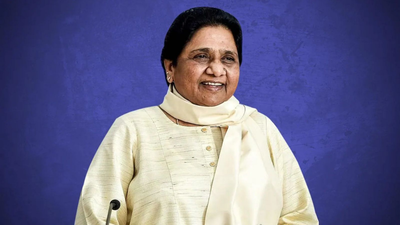
Bahujan Samaj Party (BSP) chief Mayawati has decided to go solo in the upcoming 2027 Punjab assembly election. This move has put the spotlight on a striking contradiction in the state’s politics: Punjab has India’s highest proportion of Scheduled Castes, but no political party has been able to turn that numerical strength into a durable Dalit vote bloc.On August 25, Mayawati announced that the BSP would contest the polls “alone without any alliance or compromise with anyone”, arguing that electoral tie-ups risked weakening the party’s vote share and demoralising its cadre.The decision carries particular significance in Punjab, where BSP founder Kanshi Ram began his political journey and where Scheduled Castes account for 31.94% of the population, according to the 2011 Census.Yet nearly one-third of Punjab’s population has never translated into nearly one-third of the vote for the BSP – or any other Dalit-centric political formation.Instead, the Dalit electorate has remained divided across caste, religious, regional and economic lines, allowing the Congress, AAP, SAD and BJP to each build pockets of support within it.That makes Mayawati’s 2027 gamble less about the size of Punjab’s Dalit population and more about a difficult political question: Can she turn the state’s 32% Dalit population into a coherent electoral bloc?
Punjab’s number paradox
The numbers explain why every major political party wants a share of the Dalit vote.Punjab had about 88.6 lakh Scheduled Castes in the 2011 Census, accounting for 31.94% of its population – the highest SC proportion among Indian states. The community is particularly concentrated in the Doaba region, which includes Jalandhar, Hoshiarpur and Nawanshahr.Eight of Doaba’s 23 assembly constituencies are reserved for SC candidates, while both Lok Sabha constituencies in the region, Jalandhar and Hoshiarpur, are reserved.Across Punjab, 34 of the 117 assembly seats are reserved for Scheduled Caste candidates. But the political influence of Dalit voters extends far beyond these constituencies.
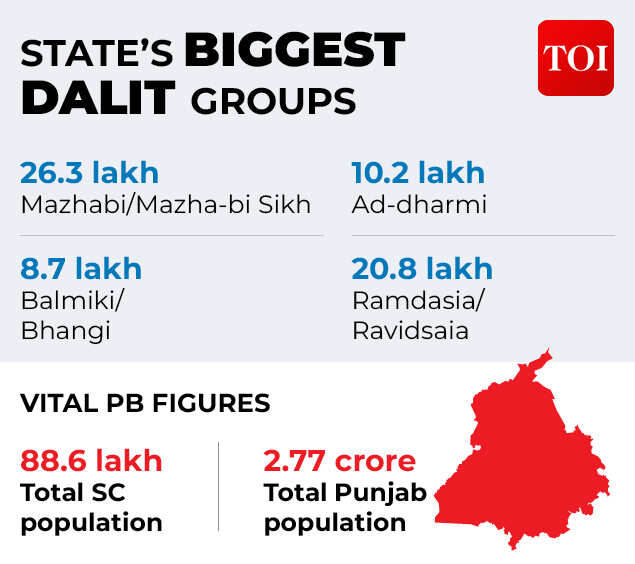
In Punjab, Dalits are divided into several sub-castes and religion.
A 2021 analysis by Lokniti-CSDS professor Sanjay Kumar found that Dalits accounted for more than 30% of voters in 54 assembly constituencies and between 20% and 30% in another 45.In other words, Dalit voters can influence far more than the 34 seats formally reserved for them.But there is a crucial caveat: ‘Dalit’ is not a single political identity in Punjab.The community comprises several sub-caste and religious groups, including Ravidassias/Ad-Dharmis, Mazhabi Sikhs, Ramdasias and others. Their geographical distribution, religious affiliations, economic circumstances and political histories differ.That fragmentation has repeatedly prevented the kind of consolidated Dalit politics that emerged around the BSP in Uttar Pradesh.Punjab’s agrarian structure adds another layer. Land and economic power remain disproportionately concentrated among dominant agrarian communities, particularly Jat Sikhs. As a result, Dalit politics in the state often revolves around land rights, employment, reservation, social dignity and access to common resources, rather than caste identity alone.
From Kanshi Ram’s Punjab to BSP’s high-water mark
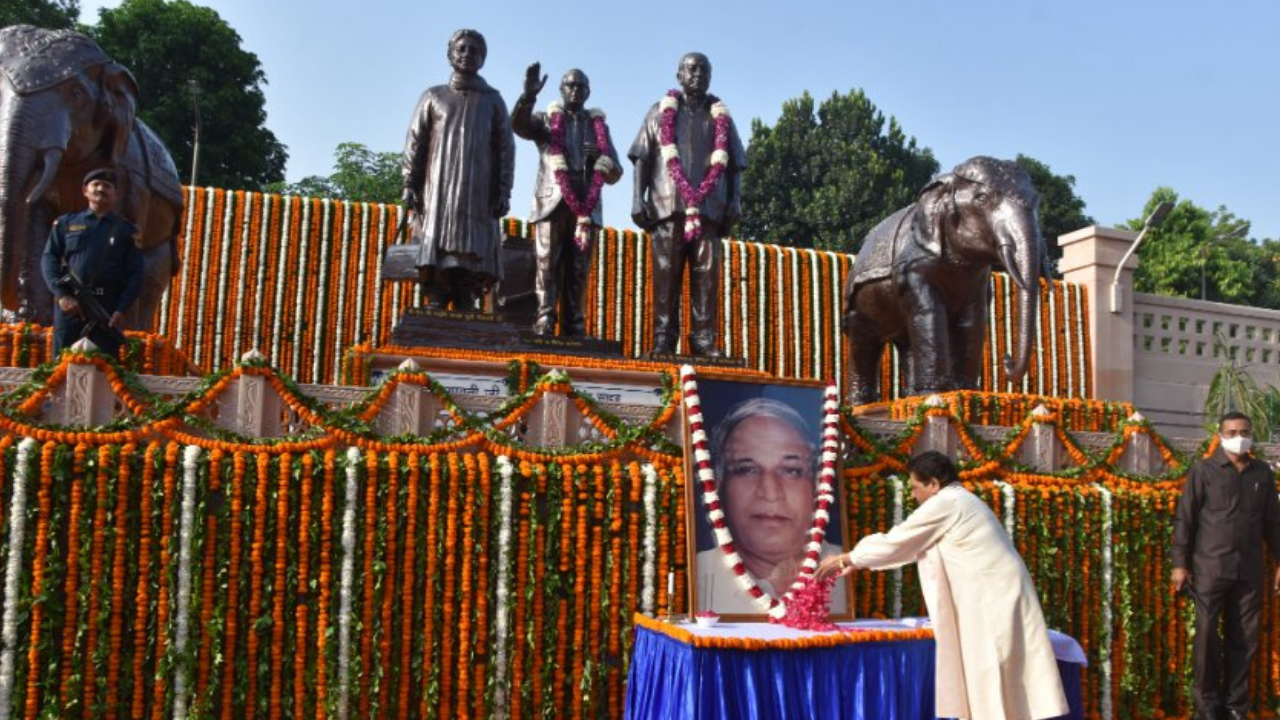
Mayawati pays tribute on death anniversary of Kanshi Ram.
The irony is that Punjab was once among the BSP’s strongest political laboratories.Kanshi Ram, born in Punjab, built his early political movement around the mobilisation of Scheduled Castes and other marginalised communities before founding the BSP in 1984.The party’s breakthrough in Punjab came in the 1992 election. It won nine of the state’s 117 seats with 16.32% of the vote, emerging as the principal opposition party in the House. Six of those nine seats came from Doaba, underlining the region’s importance to the party’s political project.But the breakthrough proved difficult to sustain.In 1997, the BSP’s tally fell to one seat, although it still secured 7.48% of the vote. Its vote share then declined steadily — to 5.69% in 2002, 4.13% in 2007 and 4.29% in 2012. By 2017, it had fallen to 1.52%.In 2022, the BSP won just one seat with 1.77% of the vote, contesting as part of its alliance with the Shiromani Akali Dal.The steep decline in three decades captures the central problem Mayawati now faces.
How 2022 exposed the paradox
If the BSP’s decline showed the difficulty of sustaining Dalit-centric politics, the 2022 assembly election demonstrated how effectively mainstream parties can cut across caste identities.The AAP won 92 of Punjab’s 117 seats with 42.01% of the statewide vote, while Congress was reduced to 18 seats.The AAP’s performance was particularly striking in SC-reserved constituencies. It won 29 of the 34 reserved seats, while Congress won four and the SAD-BSP alliance one.The result also undercut the assumption that Congress’s elevation of Charanjit Singh Channi as Punjab’s first Dalit CM would automatically consolidate the Dalit vote behind the party. Channi became CM in September 2021, just months before the election. His elevation was widely viewed as an attempt to appeal to the state’s huge Dalit electorate.But in March 2022, Congress suffered a dramatic defeat.
SAD and its alliance route
The SAD has historically had its own Dalit support base, particularly among Sikh Dalits.Its alliance with Mayawati ahead of the 2022 election was an attempt to combine the Akali network among sections of the Sikh electorate with the BSP’s Dalit support base.The combination, however, failed to produce the revival the two parties had hoped for. The alliance won four seats – three for the SAD and one for the BSP – with a combined vote share of around 20%.BJP’s gamble: From alliance politics to going soloThe BJP faces perhaps the most difficult social-coalition challenge of all.Its long-standing electoral arrangement with the SAD ended after the Akali Dal walked out of the NDA at the Centre over the farm laws.The BJP is now trying to establish itself as an independent force in a state where it historically relied heavily on the Akali alliance to provide it with a rural and Sikh social base. That means the party needs to build coalitions beyond the constituencies it traditionally relied on, while also trying to repair its relationship with farmers.Dalit voters are an obvious part of that expansion strategy.But Punjab is not Uttar Pradesh or Bihar. There, the BJP has invested heavily in a social coalition involving non-Yadav OBCs and Dalits. A different caste and religious configuration shapes Punjab’s political landscape, while its agrarian structure and Sikh identity make the BJP’s social engineering considerably more complicated.For the BJP, winning Dalit voters is therefore not simply about adding another community to its support base. It is about constructing an entirely new political coalition in a state where its old alliance no longer provides the same electoral cushion.
AAP’s pitch: Welfare, not identity
The AAP has already demonstrated why the size of the Dalit population does not automatically translate into BSP votes.In 2022, the party’s appeal cut across caste lines, combining welfare, anti-incumbency and the promise of an alternative to the traditional parties. It also had the ‘Delhi model’ to demonstrate its pitch.AAP sought to build a political vocabulary around BR Ambedkar, combining Ambedkarite symbolism with a broader welfare narrative.Rather than presenting Dalits as a separate electoral constituency, the party has sought to fold their concerns into a larger promise around government schools, healthcare, jobs, welfare delivery and social dignity.However, now the 2027 election will test whether AAP can retain that support after a full term in government.
Congress has history, but not the Dalit lock
Congress has historically had a strong base among both Hindu and Sikh Dalits in Punjab, but its 2022 performance showed the limits of that advantage. In the 2017 election, the party won 21 of 34 SC-reserved seats; by 2022, after making Charanjit Singh Channi the state’s first Dalit CM and projecting him as its CM face, Congress was reduced to just four reserved seats, while AAP won 29.The setback has not ended Congress’s Dalit outreach. In January 2026, Channi himself raised questions within the party over the representation of Dalit leaders, pointing out that several key Punjab Congress positions were held by Jat Sikhs.For Congress, the 2027 challenge is therefore not winning Dalit votes from scratch, but rebuilding a social coalition it once had, without reducing Dalit politics to the Channi factor alone.
Mayawati’s real gamble
Mayawati’s decision to contest alone is therefore both ideological and organisational.The BSP has something only a few parties can claim: a political vocabulary explicitly built around Ambedkar, Kanshi Ram and Bahujan mobilisation. Punjab also provides the demographic foundation for such a project.But the party’s electoral history demonstrates the enormous gap between having a potential social constituency and converting it into votes and seats.The challenge is not simply to persuade Dalits to vote for the BSP. It is to persuade different Dalit communities that their interests are sufficiently common to vote for the same party. That is a much harder proposition in Punjab than the 32% figure suggests.
Ready to play a spoilsport?
There is, however, another reason Mayawati’s decision could matter even if the BSP does not return to anything close to its 1992 performance.Punjab’s 2027 contest is shaping up as a fragmented battle involving AAP, Congress, BJP and SAD, although the possibility of a BJP-SAD reunion remains open.In such a contest, even a relatively small but geographically concentrated BSP vote could become consequential.The party’s past performance offers a warning to the larger parties. In 2024, the BSP was reported to have remained a significant factor in parts of Doaba despite its shrinking statewide base, with observers pointing to its potential to influence contests in seats such as Anandpur Sahib, Jalandhar and Hoshiarpur.
Share your thoughts in the comments
Be respectful · TOI community guidelines
That is the paradox of Mayawati’s Punjab gamble.The BSP may no longer have the numbers to dominate Punjab’s Dalit politics, but it could still have enough votes to disrupt everyone else’s arithmetic.The 2027 election will therefore test not just whether Mayawati can revive the BSP in Kanshi Ram’s home state, but whether Punjab’s nearly 32% Dalit population can finally translate its demographic weight into political leverage – if not as a single bloc, then as the constituency no major party can afford to ignore.


