
Lizard-inspired Mars rover wheels could transform space exploration by swimming through sand

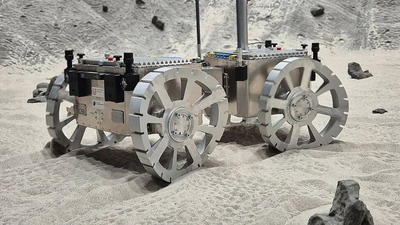
Getting stuck in sand has ended dreams of exploration before. On Mars, where loose dunes, soft soil and rocky terrain stretch for thousands of kilometres, a trapped rover can mean the loss of years of scientific work and millions in investment. Now, researchers in Germany have turned to an unlikely source for a solution: a small desert lizard that “swims” beneath Sahara sands. Inspired by the remarkable movement of the sandfish lizard, engineers have developed a new generation of Mars rover wheels designed to move through loose terrain rather than simply roll across it. The breakthrough could help future robotic explorers travel farther, avoid dangerous traps and navigate some of the most challenging landscapes on the Red Planet with greater efficiency and stability.
How a Sahara sandfish lizard inspired next-generation Mars rover wheels
The project is part of the VaMEx (Valles Marineris Explorer) initiative, a programme supported by the German Aerospace Centre (DLR) that is developing advanced robotic systems for future Mars exploration. Researchers from the Interdisciplinary Bioengineering Program, Georgia Institute of Technology looked at the sandfish lizard (Scincus scincus), a reptile famous for its ability to dive beneath desert sand and move through it as though swimming underwater.Scientists have spent years studying how the sandfish moves. Research published in the journal Science revealed that once beneath the surface, the lizard propels itself using a wave-like motion that travels down its body, allowing it to move efficiently through granular material.Using this biological blueprint, the engineering team created unconventional wheels that imitate the lizard’s interaction with loose ground rather than relying solely on traditional rolling motion. Instead of becoming trapped in soft sand, the wheels generate forces that help the rover effectively move through it.Professor Marco Schmidt and colleagues from University of Würzburg stated:“The wheels mimic the animal’s characteristic interaction with the ground, generating both longitudinal and lateral forces.”
Why conventional Mars rover wheels struggle in deep sand
Soft terrain has long been one of the greatest challenges facing planetary exploration vehicles. Traditional rover wheels are generally optimised for low-speed travel but can slip, sink or become immobilised when crossing loose material.The problem is not merely theoretical. Past Mars missions have encountered significant mobility issues caused by soft ground and wheel wear, highlighting the need for more adaptable designs. Future missions targeting regions filled with dunes and rugged landscapes will require vehicles capable of handling terrain that resembles deserts more than roads.According to VaMEx researchers, the biomimetic wheels leave distinctive sinusoidal tracks in the sand, providing evidence that the intended “swimming” mechanism is functioning as designed. Early testing demonstrated improved stability and movement across sandy surfaces.
How important do you believe the design of rover wheels is for Mars exploration?
3k+ users shared opinion today
5k+ users already voted today
3k+ users shared opinion today
Share Opinion
What the breakthrough could mean for future Mars missions
The rover has already undergone testing on sand and outdoor terrain in collaboration with the German Research Center for Artificial Intelligence (DFKI) and the University of Bremen. Another researcher Amenosis Lopez, University of Würzburg researcher stated:“Conventional wheel designs are often optimised for driving at low speeds and tend to slip, sink or get stuck on soft ground.”Researchers found that increasing wheel width and reducing wheel mass improved stability, reduced slippage and lowered the chances of sinking into soft ground.The team now plans to refine both the wheel design and the software controlling rover movement. Future systems may actively adapt to changing terrain conditions, allowing explorers to respond intelligently to slipping, sinking and uneven surfaces.As space agencies prepare for increasingly ambitious missions across Mars and beyond, nature may provide some of the most effective engineering solutions. A small lizard that evolved to survive beneath Sahara dunes could one day help robotic explorers travel through the vast canyons and deserts of another world.


