
India ranks 11th globally in digital nomad population For generations, the economic narrative of modern India was written in one direction: a relentless, exhausting migration from rural villages to hyper-urban hubs.Millions packed their lives into suitcases, chasing the glittering promises of Delhi, Mumbai, and Bangalore. They traded clean air for corporate ladders and starry skies for the sterile glow of office cubicles.But a quiet, profound revolution is happening.The tide has turned a full 180 degrees. According to the State of Digital Nomads Report, India ranks 11th globally in digital nomads, housing an estimated 1.7 million location-independent workers (roughly 2% of the global total).A digital nomad is a professional who leverages internet-based technology to earn a living while living a highly mobile, location-independent lifestyle. Once a niche counterculture among Western freelancers, this lifestyle has transitioned into a mainstream global workforce segment.Leading the charge are millennials and Gen Z. This generation is rewriting the rules of career, lifestyle, and success.From the high-altitude valleys of Himachal Pradesh to remote eco-stays like Yakten Village in misty Sikkim, a new socio-economic bridge is being built. A collective yearning for something different — sanity and peace — has shifted the tide.Traditional career track:Urban migration ➔ Cubicle hustle ➔ Burnout ➔ SeclusionA digital nomad track:Digital Connectivity ➔ Serene destination➔ Mental well-being ➔ Global impactThe irony is striking. The very digitalisation critics said would isolate this generation has instead granted them the freedom to seek peace.Reversing the historic flow: urban-to-rural migrationWhere past generations prioritised corner offices and job titles, today’s young professionals are changing success metrics. Data shows 75% of all digital nomads globally are Gen Z or Millennials.Digitalisation has broken the geographic link between earning power and urban congestion, allowing young professionals to preserve well-being in quiet regions while remaining connected to global markets.This reverse migration is only possible because India’s rural-urban divide is shrinking fast. The country has adapted digitally with astonishing speed, democratising economic opportunity across geography. Go into any remote village in Himachal, Uttarakhand, or the Northeast today: you’ll find elders and youngsters alike holding smartphones, scrolling reels, and absorbing global trends in real time.The Ministry of Statistics and Programme Implementation (MoSPI) historically pegged national urban migration at 34.9%.Today, the digital nomad movement is triggering a 180-degree reversal: high-earning knowledge workers are leaving tier-1 cities and moving temporarily or semi-permanently into rural towns and villages.Case study: the indigenous evolutionThe trend appears in eco-tourism initiatives like Yakten Village Homestay in Sikkim, which blends indigenous hospitality with remote-work accessibility. Places such as Kasol, Dharamshala, and Rishikesh—long-stay sanctuaries for international travelers, especially Israelis—are now seeing an influx of domestic workers.Indian professionals can bypass international visa hassles and currency arbitrage by staying inside their borders. They can code from the Himalayas or design from a Goa beach shack using affordable domestic networks.Digitalization has fundamentally broken the geographic link between earning power and urban congestion, allowing young professionals to protect their well-being in quiet regions while remaining structurally connected to global financial markets.Ground realities: the unfiltered nomad experienceDespite the appealing online aesthetic, working on the road involves significant infrastructure and logistical challenges. Vedant Singh, an active Indian digital nomad, highlights the operational friction points of the lifestyle:The mountain infrastructure deficit“Pahad looks beautiful on screen, but daily logistics can test your patience. Food is expensive because everything has to be hauled up winding roads. And when peak winter hits, it’s absolutely freezing. If you don’t have a reliable heater, your whole routine collapses.”The Jibbhi freezing loop:Power Grid Failure ➔ Space Heater Shuts Off ➔ Type for 1 Minute ➔ Warm Hands in Pockets for 5 Minutes“Most popular nomad destinations have great connectivity now. The Rs 349-a-month unlimited 5G plan works in about 90% of these locations. But you still have to be careful where you sleep and work. I learned to choose places with reliable facilities—mainly Zostel, a trusted backpacker hostel chain,” Singh says.Transportation in remote micro-hubs often exposes travelers to inflated tourist pricing. “When I was traveling from Dharamshala to Jibbhi, a local cab demanded Rs 2,000 for a 20-km mountain ride. Luckily, another traveller told me a public bus runs the same route for Rs 50,” he added.A global shift: from exotic foreigners to a homegrown movementWhat Vedant faces in Himachal is part of a massive global phenomenon that accelerated after COVID-19. Post-2020, countries realised remote work was not temporary but a durable structural shift. Governments from Portugal and Spain to Indonesia and Thailand introduced “digital nomad visas” to attract high-earning remote workers.For years, India’s scenic hubs were primarily playgrounds for international nomads. Hotspots like Kasol, Rishikesh, and Goa long hosted foreign travellers who settled for months, creating self-contained cultural enclaves.India has emerged as a growing destination for digital nomads, especially after the introduction of remote work and long-stay travel trends.But the true catalyst behind India’s climb to 11th globally is the explosion of homegrown nomads.The ultimate ultimatum: cubicle vs horizonThe Indian digital nomad vision is compelling. The ability to trade a claustrophobic metropolitan cubicle for a makeshift workstation overlooking Darjeeling’s tea gardens, Jibbhi’s snow-capped peaks, or South Goa’s beaches is no longer a foreign luxury.This generation’s uncompromising focus on mental well-being, backed by rapid rural digitisation, means the infrastructure for location-independent work is on the ground.However, navigating India as a digital nomad is not a passive vacation; it is an active exercise in resilience.To succeed, a nomad must trade predictable city comforts for a hyper-adaptable mindset. You must be able to troubleshoot sudden sub-zero power outages, out-negotiate aggressive transit cartels, meticulously vet budget accommodations to avoid poor infrastructure, and accept chores like hand-washing laundry.Ultimately, India offers an unparalleled, deeply enriching canvas for the self-contained worker. It presents a macroeconomic ecosystem where you can stay plugged into the global digital economy while remaining profoundly connected to a slow-paced lifestyle. If you respect the local terrain, plan for contingencies, and prioritise reliable infrastructure over the lowest price tag, the country ceases to be just a travel destination. It becomes your open-air office.The traditional corporate mold has cracked. The tools are in your hands, the networks are live, and the horizon is waiting. The only question left is: Are you ready to step out of the cubicle?Get the latest India news and live updates. Download the TOI App.End of ArticleFollow Us On Social MediaVideosTrichy East Bypoll Buzz: DMK Chief Will MK Stalin Contest To Make Assembly Comeback?Major Anti-Naxal Success: Forces Recover Rs 24 Lakh, Rifles & Explosives From Maoist Dumps In BastarShashi Tharoor Raises Concerns Over Passport Status And Citizenship; Calls For Legal ReformKetan Agarwal Murder Case: Siya Goyal, Chetan Chowdhary Blame Each Other For ConspiracyOperation Amistad: India Airlifts Army Field Hospital, BHISHM Cubes Relief To VenezuelaRam Mandir Trust Chief Champat Rai QUITS On ‘Moral Grounds’ After SIT Probe & 8 Arrests’You Have Two Days…’ Sonam Wangchuk Sets ‘New’ Deadline, Threatens Indefinite Hunger StrikeGovt Officially Reveals Names Of Six Soldiers Killed In Action During Operation SindoorNCERT Adds Section On SIR; Cites Manusmriti To Highlight Respect For Women In Vedic PeriodCM Yogi Targets Akhilesh, Says ‘Don’t Test Ram Devotees’; Warns Against Tarnishing Ayodhya’s Image123PhotostoriesFIFA World Cup 2026 underdog Cape Verde isn’t just making headlines on the field; where is it and what should travellers know10 baby girl names inspired by ‘legendary women’ in mythology across the world5 traditional things people used to clean utensils before dishwashing liquid existedMom-to-be Samantha Ruth Prabhu’s pink saree glow-up is the only fashion fairytale we’re here forRelationship lessons to take from Kajol and Ajay DevgnStunning pictures of Abu Dhabi’s Dar al Funoon ‘House of the Arts’Love quote of the day by Samantha Ruth Prabhu: ‘If you look for someone else to complete you, then it won’t go well’Monsoon Special: 9 deep-fried vegetarian Bengali snacks to enjoy with chaiYou share the bed, the house, but still feel empty? This silent syndrome could be wrecking your love life6 foods kings and royals in ancient India reportedly loved eating123Hot PicksIndia vs IrelandShamirpet TahsildarIndia Bullet trainFIFA world cup 2026India US Trade dealDelhi rape-murderMumbai local murderBrittany MahomesKetan Agarwal MurderTop TrendingDoug MartinShreyas IyerIndian Citizenship document proofFIFA World Cup 2026KEAM Rank List 2026Mumba Local Train MurderMEA PassportNandani BosmiyaMK StalinMumbai Local Train News

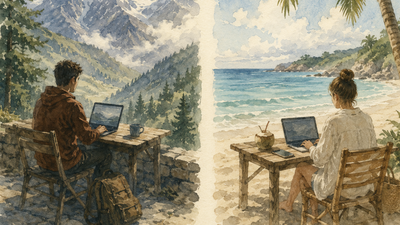
India ranks 11th globally in digital nomad population
For generations, the economic narrative of modern India was written in one direction: a relentless, exhausting migration from rural villages to hyper-urban hubs.Millions packed their lives into suitcases, chasing the glittering promises of Delhi, Mumbai, and Bangalore. They traded clean air for corporate ladders and starry skies for the sterile glow of office cubicles.But a quiet, profound revolution is happening.The tide has turned a full 180 degrees. According to the State of Digital Nomads Report, India ranks 11th globally in digital nomads, housing an estimated 1.7 million location-independent workers (roughly 2% of the global total).A digital nomad is a professional who leverages internet-based technology to earn a living while living a highly mobile, location-independent lifestyle. Once a niche counterculture among Western freelancers, this lifestyle has transitioned into a mainstream global workforce segment.Leading the charge are millennials and Gen Z. This generation is rewriting the rules of career, lifestyle, and success.From the high-altitude valleys of Himachal Pradesh to remote eco-stays like Yakten Village in misty Sikkim, a new socio-economic bridge is being built. A collective yearning for something different — sanity and peace — has shifted the tide.Traditional career track:Urban migration ➔ Cubicle hustle ➔ Burnout ➔ SeclusionA digital nomad track:Digital Connectivity ➔ Serene destination➔ Mental well-being ➔ Global impactThe irony is striking. The very digitalisation critics said would isolate this generation has instead granted them the freedom to seek peace.
Reversing the historic flow: urban-to-rural migration
Where past generations prioritised corner offices and job titles, today’s young professionals are changing success metrics. Data shows 75% of all digital nomads globally are Gen Z or Millennials.Digitalisation has broken the geographic link between earning power and urban congestion, allowing young professionals to preserve well-being in quiet regions while remaining connected to global markets.This reverse migration is only possible because India’s rural-urban divide is shrinking fast. The country has adapted digitally with astonishing speed, democratising economic opportunity across geography. Go into any remote village in Himachal, Uttarakhand, or the Northeast today: you’ll find elders and youngsters alike holding smartphones, scrolling reels, and absorbing global trends in real time.The Ministry of Statistics and Programme Implementation (MoSPI) historically pegged national urban migration at 34.9%.Today, the digital nomad movement is triggering a 180-degree reversal: high-earning knowledge workers are leaving tier-1 cities and moving temporarily or semi-permanently into rural towns and villages.
Case study: the indigenous evolution
The trend appears in eco-tourism initiatives like Yakten Village Homestay in Sikkim, which blends indigenous hospitality with remote-work accessibility. Places such as Kasol, Dharamshala, and Rishikesh—long-stay sanctuaries for international travelers, especially Israelis—are now seeing an influx of domestic workers.Indian professionals can bypass international visa hassles and currency arbitrage by staying inside their borders. They can code from the Himalayas or design from a Goa beach shack using affordable domestic networks.
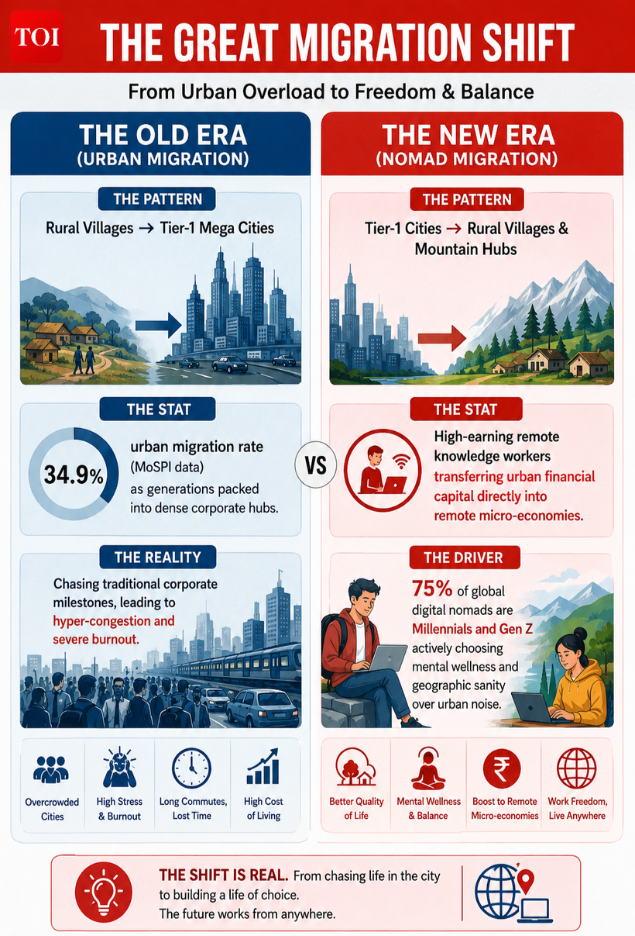
Digitalization has fundamentally broken the geographic link between earning power and urban congestion, allowing young professionals to protect their well-being in quiet regions while remaining structurally connected to global financial markets.
Ground realities: the unfiltered nomad experienceDespite the appealing online aesthetic, working on the road involves significant infrastructure and logistical challenges. Vedant Singh, an active Indian digital nomad, highlights the operational friction points of the lifestyle:
The mountain infrastructure deficit
“Pahad looks beautiful on screen, but daily logistics can test your patience. Food is expensive because everything has to be hauled up winding roads. And when peak winter hits, it’s absolutely freezing. If you don’t have a reliable heater, your whole routine collapses.”The Jibbhi freezing loop:Power Grid Failure ➔ Space Heater Shuts Off ➔ Type for 1 Minute ➔ Warm Hands in Pockets for 5 Minutes“Most popular nomad destinations have great connectivity now. The Rs 349-a-month unlimited 5G plan works in about 90% of these locations. But you still have to be careful where you sleep and work. I learned to choose places with reliable facilities—mainly Zostel, a trusted backpacker hostel chain,” Singh says.Transportation in remote micro-hubs often exposes travelers to inflated tourist pricing. “When I was traveling from Dharamshala to Jibbhi, a local cab demanded Rs 2,000 for a 20-km mountain ride. Luckily, another traveller told me a public bus runs the same route for Rs 50,” he added.
A global shift: from exotic foreigners to a homegrown movement
What Vedant faces in Himachal is part of a massive global phenomenon that accelerated after COVID-19. Post-2020, countries realised remote work was not temporary but a durable structural shift. Governments from Portugal and Spain to Indonesia and Thailand introduced “digital nomad visas” to attract high-earning remote workers.For years, India’s scenic hubs were primarily playgrounds for international nomads. Hotspots like Kasol, Rishikesh, and Goa long hosted foreign travellers who settled for months, creating self-contained cultural enclaves.
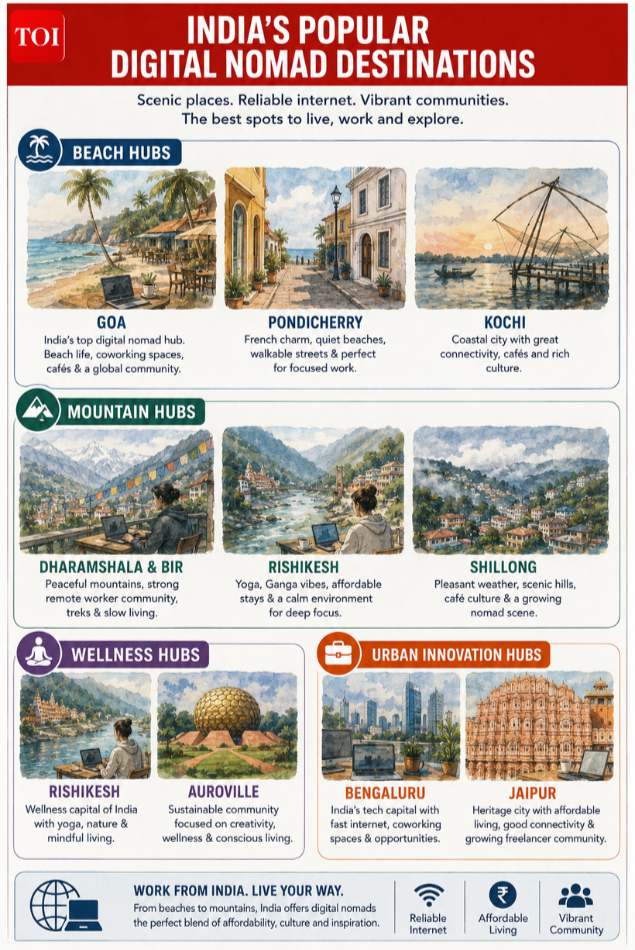
India has emerged as a growing destination for digital nomads, especially after the introduction of remote work and long-stay travel trends.
But the true catalyst behind India’s climb to 11th globally is the explosion of homegrown nomads.
The ultimate ultimatum: cubicle vs horizon
The Indian digital nomad vision is compelling. The ability to trade a claustrophobic metropolitan cubicle for a makeshift workstation overlooking Darjeeling’s tea gardens, Jibbhi’s snow-capped peaks, or South Goa’s beaches is no longer a foreign luxury.This generation’s uncompromising focus on mental well-being, backed by rapid rural digitisation, means the infrastructure for location-independent work is on the ground.However, navigating India as a digital nomad is not a passive vacation; it is an active exercise in resilience.To succeed, a nomad must trade predictable city comforts for a hyper-adaptable mindset. You must be able to troubleshoot sudden sub-zero power outages, out-negotiate aggressive transit cartels, meticulously vet budget accommodations to avoid poor infrastructure, and accept chores like hand-washing laundry.Ultimately, India offers an unparalleled, deeply enriching canvas for the self-contained worker. It presents a macroeconomic ecosystem where you can stay plugged into the global digital economy while remaining profoundly connected to a slow-paced lifestyle. If you respect the local terrain, plan for contingencies, and prioritise reliable infrastructure over the lowest price tag, the country ceases to be just a travel destination. It becomes your open-air office.The traditional corporate mold has cracked. The tools are in your hands, the networks are live, and the horizon is waiting. The only question left is: Are you ready to step out of the cubicle?


